Nike has a beta of 2.3x and Adidas has a beta of 1.8x. Which stock would...
Nike has a beta of 2.3x and Adidas has a beta of 1.8x. Which
stock would you prefer to own when the S&P 500 Index is down
6%?
a.Nike
b.Adidas
c.Both would produce the same return in a down market
d.Not enough information to solve
Homework Answers
Adidas, because as it has a smaller beta, it will fall less compared to Nike which has a higher beta
Add Answer to:
Nike has a beta of 2.3x and Adidas has a beta of 1.8x. Which
stock would...
Case C.21.25 Question Help What ratings would be most appropriate for Nike, Adidas, and UA, respectively,...
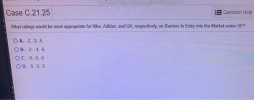 Case C.21.25 Question Help What ratings would be most appropriate for Nike, Adidas, and UA, respectively, on Barriers to Entry into the Market under SP? O A. 2.-3.-5 OB. -2. - 4.-6 OC.-5.-5.-5 OD. -5,-3, -2 EXHIBIT 9 Competitor Comparison CASE 21 • UNDER Under Armour Adidas Nike $ Market Cap. # Employees $ Revenue % Gross Margin S Net Income S EPS Ratio S P/E Ratio 5.7B 15,200 4,825M 46% 257M 0.32 38.34 54.4B 55,414 24.113M 49% 1,271M 4.25...
Suppose Jada Corp’s stock beta is 1.4. If the current market risk premium is 8% and...
Suppose Jada Corp’s stock beta is 1.4. If the current market risk premium is 8% and the risk-free rate is 2%, what is Jada Corp’s required return? 10.40% 11.20% 14.00% 13.20% None of these The expected return of the S&P 500 Index is 10%. According to stock analysts, Ingrid Corp stock has an expected return of 15%. You should buy this stock if you believe the following: You should buy the stock, regardless of the stock’s beta. You should never...
Stock A has a beta of 0.8 and Stock B has a beta of 1.2. 50%...
Stock A has a beta of 0.8 and Stock B has a beta of 1.2. 50% of Portfolio P is invested in Stock A and 50% is invested in Stock B. If the market risk premium (r M − rRF) were to increase but the risk-free rate (r RF) remained constant, which of the following would occur? a. The required return would increase for Stock B but decrease for Stock A. b. The required return would increase for Stock A...
Stock A has a beta of 0.7, whereas Stock B has a beta of 1.3. Portfolio...
 Stock A has a beta of 0.7, whereas Stock B has a beta of 1.3. Portfolio P has 50% invested in both A and B. Which of the following would occur if the market risk premium increased by 1% but the risk-free rate remained constant? a. The required return on Portfolio P would remain unchanged. b. The required return on Stock A would increase by more than 1%, while the return on Stock B would increase by less than 1%....
A stock has a Beta of 1.23, the expected return on the S&P 500 market index...
A stock has a Beta of 1.23, the expected return on the S&P 500 market index is 5.6%, and the return on T-Bills is 1.5%. Using the CAPM, what is the expected return on this stock? Enter your answer as a decimal with a leading zero and 4 decimal places of precision (i.e. 0.1234).
Stock X has a beta of 0.5 and Stock Y has a beta of 1.20. Which...
Stock X has a beta of 0.5 and Stock Y has a beta of 1.20. Which of the following statements must be true about these securities? (Assume the market is in equilibrium.) a. The required return on Stock Y will be greater than that on Stock X. b. The required return on Stock X and Stock Y will be the same. c. Stock X would be a more desirable addition to a portfolio than Stock Y. d. When held in...
(4 pts.) Adidas stock has a beta of 1.8. The risk-free rate is 3.6% and the...
 (4 pts.) Adidas stock has a beta of 1.8. The risk-free rate is 3.6% and the expected return on the market portfolio is 9%. The company has Just paid an annual dividend of $0.3. Dividends are expected to grow by 3% per year. What is the intrinsic value (fair price) of the stock? (2 pts.) Brent Crude (BZ) oil currently costs $75 per barrel. The yield on T-Bills is 0.8% (EAR). What should be the futures price for a barrel...
Suppose Intel stock has a beta of 1 6 whereas Boeing stock has a beta of...
 Suppose Intel stock has a beta of 1 6 whereas Boeing stock has a beta of 1 the risk-free interest rate is 4 % and the expected return of the market po a. What is the expected return of Intel stock? b. What is the expected return of Boeing stock? C. What is the beta of a portfolio that consists of 60% Intel stock and 40% Boeing stock? d. What is the expected return of a portfolio that consists of...
Last month a stock with a beta of 1.0 lost 20% while the S&P 500 had...
Last month a stock with a beta of 1.0 lost 20% while the S&P 500 had a 10% gain. Given this, it is most likely that the: Multiple Choice stock's beta has been calculated incorrectly. S&P 500 cannot represent the overall market. Incorrect firm released some negative information about itself. the market index had an exceptionally good month.
Beta is a measure of systematic risk. It is a relative risk measure to show you...
Beta is a measure of systematic risk. It is a relative risk measure to show you how sensitive the stock price is related to market movement, i.e., the S&P 500 index. When calculating beta, you need to regress y (stock return) against x (S&P 500 index return) and the coefficient of the x is the beta, please refer to the excel posted on module 6. I would like you to comment on the betas of the following ETFs: UGAZ, TVIX...
 Case C.21.25 Question Help What ratings would be most appropriate for Nike, Adidas, and UA, respectively, on Barriers to Entry into the Market under SP? O A. 2.-3.-5 OB. -2. - 4.-6 OC.-5.-5.-5 OD. -5,-3, -2 EXHIBIT 9 Competitor Comparison CASE 21 • UNDER Under Armour Adidas Nike $ Market Cap. # Employees $ Revenue % Gross Margin S Net Income S EPS Ratio S P/E Ratio 5.7B 15,200 4,825M 46% 257M 0.32 38.34 54.4B 55,414 24.113M 49% 1,271M 4.25...
 Stock A has a beta of 0.7, whereas Stock B has a beta of 1.3. Portfolio P has 50% invested in both A and B. Which of the following would occur if the market risk premium increased by 1% but the risk-free rate remained constant? a. The required return on Portfolio P would remain unchanged. b. The required return on Stock A would increase by more than 1%, while the return on Stock B would increase by less than 1%....
 (4 pts.) Adidas stock has a beta of 1.8. The risk-free rate is 3.6% and the expected return on the market portfolio is 9%. The company has Just paid an annual dividend of $0.3. Dividends are expected to grow by 3% per year. What is the intrinsic value (fair price) of the stock? (2 pts.) Brent Crude (BZ) oil currently costs $75 per barrel. The yield on T-Bills is 0.8% (EAR). What should be the futures price for a barrel...
 Suppose Intel stock has a beta of 1 6 whereas Boeing stock has a beta of 1 the risk-free interest rate is 4 % and the expected return of the market po a. What is the expected return of Intel stock? b. What is the expected return of Boeing stock? C. What is the beta of a portfolio that consists of 60% Intel stock and 40% Boeing stock? d. What is the expected return of a portfolio that consists of...
Most questions answered within 3 hours.
-
Where is the error in this code sequence?
String s1 = "Hello";
String s2 = "ello";...
asked 11 months ago -
Financial data for Joel de Paris, Inc., for last year
follow:
Joel de Paris, Inc.
Balance...
asked 11 months ago -
Consider this reaction:
Al2(SO4)3 (aq)+ BaCl3
(aq) Al2Cl6 (aq)- +
3BaSO4(s) . What is the...
asked 11 months ago -
Suppose that Savneet is considering increasing her
recent random sample from 20 car rentals to 40...
asked 11 months ago -
Trucks arrive at an unloading terminal at an average rate of 120
per hour.
Trucks arrive...
asked 11 months ago -
Why are methanol and ethanol completely soluble in water while
octanol is not very little soluble....
asked 11 months ago -
A facilities manager at a university reads in a research report
that the mean amount of...
asked 11 months ago -
When the CuSO4 is rehydrated by adding water to the anhydrous
compound, is this an endothermic...
asked 11 months ago -
A ray of sunlight is passing from diamond into crown glass; the
angle of incidence is...
asked 11 months ago -
A block of mass 0.249 kg is placed on top of a light, vertical
spring of...
asked 11 months ago -
how do the kidneys compensate in the presences of acidosis
a) trigger hyperventilate
b) reserve acid...
asked 11 months ago -
Question 501 pts
The rental rate of capital to the firm increases. Which of the
following...
asked 11 months ago