One of the goals of counseling psychology is to help individuals attain and maintain good mental...
One of the goals of counseling psychology is to help individuals attain and maintain good mental health. What are some of the key distinctions between the concepts of mental health vs. mental illness that a counseling psychologist would want to know?
Homework Answers
The key distinction between mental health and mental illness that everyone seems to forget is that mental health is universal, i.e., everyone has mental health, just like how everyone has health. Mental illness refers to a wide range of disorders, that play a part in affecting our mood, our behavior as well as the thoughts we have. Mental illness is just like physical illness, as in people don't always suffer from it, but it does create a struggle or a conflict within a person's psyche from time to time just like physical health disorders.
Mental health refers to our feelings, our thoughts, our familial interactions, our social interactions and how we behave in our daily life. It's only when these feelings and interactions take a turn for the worse, affected by external and/or internal factors, and the person involved starts getting affected mentally, does this turn to mental illness.
What most people think is that mental illness is not a disease and that it is sort of a taboo to talk about it, that it will just go away because they are choosing to ignore it. This reaction, that is still prevalent in a majority of people, is actually making things far worse because mental illness is just like physical illness, only, it does not show any obvious symptoms other than in a person's behavior. This means that the diagnosis of a mental illness or disorder requires conscious effort from the psychologist as well as the person who is suffering from the illness. Ignoring it and hoping it goes away doesn't work with physical illnesses and it doesn't work with mental unhealthiness either.
What a psychologist needs to clearly understand is the difference between good mental health and high mental health. They are oftentimes the same thing, but sometimes, there comes a case where a person may be suffering from a disorder, that, in its initial stages is actually helping the person in life, such as the bipolar disorder, thus giving him/her high mental health. It is only when the disorder runs unchecked for some time, without preventive measures being taken, that the person suffers from high mental illness as well. There may well be cases that even without any disorder or disease, a person is just generally of low mental health, due to their lifestyle, life choices, their routine or maybe due to some anomaly in their life. The psychologist needs to be aware of how to diagnose a person whether they have high/low mental health and high/low/no mental illness.
Add Answer to:
One of the goals of counseling psychology is to help individuals
attain and maintain good mental...
Discuss the factors that affect mental health. What steps can women take to maintain good mental...
Discuss the factors that affect mental health. What steps can women take to maintain good mental health? What are some of the resources in your community or on campus that women can turn to for help with maintaining mental health? 250 words
*Psychology Essay *: The text of your essay must be approximately 1500-2000 words in length (not...
*Psychology Essay *: The text of your essay must be approximately 1500-2000 words in length (not including references), written in clear and grammatical English, and submitted as double-spaced typed stapled hard copy with a cover page (there are staplers in the Library). You must have a minimum of three Psychology references, not including the textbook, websites etc. Use APA format for citations and quotations. The references should be listed in APA style on a ‘References’ page at the end of...
(Reading) According to the article "What is Mental Health:" (Links to an external site.) (a) Explain...
(Reading) According to the article "What is Mental Health:" (Links to an external site.) (a) Explain in detail what is mental health. (b) Describe three mental health disorders. (c) Discuss some early warning signs of mental health problems. 2. (Quiz) After completing the ten-question quiz to "Rate Your Risk for Depression,": a) What were your results from the quiz? Do you agree or disagree with the results? Why or why not? b) What can you do to decrease your risk/keep...
Chapter 11 • Community Mental Health • All answers are found in the textbook, do not...
Chapter 11 • Community Mental Health • All answers are found in the textbook, do not use any other source Textbook Title: An Introduction to Community & Public Health, 9th Edition (2018); Author(s): J. McKenzie, R. Pinger & D. Seabert; ISBN: 978-1-284-10841-5 PLEASE ANSWER EVERY SINGLE QUESTION. 1. What is the leading cause of disability in North America and Europe? 2. Approximately what percentage of American adults have diagnosable mental disorders during a given year? 3. Of those diagnosed with...
Chapter 11 • Community Mental Health • All answers are found in the textbook, do not...
Chapter 11 • Community Mental Health • All answers are found in the textbook, do not use any other source Textbook Title: An Introduction to Community & Public Health, 9th Edition (2018); Author(s): J. McKenzie, R. Pinger & D. Seabert; ISBN: 978-1-284-10841-5 PLEASE ANSWER EVERY SINGLE QUESTION. 1. What is the leading cause of disability in North America and Europe? 2. Approximately what percentage of American adults have diagnosable mental disorders during a given year? 3. Of those diagnosed with...
Biology ( Please, I don't want hand written answer) Are Mental Health Issues Like Depression Related...
Biology ( Please, I don't want hand written answer) Are Mental Health Issues Like Depression Related to Race? While there is a plethora of research that has examined health disparities in chronic and infectious diseases, less research has examined the relationship between diseases and mental health. Depression in particular, can be a huge risk factor for illness and disease. Studies suggest that blacks are more depressed than whites, given their increased exposure to race-related and generic stress (George & Lynch,...
Assignment #4 is a field experience, which will acquaint you with an applied experience with psychology....
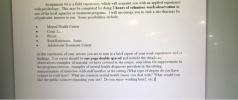 Assignment #4 is a field experience, which will acquaint you with an applied experience with psychology. This may be completed by doing 2 hours of volunteer work/observation in one of the local agencies or treatment programs. I will encourage you to visit a site that may be of particular interest to you. Some possibilities include . Mental Health Center Crisis Line Prison Rest/Retirement Home . Adolescent Treatment Center At the conclusion of your service you are to tun in a...
Psychopharmacology When did psychotropic medications first become available? 1930s 1940s 1950s 1960s Psychotropic...
Psychopharmacology When did psychotropic medications first become available? 1930s 1940s 1950s 1960s Psychotropic medications work in the following ways: by blocking excesses of certain brain chemicals by enhancing activity of existing chemicals by mimicking or improving upon the action of deficient chemicals a and c all of the above Neurotransmitters are: responsible for transmission of electrical messages necessary for connections between neurons responsible for transmission of different processes responsible for developmental of mental diseases all of the above Antipsychotic medications,...
One Flew Over the Cuckoo's Nest ( Nursing: Mental Health) (please answer questions thank you, second...
One Flew Over the Cuckoo's Nest ( Nursing: Mental Health) (please answer questions thank you, second part is nursing interventions) Write a one-page analysis discussing the following questions about this movie: The two main characters are Nurse Ratched and Randle Mcmurphy. Why was Randle on this unit? Describe the relationship between the two characters. Explain how Nurse Ratched related to the rest of the patients on the unit. Explain how Nurse Ratched led groups- was it therapeutic? If you were...
Question 5 ____________ reason is a tool that individuals use to decide what is good or...
Question 5 ____________ reason is a tool that individuals use to decide what is good or evil under St Thomas’ natural law theory. Question 6 Which of the following is true regarding the debate over the definition of harm in the clinical setting when referring to nonmaleficence? a. Harm cannot be defined as just physical. b. The term negligence is used instead of harm because the term harm can have too many c. Any act that prevents a patient from...
 Assignment #4 is a field experience, which will acquaint you with an applied experience with psychology. This may be completed by doing 2 hours of volunteer work/observation in one of the local agencies or treatment programs. I will encourage you to visit a site that may be of particular interest to you. Some possibilities include . Mental Health Center Crisis Line Prison Rest/Retirement Home . Adolescent Treatment Center At the conclusion of your service you are to tun in a...
Most questions answered within 3 hours.
-
Where is the error in this code sequence?
String s1 = "Hello";
String s2 = "ello";...
asked 11 months ago -
Financial data for Joel de Paris, Inc., for last year
follow:
Joel de Paris, Inc.
Balance...
asked 11 months ago -
Consider this reaction:
Al2(SO4)3 (aq)+ BaCl3
(aq) Al2Cl6 (aq)- +
3BaSO4(s) . What is the...
asked 11 months ago -
Suppose that Savneet is considering increasing her
recent random sample from 20 car rentals to 40...
asked 11 months ago -
Trucks arrive at an unloading terminal at an average rate of 120
per hour.
Trucks arrive...
asked 11 months ago -
Why are methanol and ethanol completely soluble in water while
octanol is not very little soluble....
asked 11 months ago -
A facilities manager at a university reads in a research report
that the mean amount of...
asked 11 months ago -
When the CuSO4 is rehydrated by adding water to the anhydrous
compound, is this an endothermic...
asked 11 months ago -
A ray of sunlight is passing from diamond into crown glass; the
angle of incidence is...
asked 11 months ago -
A block of mass 0.249 kg is placed on top of a light, vertical
spring of...
asked 11 months ago -
how do the kidneys compensate in the presences of acidosis
a) trigger hyperventilate
b) reserve acid...
asked 11 months ago -
Question 501 pts
The rental rate of capital to the firm increases. Which of the
following...
asked 11 months ago