Explain Abstract Data Types (ADT) and the benefits of creating ADTs
Explain Abstract Data Types (ADT) and the benefits of creating ADTs
Homework Answers
Abstract Data Types (ADT):
Abstract data types describe a set of objects with the same representation and behavior. Is a clear separation between the external interface of a data type and its internal implementation.There are two parts to each ADT
I) The public or external part
II)The private or internal part
Benefits :
- ADT is reusable, robust,OOP and Software Engineering.
- It's can be re-used at several places and it reduces coding efforts.
-
Encapsulation ensures that data cannot be corrupted.
1. Describe the role of a “Back-End” computer engineer in creating software. Give examples of decisions...
1. Describe the role of a “Back-End” computer engineer in creating software. Give examples of decisions back end engineers make. Use the relationship between long-term and short-term memory as context for decision examples. 3. Briefly describe Abstract Data Types (ADT) or Abstract Data structures in general. Why are Abstract data structures implemented? Make sure to use your own words.
There are two popular implementations of the List Abstract Data Types ¨An array implementation of the...
There are two popular implementations of the List Abstract Data Types ¨An array implementation of the List Abstract Data Types ¨A linked list implementation of the List Abstract Data Types Discuss the advantage/disadvantage of these implementations
6. For each of the following situations, which of these ADTS (1) Queue ADT (2) Stack...
 6. For each of the following situations, which of these ADTS (1) Queue ADT (2) Stack ADT (3) Ranked (on Positional) Sequence ADT (4) None of these would be most appropriate: a. The customers at the deli counter who take numbers to mark their turn b. An alphabetic list of names c. Integers that need to be sorted d. Execution environments of a recursive function e. A grocery list ordered by the occurrence of the items in the store f....
In this assignment you will be implementing two Abstract Data Types (ADT) the Queue ADT and...
In this assignment you will be implementing two Abstract Data Types (ADT) the Queue ADT and the Stack ADT. In addition, you will be using two different implementations for each ADT: Array Based Linked You will also be writing a driver to test your Queue and Stack implementations and you will be measuring the run times and memory use of each test case. You will also be adding some functionality to the TestTimes class that you created for Homework 1....
Explain the major benefits of creating functions for algorithms.
Explain the major benefits of creating functions for algorithms.
Collections (a) What are generic types and what is their importance in ADTs for collections? (b)...
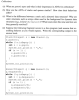 Collections (a) What are generic types and what is their importance in ADTs for collections? (b) How are the ADTS of stacks and queues similar? How does their behaviour differ? (c) What is the difference between a static and a dynamic data structure? Why are static structures such as arrays often used in the background for dynamic data structures (e.g., in Java's ArrayList)? What issues does this raise and how are they generally resolved? (d) Suppose the following fragment occurs...
A limited-sized Queue ADT is an abstract data type that has a limit on the length...
 A limited-sized Queue ADT is an abstract data type that has a limit on the length of the queue. It can be created with a static array of size N, where N is the maximum length of the array. In C, this structure can be defined as follows: typedef struct {int * data;//array of the data on the queue//you may add other attributes here but use as few as possible} queue_t; Write an (efficient) pseudocode for the implementation of each...
(20 pts) (9) Fill in the program code below for the square ADT (abstract data type)...
(20 pts) (9) Fill in the program code below for the square ADT (abstract data type) //------ POINT ---------------------------------------------------------------- typedef struct point point; struct point { double x, y; }; //------ SQUARE ----------------------------------------------------------------- typedef struct square square; struct square { point ul; size_t side; }; square* square_init(double ulx, double uly, double side); // TODO void square_delete(square* sq); // TODO void square_move(square* sq, double x, double y); // TODO void square_expandby(square* sq, double expandby); // TODO double square_area(square* sq); // TODO...
in C++, please help. Not only do we need to create an ADT but create a...
in C++, please help. Not only do we need to create an ADT but create a main file as well to implement everything. For this program you will be creating a stack ADT to allow the client program to pick up treasures for a Star Wars scavenger game to get everyone ready for the opening of Galaxy’s Edge in 2020. Each treasure should have a (a) name, (b) description, (c) category, (d) what it is used for, and (e)if this...
Why do we overload operators for programmer created data types (i.e. objects defined by creating a...
Why do we overload operators for programmer created data types (i.e. objects defined by creating a class)?
 6. For each of the following situations, which of these ADTS (1) Queue ADT (2) Stack ADT (3) Ranked (on Positional) Sequence ADT (4) None of these would be most appropriate: a. The customers at the deli counter who take numbers to mark their turn b. An alphabetic list of names c. Integers that need to be sorted d. Execution environments of a recursive function e. A grocery list ordered by the occurrence of the items in the store f....
 Collections (a) What are generic types and what is their importance in ADTs for collections? (b) How are the ADTS of stacks and queues similar? How does their behaviour differ? (c) What is the difference between a static and a dynamic data structure? Why are static structures such as arrays often used in the background for dynamic data structures (e.g., in Java's ArrayList)? What issues does this raise and how are they generally resolved? (d) Suppose the following fragment occurs...
 A limited-sized Queue ADT is an abstract data type that has a limit on the length of the queue. It can be created with a static array of size N, where N is the maximum length of the array. In C, this structure can be defined as follows: typedef struct {int * data;//array of the data on the queue//you may add other attributes here but use as few as possible} queue_t; Write an (efficient) pseudocode for the implementation of each...
Most questions answered within 3 hours.
-
Where is the error in this code sequence?
String s1 = "Hello";
String s2 = "ello";...
asked 10 months ago -
Financial data for Joel de Paris, Inc., for last year
follow:
Joel de Paris, Inc.
Balance...
asked 10 months ago -
Consider this reaction:
Al2(SO4)3 (aq)+ BaCl3
(aq) Al2Cl6 (aq)- +
3BaSO4(s) . What is the...
asked 10 months ago -
Suppose that Savneet is considering increasing her
recent random sample from 20 car rentals to 40...
asked 10 months ago -
Trucks arrive at an unloading terminal at an average rate of 120
per hour.
Trucks arrive...
asked 10 months ago -
Why are methanol and ethanol completely soluble in water while
octanol is not very little soluble....
asked 10 months ago -
A facilities manager at a university reads in a research report
that the mean amount of...
asked 10 months ago -
When the CuSO4 is rehydrated by adding water to the anhydrous
compound, is this an endothermic...
asked 10 months ago -
A ray of sunlight is passing from diamond into crown glass; the
angle of incidence is...
asked 10 months ago -
A block of mass 0.249 kg is placed on top of a light, vertical
spring of...
asked 10 months ago -
how do the kidneys compensate in the presences of acidosis
a) trigger hyperventilate
b) reserve acid...
asked 10 months ago -
Question 501 pts
The rental rate of capital to the firm increases. Which of the
following...
asked 10 months ago