by differentiation of the 2p radial wavefunction, show that it has one extremum in its amplitude,...
by differentiation of the 2p radial wavefunction, show that it has one extremum in its amplitude, and locate it.
Homework Answers

Add Answer to:
by differentiation of the 2p radial wavefunction, show that it
has one extremum in its amplitude,...
7. The radial component of the 2p wavefunction is R2p(r)-ơe-r/2 where σ--Zr/ao. In terms of ao,...
 7. The radial component of the 2p wavefunction is R2p(r)-ơe-r/2 where σ--Zr/ao. In terms of ao, for hydrogen what is the most probable distance from the nucleus of finding an electron in the 2p state? (10 points) 8. The number of nodes (points where the wavefunction crosses the r axis) of the radial How many nodes does the 3d component of the hydrogen wavefunction is wavefunction Rsd(r) have? (4 points)
QUESTION 7 One of the hydrogen atom wavefunction has the following form: 18r 212,300 U =...
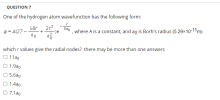 QUESTION 7 One of the hydrogen atom wavefunction has the following form: 18r 212,300 U = A(27- -De , where A is a constant, and an is Borh's radius (5.29x10⁻¹¹m) ao az + which r values give the radial nodes? there may be more than one answers 1120 1.9ao 5.6ao 1.4ao O 7.1 ao
Using mathematica please help me solve this For a radial wavefunction of the form Rn() of the one-electron atom graph the following function for n-2, 1-0: 1 ao And n = 2, l=1 Using an angular wa...
 Using mathematica please help me solve this
For a radial wavefunction of the form Rn() of the one-electron atom graph the following function for n-2, 1-0: 1 ao And n = 2, l=1 Using an angular wavefunction of the form Y1n(8,0) of the one electron atom graph the following for l = 0 and m' =0; 12. 11 47T And I = 0, mi =0 İS. Cos 47T 13.
For a radial wavefunction of the form Rn() of the one-electron...
Using mathematica please help me solve this
For a radial wavefunction of the form Rn() of the one-electron atom graph the following function for n-2, 1-0: 1 ao And n = 2, l=1 Using an angular wavefunction of the form Y1n(8,0) of the one electron atom graph the following for l = 0 and m' =0; 12. 11 47T And I = 0, mi =0 İS. Cos 47T 13.
For a radial wavefunction of the form Rn() of the one-electron...
(2 points) The following figures show (a) a contour plot in the xy plane with the y axis being th...
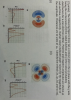 (2 points) The following figures show (a) a contour plot in the xy plane with the y axis being the vertical axis, (b) the radial function, and (c) the radial probability distribution for a one-electron orbital. Positive and negative amplitudes are shown as red and blue, respectively. Darker colors indicate larger values for the magnitude of the amplitude. Distances are in units of ao. Identify the orbital (1s, 2p, 3d, and so on).
(2 points) The following figures show (a)...
(2 points) The following figures show (a) a contour plot in the xy plane with the y axis being the vertical axis, (b) the radial function, and (c) the radial probability distribution for a one-electron orbital. Positive and negative amplitudes are shown as red and blue, respectively. Darker colors indicate larger values for the magnitude of the amplitude. Distances are in units of ao. Identify the orbital (1s, 2p, 3d, and so on).
(2 points) The following figures show (a)...
The radial probability distribution function for a hydrogen atom state has one peak, at r =...
The radial probability distribution function for a hydrogen atom state has one peak, at r = 0.476 nm. What is the nl spectroscopic notation of this state? a. 3p b. 3d c. 4f d. 2p What is r for the one peak of a 4f state? Express your answer with the appropriate units.
Suppose a particle has a wavefunction image. Sketch the form of this wavefunction. Where is the...
Suppose a particle has a wavefunction image. Sketch the form of this wavefunction. Where is the particle most likely to be found? At what values of x is the probability of finding the particle reduced by 50 per cent from its maximum value? I believe I understand the first two parts of the question, but I am confused on how to set up an equation to solve the last part. Please explain/show steps. Thanks!
Explain why the Fe 2p spectrum shows two peaks, while the P 2p show one peak....
Explain why the Fe 2p spectrum shows two peaks, while the P 2p show one peak. (XPS)
A certain element has its outermost electron in a 2p subshell. It has valence +5 because...
 A certain element has its outermost electron in a 2p subshell. It has valence +5 because it has 5 more electrons than a certain noble gas. What element is it? Express your answer using its one- or two-letter abbreviation.
8. Consider one electron in a 1D box of side L. Its wavefunction is given by...
 8. Consider one electron in a 1D box of side L. Its wavefunction is given by V3 V3 2V3i where ф1(x), фг(x), and фз(x) are the first 3 eigenfunctions of the Hamiltonian, A, of a particle in a 1D box, h2 d2 a) Is Ψ(x) normalized? If it is not normalized it, normalize it! b) Is ų (x) an eigenfunction of A? If it is an eigenfunction, what is the eigenvalue?
45 points SerPOPS 29 P027 A certain element has its outermost electron in a 2p subshell....
 45 points SerPOPS 29 P027 A certain element has its outermost electron in a 2p subshell. It has valence +4 because it has 4 more electrons than a certain noble your answer using its one- or two-letter abbreviation. y Notes Ask Your Teaches gas. What element is it? Express
 7. The radial component of the 2p wavefunction is R2p(r)-ơe-r/2 where σ--Zr/ao. In terms of ao, for hydrogen what is the most probable distance from the nucleus of finding an electron in the 2p state? (10 points) 8. The number of nodes (points where the wavefunction crosses the r axis) of the radial How many nodes does the 3d component of the hydrogen wavefunction is wavefunction Rsd(r) have? (4 points)
 QUESTION 7 One of the hydrogen atom wavefunction has the following form: 18r 212,300 U = A(27- -De , where A is a constant, and an is Borh's radius (5.29x10⁻¹¹m) ao az + which r values give the radial nodes? there may be more than one answers 1120 1.9ao 5.6ao 1.4ao O 7.1 ao
 Using mathematica please help me solve this
For a radial wavefunction of the form Rn() of the one-electron atom graph the following function for n-2, 1-0: 1 ao And n = 2, l=1 Using an angular wavefunction of the form Y1n(8,0) of the one electron atom graph the following for l = 0 and m' =0; 12. 11 47T And I = 0, mi =0 İS. Cos 47T 13.
For a radial wavefunction of the form Rn() of the one-electron...
Using mathematica please help me solve this
For a radial wavefunction of the form Rn() of the one-electron atom graph the following function for n-2, 1-0: 1 ao And n = 2, l=1 Using an angular wavefunction of the form Y1n(8,0) of the one electron atom graph the following for l = 0 and m' =0; 12. 11 47T And I = 0, mi =0 İS. Cos 47T 13.
For a radial wavefunction of the form Rn() of the one-electron...
 (2 points) The following figures show (a) a contour plot in the xy plane with the y axis being the vertical axis, (b) the radial function, and (c) the radial probability distribution for a one-electron orbital. Positive and negative amplitudes are shown as red and blue, respectively. Darker colors indicate larger values for the magnitude of the amplitude. Distances are in units of ao. Identify the orbital (1s, 2p, 3d, and so on).
(2 points) The following figures show (a)...
(2 points) The following figures show (a) a contour plot in the xy plane with the y axis being the vertical axis, (b) the radial function, and (c) the radial probability distribution for a one-electron orbital. Positive and negative amplitudes are shown as red and blue, respectively. Darker colors indicate larger values for the magnitude of the amplitude. Distances are in units of ao. Identify the orbital (1s, 2p, 3d, and so on).
(2 points) The following figures show (a)...
 A certain element has its outermost electron in a 2p subshell. It has valence +5 because it has 5 more electrons than a certain noble gas. What element is it? Express your answer using its one- or two-letter abbreviation.
 8. Consider one electron in a 1D box of side L. Its wavefunction is given by V3 V3 2V3i where ф1(x), фг(x), and фз(x) are the first 3 eigenfunctions of the Hamiltonian, A, of a particle in a 1D box, h2 d2 a) Is Ψ(x) normalized? If it is not normalized it, normalize it! b) Is ų (x) an eigenfunction of A? If it is an eigenfunction, what is the eigenvalue?
 45 points SerPOPS 29 P027 A certain element has its outermost electron in a 2p subshell. It has valence +4 because it has 4 more electrons than a certain noble your answer using its one- or two-letter abbreviation. y Notes Ask Your Teaches gas. What element is it? Express
Most questions answered within 3 hours.
-
Where is the error in this code sequence?
String s1 = "Hello";
String s2 = "ello";...
asked 10 months ago -
Financial data for Joel de Paris, Inc., for last year
follow:
Joel de Paris, Inc.
Balance...
asked 10 months ago -
Consider this reaction:
Al2(SO4)3 (aq)+ BaCl3
(aq) Al2Cl6 (aq)- +
3BaSO4(s) . What is the...
asked 10 months ago -
Suppose that Savneet is considering increasing her
recent random sample from 20 car rentals to 40...
asked 10 months ago -
Trucks arrive at an unloading terminal at an average rate of 120
per hour.
Trucks arrive...
asked 10 months ago -
Why are methanol and ethanol completely soluble in water while
octanol is not very little soluble....
asked 10 months ago -
A facilities manager at a university reads in a research report
that the mean amount of...
asked 10 months ago -
When the CuSO4 is rehydrated by adding water to the anhydrous
compound, is this an endothermic...
asked 10 months ago -
A ray of sunlight is passing from diamond into crown glass; the
angle of incidence is...
asked 10 months ago -
A block of mass 0.249 kg is placed on top of a light, vertical
spring of...
asked 10 months ago -
how do the kidneys compensate in the presences of acidosis
a) trigger hyperventilate
b) reserve acid...
asked 10 months ago -
Question 501 pts
The rental rate of capital to the firm increases. Which of the
following...
asked 10 months ago