1. Scientific studies show that the shelled organisms in the ocean begin to dissolve at lower...
1. Scientific studies show that the shelled organisms in the ocean begin to dissolve at lower pH. What are shells composed of? Explain why the shells are more soluble at lower pH? Use chemical reactions to support your answer.
Homework Answers
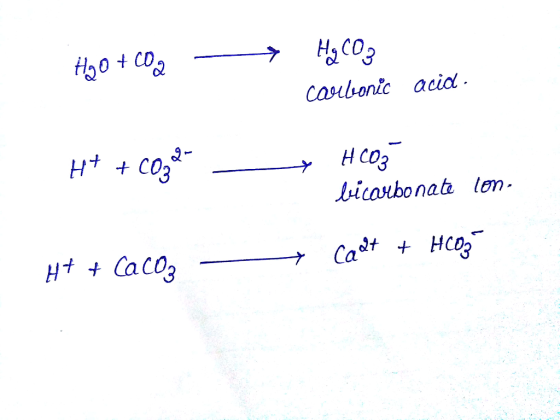
The carbon dioxide present in the atmosphere dissolves in the sea water, the water molecules combine with carbon dioxide molecules to form carbonic acid. As a result of this, the acidity of the sea water increases. thus pH value is low. therefore, the concentration of H+ ions is high.
The shells are mostly composed of calcium carbonate CaCO3. The H+ ions also have tendency to combine with carbonate ion. The H+ ions have greater attraction to combine with the carbonate ion than the calcium ion to form bicarbonate ion (HCO3-). As a result the shells get dissolved forming bicarbonate ions at high concentration of hydronium ion.
Add Answer to:
1. Scientific studies show that the shelled organisms in the
ocean begin to dissolve at lower...
Please show all work, all the steps leading to final answer. Thanks 8. Many marine organisms...
 Please show all work, all the
steps leading to final answer. Thanks
8. Many marine organisms generate shells from calcium carbonate (CaCO3). A. (4 pts) Write out the balanced chemical equation that corresponds to dissociation of calcium carbonate. B. (5 pts) One of the many consequences of climate change is ocean acidification, which occurs because rising surface temperatures allow more CO2 to dissolve in the water, resulting in increased H3O* concentration in the ocean. Using a chemical reaction and a...
Please show all work, all the
steps leading to final answer. Thanks
8. Many marine organisms generate shells from calcium carbonate (CaCO3). A. (4 pts) Write out the balanced chemical equation that corresponds to dissociation of calcium carbonate. B. (5 pts) One of the many consequences of climate change is ocean acidification, which occurs because rising surface temperatures allow more CO2 to dissolve in the water, resulting in increased H3O* concentration in the ocean. Using a chemical reaction and a...
What happens to the market demand for McDonald’s hamburgers when ______? Scientific studies show that eating...
What happens to the market demand for McDonald’s hamburgers when ______? Scientific studies show that eating hamburgers increases the risk of cancer comparable to tobacco use. The question is presenting a change in the demand environment for McDonald’s hamburgers. The assumption of "ceteris paribus" (other things being equal) is made in each case. You should begin by drawing a typical market demand curve for McDonald’s hamburgers. You must both explain your answer verbally and illustrate your answer graphically. Label the...
1. What are the different sources of energy available to living organisms? 2. How do the...
 1. What are the different sources of energy available to living organisms? 2. How do the acquisition and the use of energy by living organisms work according to the laws of thermodynamics? 3. Explain the energy use in the following reactions: endergonic/exergonic. 4. What is metabolism? How are chemical reactions related to metabolism? Why is energy needed to run a metabolism? What are coupled reactions? 5. Draw a picture of ATP. Why is this molecule so important for cells? How...
EXAM 3: CHAPTER 7 1. Why are photosynthetic organisms also considered autotrophic? What are heterotrophic organisms?...
 EXAM 3: CHAPTER 7 1. Why are photosynthetic organisms also considered autotrophic? What are heterotrophic organisms? How are both autotrophs and heterophs the same when it comes to the use of organic molecules to produce energy? 2. What is the particular part that oxygen plays in photosynthesis and cellular respiration? 3. Describe the structural aspects of photosynthesis. For example, where does photosynthesis take place and what parts inside the cell are used to carry out photosynthesis? What chemicals are necessary...
1) Define the following: matter, element, atom, trace element, proton, electron, neutron, atomic number, mass number,...
1) Define the following: matter, element, atom, trace element, proton, electron, neutron, atomic number, mass number, isotopes, radioisotope, molecule, compound, salt, ion. 2) List the 6 elements that make up about 99% of the weight of an organism. 3) What are the functions of the trace elements iron, fluorine (fluoride), and iodine? 4) An iodine deficiency can result in goiter. True/False 5) Where are protons, neutrons and electrons located? 6) Can you determine the atomic number and mass number from...
can you answerthe lab questions 1-5? 1. Explain why methanol and sodium carbonate were both able...
 can
you answerthe lab questions 1-5?
1. Explain why methanol and sodium carbonate were both able to dissolve in water, but only sodium carbonate was able to conduct electricity in solution. (3 pts) 2. Look up the chemical structures of methane and methanol. Based on their structures, which of the two do you expect to be water soluble? Explain your answer. (4 pts) 3. What are the main structural differences and similarities between methanol and 1-decanol. Explain the observed difference...
can
you answerthe lab questions 1-5?
1. Explain why methanol and sodium carbonate were both able to dissolve in water, but only sodium carbonate was able to conduct electricity in solution. (3 pts) 2. Look up the chemical structures of methane and methanol. Based on their structures, which of the two do you expect to be water soluble? Explain your answer. (4 pts) 3. What are the main structural differences and similarities between methanol and 1-decanol. Explain the observed difference...
Postlab Questions 1. How fumaric acid and maleic acid are structurally different compounds and how that...
 Postlab Questions 1. How fumaric acid and maleic acid are structurally different compounds and how that affects their physical and chemical properties. 2. Include drawings of the structures of maleic and fumaric acid to illustrate your point, 3. Calcuate the reaction yield. Show all calculations. 4 Although maleic and fumaric acid are two different isomers, cis and trans isomers of succinic acid (HOOC-CH2-CH2-COOH) do not exist. Explain and use drawings of all molecules to illustrate your argument. 5 Which of...
For each experiment described below 1) provide the relevant equilibrium reaction or reactions, 2) use LeChatelier's...
For each experiment described below 1) provide the relevant equilibrium reaction or reactions, 2) use LeChatelier's Principle to explain why the reaction has shifted left (L) or right (R), and 3) answer any other questions. a) To a solution containing 1M Pb(NO3)2, 1 M HCl is slowly added until a white precipitate forms. The mixture is then heated and the precipitate disappears. Is the dissociation of the precipitate endothermic or exothermic? Does the equilibrium constant (Ksp) change when the solution...
Would the disaccharide (formed in the experiment described above dissolve in water? Only Question 3 needs...
 Would the disaccharide (formed in the experiment described above
dissolve in water? Only Question 3 needs answering
3-Would the disaccharide (formed in the experiment described above dissolve in water? Explain (2pt) Answer all parts. Type or write your answers. You will need to draw molecules and reactions. I suggest that. You write your answers on a sheet of paper and then take a photo. Load the picture into a document and submit the document. 1. Amino acid experiment < U...
Would the disaccharide (formed in the experiment described above
dissolve in water? Only Question 3 needs answering
3-Would the disaccharide (formed in the experiment described above dissolve in water? Explain (2pt) Answer all parts. Type or write your answers. You will need to draw molecules and reactions. I suggest that. You write your answers on a sheet of paper and then take a photo. Load the picture into a document and submit the document. 1. Amino acid experiment < U...
Chemical Reactions a. From your observations, arrange e Cu. Ag. Ph, Zn, and Mg in order of their ...
 Fill in all the blanks. the table 9.13 helps to answer
questions a-c.
Chemical Reactions a. From your observations, arrange e Cu. Ag. Ph, Zn, and Mg in order of their activities, lst- ing the most active first. Explain how you determined this order using your e tal data b. Where would H' fit in the activity series you developed in question 1 (use your experi- mental data)? Can you conclusively determine its position? Why or why not? If not...
Fill in all the blanks. the table 9.13 helps to answer
questions a-c.
Chemical Reactions a. From your observations, arrange e Cu. Ag. Ph, Zn, and Mg in order of their activities, lst- ing the most active first. Explain how you determined this order using your e tal data b. Where would H' fit in the activity series you developed in question 1 (use your experi- mental data)? Can you conclusively determine its position? Why or why not? If not...
 Please show all work, all the
steps leading to final answer. Thanks
8. Many marine organisms generate shells from calcium carbonate (CaCO3). A. (4 pts) Write out the balanced chemical equation that corresponds to dissociation of calcium carbonate. B. (5 pts) One of the many consequences of climate change is ocean acidification, which occurs because rising surface temperatures allow more CO2 to dissolve in the water, resulting in increased H3O* concentration in the ocean. Using a chemical reaction and a...
Please show all work, all the
steps leading to final answer. Thanks
8. Many marine organisms generate shells from calcium carbonate (CaCO3). A. (4 pts) Write out the balanced chemical equation that corresponds to dissociation of calcium carbonate. B. (5 pts) One of the many consequences of climate change is ocean acidification, which occurs because rising surface temperatures allow more CO2 to dissolve in the water, resulting in increased H3O* concentration in the ocean. Using a chemical reaction and a...
 1. What are the different sources of energy available to living organisms? 2. How do the acquisition and the use of energy by living organisms work according to the laws of thermodynamics? 3. Explain the energy use in the following reactions: endergonic/exergonic. 4. What is metabolism? How are chemical reactions related to metabolism? Why is energy needed to run a metabolism? What are coupled reactions? 5. Draw a picture of ATP. Why is this molecule so important for cells? How...
 EXAM 3: CHAPTER 7 1. Why are photosynthetic organisms also considered autotrophic? What are heterotrophic organisms? How are both autotrophs and heterophs the same when it comes to the use of organic molecules to produce energy? 2. What is the particular part that oxygen plays in photosynthesis and cellular respiration? 3. Describe the structural aspects of photosynthesis. For example, where does photosynthesis take place and what parts inside the cell are used to carry out photosynthesis? What chemicals are necessary...
 can
you answerthe lab questions 1-5?
1. Explain why methanol and sodium carbonate were both able to dissolve in water, but only sodium carbonate was able to conduct electricity in solution. (3 pts) 2. Look up the chemical structures of methane and methanol. Based on their structures, which of the two do you expect to be water soluble? Explain your answer. (4 pts) 3. What are the main structural differences and similarities between methanol and 1-decanol. Explain the observed difference...
can
you answerthe lab questions 1-5?
1. Explain why methanol and sodium carbonate were both able to dissolve in water, but only sodium carbonate was able to conduct electricity in solution. (3 pts) 2. Look up the chemical structures of methane and methanol. Based on their structures, which of the two do you expect to be water soluble? Explain your answer. (4 pts) 3. What are the main structural differences and similarities between methanol and 1-decanol. Explain the observed difference...
 Postlab Questions 1. How fumaric acid and maleic acid are structurally different compounds and how that affects their physical and chemical properties. 2. Include drawings of the structures of maleic and fumaric acid to illustrate your point, 3. Calcuate the reaction yield. Show all calculations. 4 Although maleic and fumaric acid are two different isomers, cis and trans isomers of succinic acid (HOOC-CH2-CH2-COOH) do not exist. Explain and use drawings of all molecules to illustrate your argument. 5 Which of...
 Would the disaccharide (formed in the experiment described above
dissolve in water? Only Question 3 needs answering
3-Would the disaccharide (formed in the experiment described above dissolve in water? Explain (2pt) Answer all parts. Type or write your answers. You will need to draw molecules and reactions. I suggest that. You write your answers on a sheet of paper and then take a photo. Load the picture into a document and submit the document. 1. Amino acid experiment < U...
Would the disaccharide (formed in the experiment described above
dissolve in water? Only Question 3 needs answering
3-Would the disaccharide (formed in the experiment described above dissolve in water? Explain (2pt) Answer all parts. Type or write your answers. You will need to draw molecules and reactions. I suggest that. You write your answers on a sheet of paper and then take a photo. Load the picture into a document and submit the document. 1. Amino acid experiment < U...
 Fill in all the blanks. the table 9.13 helps to answer
questions a-c.
Chemical Reactions a. From your observations, arrange e Cu. Ag. Ph, Zn, and Mg in order of their activities, lst- ing the most active first. Explain how you determined this order using your e tal data b. Where would H' fit in the activity series you developed in question 1 (use your experi- mental data)? Can you conclusively determine its position? Why or why not? If not...
Fill in all the blanks. the table 9.13 helps to answer
questions a-c.
Chemical Reactions a. From your observations, arrange e Cu. Ag. Ph, Zn, and Mg in order of their activities, lst- ing the most active first. Explain how you determined this order using your e tal data b. Where would H' fit in the activity series you developed in question 1 (use your experi- mental data)? Can you conclusively determine its position? Why or why not? If not...
Most questions answered within 3 hours.
-
Where is the error in this code sequence?
String s1 = "Hello";
String s2 = "ello";...
asked 10 months ago -
Financial data for Joel de Paris, Inc., for last year
follow:
Joel de Paris, Inc.
Balance...
asked 10 months ago -
Consider this reaction:
Al2(SO4)3 (aq)+ BaCl3
(aq) Al2Cl6 (aq)- +
3BaSO4(s) . What is the...
asked 10 months ago -
Suppose that Savneet is considering increasing her
recent random sample from 20 car rentals to 40...
asked 10 months ago -
Trucks arrive at an unloading terminal at an average rate of 120
per hour.
Trucks arrive...
asked 10 months ago -
Why are methanol and ethanol completely soluble in water while
octanol is not very little soluble....
asked 10 months ago -
A facilities manager at a university reads in a research report
that the mean amount of...
asked 10 months ago -
When the CuSO4 is rehydrated by adding water to the anhydrous
compound, is this an endothermic...
asked 10 months ago -
A ray of sunlight is passing from diamond into crown glass; the
angle of incidence is...
asked 10 months ago -
A block of mass 0.249 kg is placed on top of a light, vertical
spring of...
asked 10 months ago -
how do the kidneys compensate in the presences of acidosis
a) trigger hyperventilate
b) reserve acid...
asked 10 months ago -
Question 501 pts
The rental rate of capital to the firm increases. Which of the
following...
asked 10 months ago