Smelling a sharp penetrating odor probably indicates that you have formed which of the following. A)...
Smelling a sharp penetrating odor probably indicates that you have formed which of the following.
A) CO2
B) NH3
C) H2O
D) H2
Homework Answers
CO2 'H2O ' H2 literally don't have any odor.. But here ammonia has a very sharp pungent smell. The smell distinguish NH3 from the other molecules here.
So answer is B) NH3
Add Answer to:
Smelling a sharp penetrating odor probably indicates that you
have formed which of the following.
A)...
Which of the following processes have a ΔS > 0? A) Na2CO3(s) + H2O(g) + CO2(g) → 2 NaHCO3(s) B)CH4(g) + H2O(g) → CO(g...
Which of the following processes have a ΔS > 0? A) Na2CO3(s) + H2O(g) + CO2(g) → 2 NaHCO3(s) B)CH4(g) + H2O(g) → CO(g) + 3 H2(g) C)CH3OH(l) → CH3OH(s) D)N2(g) + 3 H2(g) → 2 NH3(g) E)All of the above processes have a DS > 0.
Please answer both questions. Thank you For which of the following reactions is ASO > 0?...
 Please answer both questions. Thank you
For which of the following reactions is ASO > 0? a. 2 C2H6(g) +702(g) → 4 CO2(g) + 6 H2O(g) b. H2CO(g) + O2(g) → CO2(g) + H20(1) C. N2(g) + 3 H2(g) → 2 NH3(g) d. NH3(g) + HI(g) → NH41(s) QUESTION 5 For which of the following reactions is AS° at 25 °C closest to zero? a. N2(g) + O2(g) → 2 NO(g) b. H2(g) + 12(s) → 2 HI(g) c. CH3CHO(g)...
Please answer both questions. Thank you
For which of the following reactions is ASO > 0? a. 2 C2H6(g) +702(g) → 4 CO2(g) + 6 H2O(g) b. H2CO(g) + O2(g) → CO2(g) + H20(1) C. N2(g) + 3 H2(g) → 2 NH3(g) d. NH3(g) + HI(g) → NH41(s) QUESTION 5 For which of the following reactions is AS° at 25 °C closest to zero? a. N2(g) + O2(g) → 2 NO(g) b. H2(g) + 12(s) → 2 HI(g) c. CH3CHO(g)...
Which of the following reaction stoichiometry would be used to calculate the moles of H2O formed...
Which of the following reaction stoichiometry would be used to calculate the moles of H2O formed when a given mole of NH3 completely react with excess amount of O2? 4 NH3 + 5 O2 → 4 NO + 6 H2O a. 6 mol H2O/4 mol NH3 b. 4 mol NH3/6 mol H2O c. 5 mol O2/4 mol NH3 d. 4 mol NH3/5 mol O2
3 pages 22.. Which of the following ia not a chemical method of taste and odor...
 3
pages
22.. Which of the following ia not a chemical method of taste and odor removal: a.- Ozonation b.- Aeration C.- Chlorination d.- Potassium Permanganate oxidation 23.- Which of the following is not a quality of Ozone gas: a.- Pungent bluish gas b.- Powerful oxidizer C.- Leaves no residual d.- Most economical method 24.- Which of the following is true regarding Chlorination for taste & odor removal: a.- Very expensive b.- May create odor problems C.- Is used with...
3
pages
22.. Which of the following ia not a chemical method of taste and odor removal: a.- Ozonation b.- Aeration C.- Chlorination d.- Potassium Permanganate oxidation 23.- Which of the following is not a quality of Ozone gas: a.- Pungent bluish gas b.- Powerful oxidizer C.- Leaves no residual d.- Most economical method 24.- Which of the following is true regarding Chlorination for taste & odor removal: a.- Very expensive b.- May create odor problems C.- Is used with...
1. Animals probably evolved from: a). Placozoans that formed colonies b). Choanoflagellates that formed colonies c)....
1. Animals probably evolved from: a). Placozoans that formed colonies b). Choanoflagellates that formed colonies c). All protozoa d). Both a and b 2. Which of the following represent an early branch on the animal family tree? a). Placozoans that formed colonies b). Choanoflagellates that formed colonies c). All protozoa d). Both a and b 3. Feathers first evolved in reptiles.Today they are seen in reptile descendants, the ....? a). mammals b). Birds c). Insects d). Crocdilians
2. Which of the following equations will have a negative ∆S? A. 3 H2(g)+ N2(g) -->...
2. Which of the following equations will have a negative ∆S? A. 3 H2(g)+ N2(g) --> 2 NH3(g) B. C6H6(l)--> C6H6(g) C. NH4OH(s)--> H2O(l)+ NH3(g) D. NaCl(s) --> Na+(aq) + Cl-(aq)
Which member of the following pairs would you expect to have a higher boiling point? (a)...
Which member of the following pairs would you expect to have a higher boiling point? (a) N2 or F2, ?(b) SO2 or CO2, (c) HF or HBr, ?(d) Ar or Xe, (e) CO2 or CS2, ?(f) CCl4 or CH4, (g) Cl2 or LiCl, ?(h) NH3 or PH3, ?(i) BH3 or NH3,?(j) F2 or I2?
Select all of the following that you would predict to have a negative ΔS. a) 2...
Select all of the following that you would predict to have a negative ΔS. a) 2 NO2 (g) → N2 (g) + 2 O2 (g) b) 2SO2 (g) + O2 (g) → 2 SO3 (g) c) 2 C6H6 (l) + 15 O2 (g) → 12 CO2 (g) + 6 H2O (g) d) 4 NO (g) + 6 H2O (g) → 4 NH3 (g) + 5 O2 (g) e) 2 BF3 (g) + 3 CaO (s) → B2O3 (s) + 3...
In a patch of 594 wildflowers, you have the following genotypes: a strong smelling (SS) flower,...
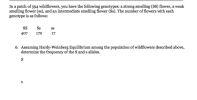 In a patch of 594 wildflowers, you have the following genotypes: a strong smelling (SS) flower, a weak smelling flower (ss), and an intermediate smelling flower (Ss). The number of flowers with each genotype is as follows: Ss ss 170 407 17 6. Assuming Hardy-Weinberg Equilibrium among the population of wildflowers described above, determine the frequency of the S and s alleles. S
Which of the following reactions would have the most positive AS° value? A) SO2(g) + Na20(s)...
 Which of the following reactions would have the most positive AS° value? A) SO2(g) + Na20(s) – Na,SO3(s) B) CO2(s) — CO2(g) C) Fe3+(aq) + SCN-(aq) — FeSCN2+(aq) D) N2(g) + 3 H2(g) – 2 NH3(g) E) 2 NO(g) + Cl2(g) – 2 NOCI(g)
 Please answer both questions. Thank you
For which of the following reactions is ASO > 0? a. 2 C2H6(g) +702(g) → 4 CO2(g) + 6 H2O(g) b. H2CO(g) + O2(g) → CO2(g) + H20(1) C. N2(g) + 3 H2(g) → 2 NH3(g) d. NH3(g) + HI(g) → NH41(s) QUESTION 5 For which of the following reactions is AS° at 25 °C closest to zero? a. N2(g) + O2(g) → 2 NO(g) b. H2(g) + 12(s) → 2 HI(g) c. CH3CHO(g)...
Please answer both questions. Thank you
For which of the following reactions is ASO > 0? a. 2 C2H6(g) +702(g) → 4 CO2(g) + 6 H2O(g) b. H2CO(g) + O2(g) → CO2(g) + H20(1) C. N2(g) + 3 H2(g) → 2 NH3(g) d. NH3(g) + HI(g) → NH41(s) QUESTION 5 For which of the following reactions is AS° at 25 °C closest to zero? a. N2(g) + O2(g) → 2 NO(g) b. H2(g) + 12(s) → 2 HI(g) c. CH3CHO(g)...
 3
pages
22.. Which of the following ia not a chemical method of taste and odor removal: a.- Ozonation b.- Aeration C.- Chlorination d.- Potassium Permanganate oxidation 23.- Which of the following is not a quality of Ozone gas: a.- Pungent bluish gas b.- Powerful oxidizer C.- Leaves no residual d.- Most economical method 24.- Which of the following is true regarding Chlorination for taste & odor removal: a.- Very expensive b.- May create odor problems C.- Is used with...
3
pages
22.. Which of the following ia not a chemical method of taste and odor removal: a.- Ozonation b.- Aeration C.- Chlorination d.- Potassium Permanganate oxidation 23.- Which of the following is not a quality of Ozone gas: a.- Pungent bluish gas b.- Powerful oxidizer C.- Leaves no residual d.- Most economical method 24.- Which of the following is true regarding Chlorination for taste & odor removal: a.- Very expensive b.- May create odor problems C.- Is used with...
 In a patch of 594 wildflowers, you have the following genotypes: a strong smelling (SS) flower, a weak smelling flower (ss), and an intermediate smelling flower (Ss). The number of flowers with each genotype is as follows: Ss ss 170 407 17 6. Assuming Hardy-Weinberg Equilibrium among the population of wildflowers described above, determine the frequency of the S and s alleles. S
 Which of the following reactions would have the most positive AS° value? A) SO2(g) + Na20(s) – Na,SO3(s) B) CO2(s) — CO2(g) C) Fe3+(aq) + SCN-(aq) — FeSCN2+(aq) D) N2(g) + 3 H2(g) – 2 NH3(g) E) 2 NO(g) + Cl2(g) – 2 NOCI(g)
Most questions answered within 3 hours.
-
Where is the error in this code sequence?
String s1 = "Hello";
String s2 = "ello";...
asked 10 months ago -
Financial data for Joel de Paris, Inc., for last year
follow:
Joel de Paris, Inc.
Balance...
asked 10 months ago -
Consider this reaction:
Al2(SO4)3 (aq)+ BaCl3
(aq) Al2Cl6 (aq)- +
3BaSO4(s) . What is the...
asked 10 months ago -
Suppose that Savneet is considering increasing her
recent random sample from 20 car rentals to 40...
asked 10 months ago -
Trucks arrive at an unloading terminal at an average rate of 120
per hour.
Trucks arrive...
asked 10 months ago -
Why are methanol and ethanol completely soluble in water while
octanol is not very little soluble....
asked 10 months ago -
A facilities manager at a university reads in a research report
that the mean amount of...
asked 10 months ago -
When the CuSO4 is rehydrated by adding water to the anhydrous
compound, is this an endothermic...
asked 10 months ago -
A ray of sunlight is passing from diamond into crown glass; the
angle of incidence is...
asked 10 months ago -
A block of mass 0.249 kg is placed on top of a light, vertical
spring of...
asked 10 months ago -
how do the kidneys compensate in the presences of acidosis
a) trigger hyperventilate
b) reserve acid...
asked 10 months ago -
Question 501 pts
The rental rate of capital to the firm increases. Which of the
following...
asked 10 months ago