2) How much time does the following “algorithm” require as a function of n? l...
2) How much time does the following “algorithm” require as a function of n?
l =0
for i = 1 to n do
for j = 1 to n2 do
for k = 1 to n3 do
l = l + 1
Homework Answers

Add Answer to:
2) How much time does the following “algorithm” require as a
function of n?
l...
3) How much time does the following “algorithm” require as a function of n? l=0 for...
3) How much time does the following “algorithm” require as a function of n? l=0 for i=1 to n do for j=1 to i do for k=j to n do l = l + 1
How much time does the following "algorithm" require as a function Problem 4.1. of n? for...
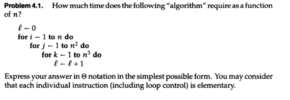 How much time does the following "algorithm" require as a function Problem 4.1. of n? for i 1 to n do for j 1 to n do for k 1 to n3 do Express your answer in 6 notation in the simplest possible form. You may consider that each individual instruction (including loop control) is elementary
Perform the following to the algorithm below: - - Express T(n) as a function of n...
 Perform the following to the algorithm below: - - Express T(n) as a function of n Find a best approximation for the Big O function for T(n) Perform a time complexity analysis Define the basic operation of the algorithm Correctness Efficiency - - Procedure maxMin (n, A, I, h) integer h, I, A (1:n), n integer j j-2 IA (1) hS (1) while (i <=n) do if (Ali) < 1) then TEA (0) if(Ali) >h) then h A() j+į+1 repeat...
1. (10 points) Write an efficient iterative (i.e., loop-based) function Fibonnaci(n) that returns the nth Fibonnaci...
 1. (10 points) Write an efficient iterative (i.e., loop-based) function Fibonnaci(n) that returns the nth Fibonnaci number. By definition Fibonnaci(0) is 1, Fibonnaci(1) is 1, Fibonnaci(2) is 2, Fibonnaci(3) is 3, Fibonnaci(4) is 5, and so on. Your function may only use a constant amount of memory (i.e. no auxiliary array). Argue that the running time of the function is Θ(n), i.e. the function is linear in n. 2. (10 points) Order the following functions by growth rate: N, \N,...
Consider the following algorithm. ALGORITHM Enigma(A[0.n - 1]) //Input: An array A[0.n - 1] of integer...
 Consider the following algorithm. ALGORITHM Enigma(A[0.n - 1]) //Input: An array A[0.n - 1] of integer numbers for i leftarrow 0 to n - 2 do for j leftarrow i +1 to n - 1 do if A[i] = = A[j] return false return true a) What does this algorithm do? b) Compute the running time of this algorithm.
Analyze the running time of the following algorithms asymptotically. (a) Algorithm for-loop(n): P = 1 for...
 Analyze the running time of the following algorithms asymptotically. (a) Algorithm for-loop(n): P = 1 for i = 1 to 5n^2 do p = p times i return p (b) Algorithm for-loop(n): s = 0 for i = 1 to n do for j = I to n do s = s + i return s (c) Algorithm WhileLoop(n): x = 0; j = 2; while (j = n){x = x+ 1; j =j times 2;}
1 question) Arrange the following in the order of their growth rates, from least to greatest:...
1 question) Arrange the following in the order of their growth rates, from least to greatest: (5 pts) n3 n2 nn lg n n! n lg n 2n n 2 question)Show that 3n3 + n2 is big-Oh of n3. You can use either the definition of big-Oh (formal) or the limit approach. Show your work! (5 pts.) 3 question)Show that 6n2 + 20n is big-Oh of n3, but not big-Omega of n3. You can use either the definition of big-Omega...
Question 2 Consider the following algorithm Fun that takes array A and key Kas Fun(AO,...,n -...
 Question 2 Consider the following algorithm Fun that takes array A and key Kas Fun(AO,...,n - 1], K) count = 0 for i = 0 ton - 1 do for j = i +1 to n - 1 do if A[i] + A[j] == K then count = count +1 end if end for end for return count What is the best case time complexity of the above algorithm?! (log(n)) O(1) (n) (na) Previous o H H 9
a) Prove that running time T(n)=n3+30n+1 is O(n3) [1 mark] b) Prove that running time T(n)=(n+30)(n+5)...
a) Prove that running time T(n)=n3+30n+1 is O(n3) [1 mark] b) Prove that running time T(n)=(n+30)(n+5) is O(n2) [1 mark] c) Count the number of primitive operation of algorithm unique1 on page 174 of textbook, give a big-Oh of this algorithm and prove it. [2 mark] d) Order the following function by asymptotic growth rate [2 mark] a. 4nlogn+2n b. 210 c. 3n+100logn d. n2+10n e. n3 f. nlogn
(V). Given the following algorithm, answer relevant questions. Algorithm 1 An algorithm 1: procedure WHATISTHIS(21,22,...,n: a...
 (V). Given the following algorithm, answer relevant questions. Algorithm 1 An algorithm 1: procedure WHATISTHIS(21,22,...,n: a list of n integers) for i = 2 to n do c= j=i-1 while (j > 0) do if ra; then break end if 4j+1 = a; j= j-1 end while j+1 = 1 end for 14: return 0.02. 1, 15: end procedure Answer the following questions: (1) Run the algorithm with input (41, 02, 03, 04) = (3, 0, 1,6). Record the values...
 How much time does the following "algorithm" require as a function Problem 4.1. of n? for i 1 to n do for j 1 to n do for k 1 to n3 do Express your answer in 6 notation in the simplest possible form. You may consider that each individual instruction (including loop control) is elementary
 Perform the following to the algorithm below: - - Express T(n) as a function of n Find a best approximation for the Big O function for T(n) Perform a time complexity analysis Define the basic operation of the algorithm Correctness Efficiency - - Procedure maxMin (n, A, I, h) integer h, I, A (1:n), n integer j j-2 IA (1) hS (1) while (i <=n) do if (Ali) < 1) then TEA (0) if(Ali) >h) then h A() j+į+1 repeat...
 1. (10 points) Write an efficient iterative (i.e., loop-based) function Fibonnaci(n) that returns the nth Fibonnaci number. By definition Fibonnaci(0) is 1, Fibonnaci(1) is 1, Fibonnaci(2) is 2, Fibonnaci(3) is 3, Fibonnaci(4) is 5, and so on. Your function may only use a constant amount of memory (i.e. no auxiliary array). Argue that the running time of the function is Θ(n), i.e. the function is linear in n. 2. (10 points) Order the following functions by growth rate: N, \N,...
 Consider the following algorithm. ALGORITHM Enigma(A[0.n - 1]) //Input: An array A[0.n - 1] of integer numbers for i leftarrow 0 to n - 2 do for j leftarrow i +1 to n - 1 do if A[i] = = A[j] return false return true a) What does this algorithm do? b) Compute the running time of this algorithm.
 Analyze the running time of the following algorithms asymptotically. (a) Algorithm for-loop(n): P = 1 for i = 1 to 5n^2 do p = p times i return p (b) Algorithm for-loop(n): s = 0 for i = 1 to n do for j = I to n do s = s + i return s (c) Algorithm WhileLoop(n): x = 0; j = 2; while (j = n){x = x+ 1; j =j times 2;}
 Question 2 Consider the following algorithm Fun that takes array A and key Kas Fun(AO,...,n - 1], K) count = 0 for i = 0 ton - 1 do for j = i +1 to n - 1 do if A[i] + A[j] == K then count = count +1 end if end for end for return count What is the best case time complexity of the above algorithm?! (log(n)) O(1) (n) (na) Previous o H H 9
 (V). Given the following algorithm, answer relevant questions. Algorithm 1 An algorithm 1: procedure WHATISTHIS(21,22,...,n: a list of n integers) for i = 2 to n do c= j=i-1 while (j > 0) do if ra; then break end if 4j+1 = a; j= j-1 end while j+1 = 1 end for 14: return 0.02. 1, 15: end procedure Answer the following questions: (1) Run the algorithm with input (41, 02, 03, 04) = (3, 0, 1,6). Record the values...
Most questions answered within 3 hours.
-
Where is the error in this code sequence?
String s1 = "Hello";
String s2 = "ello";...
asked 10 months ago -
Financial data for Joel de Paris, Inc., for last year
follow:
Joel de Paris, Inc.
Balance...
asked 10 months ago -
Consider this reaction:
Al2(SO4)3 (aq)+ BaCl3
(aq) Al2Cl6 (aq)- +
3BaSO4(s) . What is the...
asked 10 months ago -
Suppose that Savneet is considering increasing her
recent random sample from 20 car rentals to 40...
asked 10 months ago -
Trucks arrive at an unloading terminal at an average rate of 120
per hour.
Trucks arrive...
asked 10 months ago -
Why are methanol and ethanol completely soluble in water while
octanol is not very little soluble....
asked 10 months ago -
A facilities manager at a university reads in a research report
that the mean amount of...
asked 10 months ago -
When the CuSO4 is rehydrated by adding water to the anhydrous
compound, is this an endothermic...
asked 10 months ago -
A ray of sunlight is passing from diamond into crown glass; the
angle of incidence is...
asked 10 months ago -
A block of mass 0.249 kg is placed on top of a light, vertical
spring of...
asked 10 months ago -
how do the kidneys compensate in the presences of acidosis
a) trigger hyperventilate
b) reserve acid...
asked 10 months ago -
Question 501 pts
The rental rate of capital to the firm increases. Which of the
following...
asked 10 months ago