1. Create the following signals, f1, f2 in time domain. t = 0 to 1 second....
1. Create the following signals, f1, f2 in time
domain.
t = 0 to 1 second.
f1(t) = 8 sin (2 *pi*80*t);
f2(t) = 4 cos (2*pi*240*t)
Define any assumptions you make to generate the signals.
2. Plot the two graphs as sub plots with appropriate
lables in x axis (time), y
axis, title etc.
3. Generate the following signal
f3 = f1 + f2;
4. Plot as sub plot in (2).
5. Compute the fourier transform of this signal,
cannot use the built-in
MATLAB function. Implement your own FT function. (You will have to
refer to FT theory)
6. Plot the magnitude and phase response. (Again read up the formula to compute this).
Homework Answers
`Hey,
Note: Brother if you have any queries related the answer please do comment. I would be very happy to resolve all your queries.
clc
clear all
close all
format long
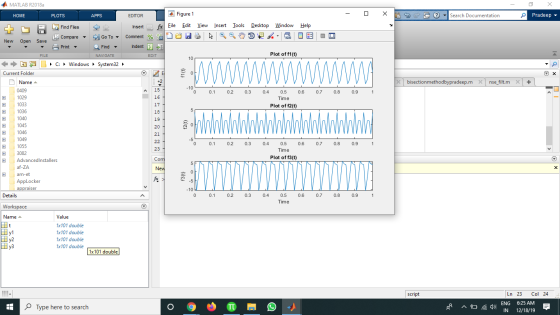
t=0:0.01:1;
y1=8*sin (2 *pi*80*t);
y2=4*cos (2*pi*240*t);
subplot(3,1,1)
plot(t,y1);
xlabel('Time');
ylabel('f1(t)');
title('Plot of f1(t)');
subplot(3,1,2)
plot(t,y2);
xlabel('Time');
ylabel('f2(t)');
title('Plot of f2(t)');
y3=y1+y2;
subplot(3,1,3)
plot(t,y3);
xlabel('Time');
ylabel('f3(t)');
title('Plot of f3(t)');
Note: Brother According to HomeworkLib's policy we are only allowed to answer first 4 part if there are many. So, I request you to post other part as separate posts
Kindly revert for any queries
Thanks.
Add Answer to:
1. Create the following signals, f1, f2 in time
domain.
t = 0 to 1 second....
Write a Matlab code to generate the signal y(t)=10*(cos(2*pi*f1*t)+ cos(2*pi*f2*t)+ cos(2*pi*f3*t)), where f1=500 Hz, f2=750 Hz...
Write a Matlab code to generate the signal y(t)=10*(cos(2*pi*f1*t)+ cos(2*pi*f2*t)+ cos(2*pi*f3*t)), where f1=500 Hz, f2=750 Hz and f3=1000 Hz. Plot the signal in time domain. Sketch the Fourier transform of the signal with appropriately generating frequency axis. Apply an appropriate filter to y(t) so that signal part with frequency f1 can be extracted. Sketch the Fourier transform of the extracted signal. Apply an appropriate filter to y(t) so that signal part with frequency f2 can be extracted. Sketch the Fourier...
There is a system that can multiply and / or add several input signals (constants or variables) i...
 There is a system that can multiply and / or add
several input signals (constants or variables) in the time domain;
the input signals are f1 (t), f2 (t) and f3; the output signals are
f4 (t), f5 (t) and f6 (t). The substime lowpass filter (FPBj) is a
system that has a transfer function h (t) (H (w)), with unit gain
in the operating area and cutoff frequency of + - 400 Hz. (The
filter gain passes abruptly from...
There is a system that can multiply and / or add
several input signals (constants or variables) in the time domain;
the input signals are f1 (t), f2 (t) and f3; the output signals are
f4 (t), f5 (t) and f6 (t). The substime lowpass filter (FPBj) is a
system that has a transfer function h (t) (H (w)), with unit gain
in the operating area and cutoff frequency of + - 400 Hz. (The
filter gain passes abruptly from...
Now use MATLAB to generate and plot 15seconds of this signal in the time-domain.Use the fft()...
 Now use MATLAB to generate and plot 15seconds of this signal
in the time-domain.Use the fft() function to find the fourier
transform of this signal and plot its magnitude spectrum
School of Engineering Task 3 - The Fourier Transform: Scaling property Exercise: Let's take a look now at using the Fourier transform on aperiodic signals. Consider the real exponential signal from the discharging capacitor in tas 3 of laboratory 1 which was found to be: You(t)=e"u(t) Begin by calculating manually...
Now use MATLAB to generate and plot 15seconds of this signal
in the time-domain.Use the fft() function to find the fourier
transform of this signal and plot its magnitude spectrum
School of Engineering Task 3 - The Fourier Transform: Scaling property Exercise: Let's take a look now at using the Fourier transform on aperiodic signals. Consider the real exponential signal from the discharging capacitor in tas 3 of laboratory 1 which was found to be: You(t)=e"u(t) Begin by calculating manually...
Using QAM we wish to transmit the following baseband message signals Bcos (w t a) Show the time and frequency domain expression for the transmitted signal. Also, plot the magnitude of the frequency d...
 Using QAM we wish to transmit the following baseband message signals Bcos (w t a) Show the time and frequency domain expression for the transmitted signal. Also, plot the magnitude of the frequency domain representation of the signal. b) On the receiver end, we demodulate the received signal by multiplying with 2cos(Wet +Au). Derive the expression of the demodulated signal in the time domain, before low-pass filtering. c) Derive the Fourier Transform of the demodulated signal.
Using QAM we wish...
Using QAM we wish to transmit the following baseband message signals Bcos (w t a) Show the time and frequency domain expression for the transmitted signal. Also, plot the magnitude of the frequency domain representation of the signal. b) On the receiver end, we demodulate the received signal by multiplying with 2cos(Wet +Au). Derive the expression of the demodulated signal in the time domain, before low-pass filtering. c) Derive the Fourier Transform of the demodulated signal.
Using QAM we wish...
Compute Laplace transforms of the following functions: (a) f1 = (1 + t) (b) f2 =...
 Compute Laplace transforms of the following functions: (a) f1 = (1 + t) (b) f2 = eat sin(bt) 11, 0<t<1, (c) f3 = -1 1<t<2, | 2, t>2, Find the functions from their Laplace transforms: (a) Lyı] s(s + 1) (s +3) 2+s (b) L[42] = 52 + 2 s +5 (c) L[y3] = Solve the following initial value problems using the Laplace transform. Confirm each solution with a Matlab plot showing the function on the interval 0 <t<5. (a)...
Can you please help me answer Task 2.b? Please show all work. fs=44100; no_pts=8192; t=([0:no_pts-1]')/fs; y1=sin(2...
 Can you please help me answer Task 2.b?
Please show all work.
fs=44100; no_pts=8192;
t=([0:no_pts-1]')/fs;
y1=sin(2*pi*1000*t);
figure;
plot(t,y1);
xlabel('t (second)')
ylabel('y(t)')
axis([0,.004,-1.2,1.2]) % constrain axis so you can actually see
the wave
sound(y1,fs); % play sound using windows driver.
%%
% Check the frequency domain signal. fr is the frequency vector and
f1 is the magnitude of F{y1}.
fr=([0:no_pts-1]')/no_pts*fs; %in Hz
fr=fr(1:no_pts/2); % single-sided spectrum
f1=abs(fft(y1)); % compute fft
f1=f1(1:no_pts/2)/fs;
%%
% F is the continuous time Fourier. (See derivation...
Can you please help me answer Task 2.b?
Please show all work.
fs=44100; no_pts=8192;
t=([0:no_pts-1]')/fs;
y1=sin(2*pi*1000*t);
figure;
plot(t,y1);
xlabel('t (second)')
ylabel('y(t)')
axis([0,.004,-1.2,1.2]) % constrain axis so you can actually see
the wave
sound(y1,fs); % play sound using windows driver.
%%
% Check the frequency domain signal. fr is the frequency vector and
f1 is the magnitude of F{y1}.
fr=([0:no_pts-1]')/no_pts*fs; %in Hz
fr=fr(1:no_pts/2); % single-sided spectrum
f1=abs(fft(y1)); % compute fft
f1=f1(1:no_pts/2)/fs;
%%
% F is the continuous time Fourier. (See derivation...
Q4) Calculate the Fourier transform of the following time domain signals. Use the properties of t...
 Q4) Calculate the Fourier transform of the following time domain signals. Use the properties of the Fourier transform found in the "Properties of Fourier Transforms" table in textbook and the "Famous Fourier Transforms Table" in textbook instead of direct integration as much as possible to simplify your calculation wherever appropriate: 2-2
(a) Given the following signals: z(t) = { ={ex? exp(-kt) t> 0 0 t<0 sin(Ot) g(t)...
 (a) Given the following signals: z(t) = { ={ex? exp(-kt) t> 0 0 t<0 sin(Ot) g(t) = **(t) art (i) Explain what the symbol * means in this context and write down the expression for the function y(t). (ii) Compute the energy of the signal x(t) in the time domain. (iii) Using the formulae 1 F[2(t)]() = k + 2ris F(II(t)](s) = sinc(s) It > 1/2 II(t) It < 1/2 sin(TTS) sinc(s) ITS compute the energy of the signal y(t)...
Please answer in MATLAB, thank you! 2. Calculate the energy of time domain signal x (t) and z (t) for the range of 0SIS...
 Please answer in MATLAB, thank you!
2. Calculate the energy of time domain signal x (t) and z (t) for the range of 0SIS2.5 Also calculate the energy of these signals in frequency domain using Parseval's theorem. Plot Energy (X) and Energy (Z) as a function of frequency f in a 2xl subplot (Energy vs frequency plot is know as energy spectrum of a signal).
2. Calculate the energy of time domain signal x (t) and z (t) for the...
Please answer in MATLAB, thank you!
2. Calculate the energy of time domain signal x (t) and z (t) for the range of 0SIS2.5 Also calculate the energy of these signals in frequency domain using Parseval's theorem. Plot Energy (X) and Energy (Z) as a function of frequency f in a 2xl subplot (Energy vs frequency plot is know as energy spectrum of a signal).
2. Calculate the energy of time domain signal x (t) and z (t) for the...
Name: ID NO: Section: 1. Assume that you have three sinusoidal signals and the parameters of...
 Name: ID NO: Section: 1. Assume that you have three sinusoidal signals and the parameters of each one of them is given below Amplitude is 3. cyclic frequency is 50Hz and phase shift is - Amplitude is 4, radian frequency is 40 and phase shift is Amplitude is 6, period is 0.05s, and phase shiftis- Write MATLAB code for the following Assume that the time interval is. Generate each signal Plot the above three signals in the same figure window...
 There is a system that can multiply and / or add
several input signals (constants or variables) in the time domain;
the input signals are f1 (t), f2 (t) and f3; the output signals are
f4 (t), f5 (t) and f6 (t). The substime lowpass filter (FPBj) is a
system that has a transfer function h (t) (H (w)), with unit gain
in the operating area and cutoff frequency of + - 400 Hz. (The
filter gain passes abruptly from...
There is a system that can multiply and / or add
several input signals (constants or variables) in the time domain;
the input signals are f1 (t), f2 (t) and f3; the output signals are
f4 (t), f5 (t) and f6 (t). The substime lowpass filter (FPBj) is a
system that has a transfer function h (t) (H (w)), with unit gain
in the operating area and cutoff frequency of + - 400 Hz. (The
filter gain passes abruptly from...
 Now use MATLAB to generate and plot 15seconds of this signal
in the time-domain.Use the fft() function to find the fourier
transform of this signal and plot its magnitude spectrum
School of Engineering Task 3 - The Fourier Transform: Scaling property Exercise: Let's take a look now at using the Fourier transform on aperiodic signals. Consider the real exponential signal from the discharging capacitor in tas 3 of laboratory 1 which was found to be: You(t)=e"u(t) Begin by calculating manually...
Now use MATLAB to generate and plot 15seconds of this signal
in the time-domain.Use the fft() function to find the fourier
transform of this signal and plot its magnitude spectrum
School of Engineering Task 3 - The Fourier Transform: Scaling property Exercise: Let's take a look now at using the Fourier transform on aperiodic signals. Consider the real exponential signal from the discharging capacitor in tas 3 of laboratory 1 which was found to be: You(t)=e"u(t) Begin by calculating manually...
 Using QAM we wish to transmit the following baseband message signals Bcos (w t a) Show the time and frequency domain expression for the transmitted signal. Also, plot the magnitude of the frequency domain representation of the signal. b) On the receiver end, we demodulate the received signal by multiplying with 2cos(Wet +Au). Derive the expression of the demodulated signal in the time domain, before low-pass filtering. c) Derive the Fourier Transform of the demodulated signal.
Using QAM we wish...
Using QAM we wish to transmit the following baseband message signals Bcos (w t a) Show the time and frequency domain expression for the transmitted signal. Also, plot the magnitude of the frequency domain representation of the signal. b) On the receiver end, we demodulate the received signal by multiplying with 2cos(Wet +Au). Derive the expression of the demodulated signal in the time domain, before low-pass filtering. c) Derive the Fourier Transform of the demodulated signal.
Using QAM we wish...
 Compute Laplace transforms of the following functions: (a) f1 = (1 + t) (b) f2 = eat sin(bt) 11, 0<t<1, (c) f3 = -1 1<t<2, | 2, t>2, Find the functions from their Laplace transforms: (a) Lyı] s(s + 1) (s +3) 2+s (b) L[42] = 52 + 2 s +5 (c) L[y3] = Solve the following initial value problems using the Laplace transform. Confirm each solution with a Matlab plot showing the function on the interval 0 <t<5. (a)...
 Can you please help me answer Task 2.b?
Please show all work.
fs=44100; no_pts=8192;
t=([0:no_pts-1]')/fs;
y1=sin(2*pi*1000*t);
figure;
plot(t,y1);
xlabel('t (second)')
ylabel('y(t)')
axis([0,.004,-1.2,1.2]) % constrain axis so you can actually see
the wave
sound(y1,fs); % play sound using windows driver.
%%
% Check the frequency domain signal. fr is the frequency vector and
f1 is the magnitude of F{y1}.
fr=([0:no_pts-1]')/no_pts*fs; %in Hz
fr=fr(1:no_pts/2); % single-sided spectrum
f1=abs(fft(y1)); % compute fft
f1=f1(1:no_pts/2)/fs;
%%
% F is the continuous time Fourier. (See derivation...
Can you please help me answer Task 2.b?
Please show all work.
fs=44100; no_pts=8192;
t=([0:no_pts-1]')/fs;
y1=sin(2*pi*1000*t);
figure;
plot(t,y1);
xlabel('t (second)')
ylabel('y(t)')
axis([0,.004,-1.2,1.2]) % constrain axis so you can actually see
the wave
sound(y1,fs); % play sound using windows driver.
%%
% Check the frequency domain signal. fr is the frequency vector and
f1 is the magnitude of F{y1}.
fr=([0:no_pts-1]')/no_pts*fs; %in Hz
fr=fr(1:no_pts/2); % single-sided spectrum
f1=abs(fft(y1)); % compute fft
f1=f1(1:no_pts/2)/fs;
%%
% F is the continuous time Fourier. (See derivation...
 Q4) Calculate the Fourier transform of the following time domain signals. Use the properties of the Fourier transform found in the "Properties of Fourier Transforms" table in textbook and the "Famous Fourier Transforms Table" in textbook instead of direct integration as much as possible to simplify your calculation wherever appropriate: 2-2
 (a) Given the following signals: z(t) = { ={ex? exp(-kt) t> 0 0 t<0 sin(Ot) g(t) = **(t) art (i) Explain what the symbol * means in this context and write down the expression for the function y(t). (ii) Compute the energy of the signal x(t) in the time domain. (iii) Using the formulae 1 F[2(t)]() = k + 2ris F(II(t)](s) = sinc(s) It > 1/2 II(t) It < 1/2 sin(TTS) sinc(s) ITS compute the energy of the signal y(t)...
 Please answer in MATLAB, thank you!
2. Calculate the energy of time domain signal x (t) and z (t) for the range of 0SIS2.5 Also calculate the energy of these signals in frequency domain using Parseval's theorem. Plot Energy (X) and Energy (Z) as a function of frequency f in a 2xl subplot (Energy vs frequency plot is know as energy spectrum of a signal).
2. Calculate the energy of time domain signal x (t) and z (t) for the...
Please answer in MATLAB, thank you!
2. Calculate the energy of time domain signal x (t) and z (t) for the range of 0SIS2.5 Also calculate the energy of these signals in frequency domain using Parseval's theorem. Plot Energy (X) and Energy (Z) as a function of frequency f in a 2xl subplot (Energy vs frequency plot is know as energy spectrum of a signal).
2. Calculate the energy of time domain signal x (t) and z (t) for the...
 Name: ID NO: Section: 1. Assume that you have three sinusoidal signals and the parameters of each one of them is given below Amplitude is 3. cyclic frequency is 50Hz and phase shift is - Amplitude is 4, radian frequency is 40 and phase shift is Amplitude is 6, period is 0.05s, and phase shiftis- Write MATLAB code for the following Assume that the time interval is. Generate each signal Plot the above three signals in the same figure window...
Most questions answered within 3 hours.
-
Where is the error in this code sequence?
String s1 = "Hello";
String s2 = "ello";...
asked 11 months ago -
Financial data for Joel de Paris, Inc., for last year
follow:
Joel de Paris, Inc.
Balance...
asked 11 months ago -
Consider this reaction:
Al2(SO4)3 (aq)+ BaCl3
(aq) Al2Cl6 (aq)- +
3BaSO4(s) . What is the...
asked 11 months ago -
Suppose that Savneet is considering increasing her
recent random sample from 20 car rentals to 40...
asked 11 months ago -
Trucks arrive at an unloading terminal at an average rate of 120
per hour.
Trucks arrive...
asked 11 months ago -
Why are methanol and ethanol completely soluble in water while
octanol is not very little soluble....
asked 11 months ago -
A facilities manager at a university reads in a research report
that the mean amount of...
asked 11 months ago -
When the CuSO4 is rehydrated by adding water to the anhydrous
compound, is this an endothermic...
asked 11 months ago -
A ray of sunlight is passing from diamond into crown glass; the
angle of incidence is...
asked 11 months ago -
A block of mass 0.249 kg is placed on top of a light, vertical
spring of...
asked 11 months ago -
how do the kidneys compensate in the presences of acidosis
a) trigger hyperventilate
b) reserve acid...
asked 11 months ago -
Question 501 pts
The rental rate of capital to the firm increases. Which of the
following...
asked 11 months ago