Neglecting air resistance, what are the three primary quantities responsible for the time-of-flight for any projectile?...
-
Neglecting air resistance, what are the three primary quantities responsible for the time-of-flight for any projectile? For each, briefly describe how that quantity affects the projectile’s time of flight.
Homework Answers

 Thanks
Add Answer to:
Neglecting air resistance, what are the three primary
quantities responsible for the time-of-flight for any projectile?...
QUESTION 4 For the motion of a projectile with no air resistance. How does total flight...
 QUESTION 4 For the motion of a projectile with no air resistance. How does total flight time change if you double the mass of your projectile? The time of flight is doubled. The time of flight is halved. The time of flight is the same for both masses. The time of flight decreases proportionally to the inverse of the mass. QUESTION 5 Which of these quantities stay constant for the 2D motion of a projectile with no air resistance? Acceleration...
Assuming that air resistance is negligible, what force is acting on a projectile during its flight?...
Assuming that air resistance is negligible, what force is acting on a projectile during its flight? In what direction?
5. Neglecting air resistance, find the equation of the curve describing the trajectory of a projectile...
5. Neglecting air resistance, find the equation of the curve describing the trajectory of a projectile launched with initial speed v0 at an angle θ with respect to the horizontal. Plot this curve for the values θ = 30◦ and v0 = 100 m/s, experimenting numerically to find an appropriate time interval for the plot. ( USE MATLAB CODE ONLY).
air resistance, the projectile will travel what e muzzle velocity is 980 m/s. Neglecting A large...
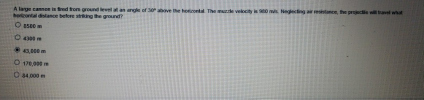 air resistance, the projectile will travel what e muzzle velocity is 980 m/s. Neglecting A large cannon is fired from ground level at an angle of 30° above the horizontal. The muzzle velocity is 980 m/s. Neglecting horizontal distance before striking the ground? O 8500 m O 4300 m O 43,000 m O 170,000 m O 84,000 m
what is the time of flight for a projectile each of these following case? What is...
 what is the time of flight for a projectile each of these
following case?
What is the time of flight for a projectile each of these following cases? Gravity is acting in the negative y-direction. a. A ball is thrown at 0° from the horizontal. It lands at Ax 6m, Ay--3m. b. A ball is thrown at 30° from the horizontal. It lands at ?? 10m,Ay Orn. c. A ball is thrown at 60° from the horizontal. It lands at...
what is the time of flight for a projectile each of these
following case?
What is the time of flight for a projectile each of these following cases? Gravity is acting in the negative y-direction. a. A ball is thrown at 0° from the horizontal. It lands at Ax 6m, Ay--3m. b. A ball is thrown at 30° from the horizontal. It lands at ?? 10m,Ay Orn. c. A ball is thrown at 60° from the horizontal. It lands at...
Please help with Q1 a)b)c). Question 1: In the lectures we considered simple projectile motion. Here we extend the description to include air resistance. For macroscopic objects in air, the dynamics...
 Please help with Q1 a)b)c).
Question 1: In the lectures we considered simple projectile motion. Here we extend the description to include air resistance. For macroscopic objects in air, the dynamics equations including air resistance may be written V and ^- where m is the mass of the object, g is the acceleration due to gravity, y is the vertical direction, C is a dimensionless drag coefficient, A is the cross-sectional area of the object, pa 1.2kg/m3 is the density...
Please help with Q1 a)b)c).
Question 1: In the lectures we considered simple projectile motion. Here we extend the description to include air resistance. For macroscopic objects in air, the dynamics equations including air resistance may be written V and ^- where m is the mass of the object, g is the acceleration due to gravity, y is the vertical direction, C is a dimensionless drag coefficient, A is the cross-sectional area of the object, pa 1.2kg/m3 is the density...
A ball is thrown vertically upwards with an initial velocity of 27.0 m/s. Neglecting air resistance,...
 A ball is thrown vertically upwards with an initial velocity of 27.0 m/s. Neglecting air resistance, how long is the ball in the air? Submit Answer Tries 0/99 What is the greatest height reached by the ball? Submit Answer Tries 0/99 Calculate the first time where the ball has half of its initial velocity
22. the launching velocity of a projectile is 20 m/s at 53 above the horizontal. What...
 22. the launching velocity of a projectile is 20 m/s at 53 above the horizontal. What i the vertical component of its velocity at launch? Its horizontal component of air friction, which of these components remains constant throughout t of these components determines the projectile's time in the air? velocity? Neglecting hich he flight path? W uppose you exert 200 N horizontally on your refrigerator to push it acros the kitchen foor at constant velocity (a) How much work is...
Q2. A) Projectile motion (General launch angle): Select any one of the options as answer A...
 Q2. A) Projectile motion (General launch angle): Select any one of the options as answer A football kicker is attempting a field goal from 44 m out. The ball is kicked and just clears the lower bar with a time of flight of 2.9 s. If the angle of the kick was 45°, what was the initial speed(Vo) of the ball, assuming no air resistance? a) 21.5 m/s b) 19.7 m/s c) 2.2 m/s d) 39 m/s (Hint: x-Xo =...
1. A projectile is launched horizontally from a height above level ground of 3 m. When...
 1. A projectile is launched horizontally from a height above level ground of 3 m. When it hits the ground, it's horizonta displacement from the launch point is 7 m. a. b. How much time does it spend in flight? With what speed was it launched? Suppose the projectile were now launched from the same point at an angle of 45 above the horizontal. a. b. How much time does it spend in the air? What is its horizontal displacement...
 QUESTION 4 For the motion of a projectile with no air resistance. How does total flight time change if you double the mass of your projectile? The time of flight is doubled. The time of flight is halved. The time of flight is the same for both masses. The time of flight decreases proportionally to the inverse of the mass. QUESTION 5 Which of these quantities stay constant for the 2D motion of a projectile with no air resistance? Acceleration...
 air resistance, the projectile will travel what e muzzle velocity is 980 m/s. Neglecting A large cannon is fired from ground level at an angle of 30° above the horizontal. The muzzle velocity is 980 m/s. Neglecting horizontal distance before striking the ground? O 8500 m O 4300 m O 43,000 m O 170,000 m O 84,000 m
 what is the time of flight for a projectile each of these
following case?
What is the time of flight for a projectile each of these following cases? Gravity is acting in the negative y-direction. a. A ball is thrown at 0° from the horizontal. It lands at Ax 6m, Ay--3m. b. A ball is thrown at 30° from the horizontal. It lands at ?? 10m,Ay Orn. c. A ball is thrown at 60° from the horizontal. It lands at...
what is the time of flight for a projectile each of these
following case?
What is the time of flight for a projectile each of these following cases? Gravity is acting in the negative y-direction. a. A ball is thrown at 0° from the horizontal. It lands at Ax 6m, Ay--3m. b. A ball is thrown at 30° from the horizontal. It lands at ?? 10m,Ay Orn. c. A ball is thrown at 60° from the horizontal. It lands at...
 Please help with Q1 a)b)c).
Question 1: In the lectures we considered simple projectile motion. Here we extend the description to include air resistance. For macroscopic objects in air, the dynamics equations including air resistance may be written V and ^- where m is the mass of the object, g is the acceleration due to gravity, y is the vertical direction, C is a dimensionless drag coefficient, A is the cross-sectional area of the object, pa 1.2kg/m3 is the density...
Please help with Q1 a)b)c).
Question 1: In the lectures we considered simple projectile motion. Here we extend the description to include air resistance. For macroscopic objects in air, the dynamics equations including air resistance may be written V and ^- where m is the mass of the object, g is the acceleration due to gravity, y is the vertical direction, C is a dimensionless drag coefficient, A is the cross-sectional area of the object, pa 1.2kg/m3 is the density...
 A ball is thrown vertically upwards with an initial velocity of 27.0 m/s. Neglecting air resistance, how long is the ball in the air? Submit Answer Tries 0/99 What is the greatest height reached by the ball? Submit Answer Tries 0/99 Calculate the first time where the ball has half of its initial velocity
 22. the launching velocity of a projectile is 20 m/s at 53 above the horizontal. What i the vertical component of its velocity at launch? Its horizontal component of air friction, which of these components remains constant throughout t of these components determines the projectile's time in the air? velocity? Neglecting hich he flight path? W uppose you exert 200 N horizontally on your refrigerator to push it acros the kitchen foor at constant velocity (a) How much work is...
 Q2. A) Projectile motion (General launch angle): Select any one of the options as answer A football kicker is attempting a field goal from 44 m out. The ball is kicked and just clears the lower bar with a time of flight of 2.9 s. If the angle of the kick was 45°, what was the initial speed(Vo) of the ball, assuming no air resistance? a) 21.5 m/s b) 19.7 m/s c) 2.2 m/s d) 39 m/s (Hint: x-Xo =...
 1. A projectile is launched horizontally from a height above level ground of 3 m. When it hits the ground, it's horizonta displacement from the launch point is 7 m. a. b. How much time does it spend in flight? With what speed was it launched? Suppose the projectile were now launched from the same point at an angle of 45 above the horizontal. a. b. How much time does it spend in the air? What is its horizontal displacement...
Most questions answered within 3 hours.
-
Where is the error in this code sequence?
String s1 = "Hello";
String s2 = "ello";...
asked 10 months ago -
Financial data for Joel de Paris, Inc., for last year
follow:
Joel de Paris, Inc.
Balance...
asked 10 months ago -
Consider this reaction:
Al2(SO4)3 (aq)+ BaCl3
(aq) Al2Cl6 (aq)- +
3BaSO4(s) . What is the...
asked 10 months ago -
Suppose that Savneet is considering increasing her
recent random sample from 20 car rentals to 40...
asked 10 months ago -
Trucks arrive at an unloading terminal at an average rate of 120
per hour.
Trucks arrive...
asked 10 months ago -
Why are methanol and ethanol completely soluble in water while
octanol is not very little soluble....
asked 10 months ago -
A facilities manager at a university reads in a research report
that the mean amount of...
asked 10 months ago -
When the CuSO4 is rehydrated by adding water to the anhydrous
compound, is this an endothermic...
asked 10 months ago -
A ray of sunlight is passing from diamond into crown glass; the
angle of incidence is...
asked 10 months ago -
A block of mass 0.249 kg is placed on top of a light, vertical
spring of...
asked 10 months ago -
how do the kidneys compensate in the presences of acidosis
a) trigger hyperventilate
b) reserve acid...
asked 10 months ago -
Question 501 pts
The rental rate of capital to the firm increases. Which of the
following...
asked 10 months ago