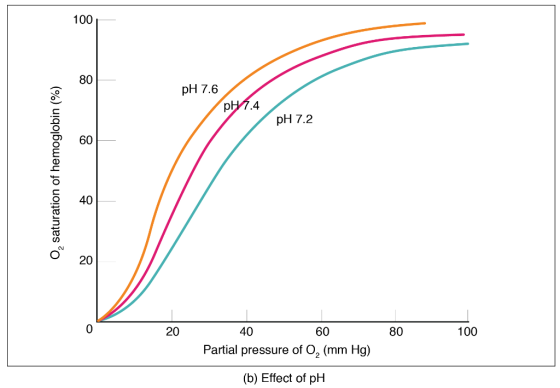
An increase in blood pH will shift the hemoglobin saturation curve to the right / left.
An increase in blood pH will shift the hemoglobin saturation curve to the right / left.
Homework Answers
shift happens to left as shown in figure
pH increase is associated with lowering of CO2 in blood which inturn increases affinity of oxygen to hemoglobin this is called as Bohr effect
Add Answer to:
An increase in blood pH will shift the hemoglobin saturation
curve to the right / left.
Decreased interest rates will shift the aggregate demand curve to the ___and output demanded. left; increase...
 Decreased interest rates will shift the aggregate demand curve to the ___and output demanded. left; increase left; decrease right; decrease right; increase
during exercise body temp will rise and cause a right shift in the o2 dissociation curve...
 during exercise body temp will rise and cause a right shift in the
o2 dissociation curve allowing hemoglobin to:
please answer all
O a. True b. False * Question Completion Status: QUESTION 5 During exercise body temp will rise and cause a right shift in the 02 dissociation curve allowing Hemoglobin to: a. Increase binding affinity for 02 b. Increase O2 uptake from the organs c. Increase O2 release to the active tissue d. Not change its affinity for 02...
during exercise body temp will rise and cause a right shift in the
o2 dissociation curve allowing hemoglobin to:
please answer all
O a. True b. False * Question Completion Status: QUESTION 5 During exercise body temp will rise and cause a right shift in the 02 dissociation curve allowing Hemoglobin to: a. Increase binding affinity for 02 b. Increase O2 uptake from the organs c. Increase O2 release to the active tissue d. Not change its affinity for 02...
9. Below is the saturation curve for hemoglobin. Each large cube represents one molecule of hemoglobin....
 9. Below is the saturation curve for hemoglobin. Each large cube represents one molecule of hemoglobin. Label the corresponding amount of oxygen that is bound to hemoglobin for 25% and 75% saturated. (10) 1989 Percent saturation (50,%) 26.8 80 40 120 Oxygen partial pressure (pO2, mmHg)
% Hb saturation % Hb saturation P Effect of pH Effect of temperature The above illustrations...
 % Hb saturation % Hb saturation P Effect of pH Effect of temperature The above illustrations represent the influence of pH and temperature on the saturation of hemoglobin. Which of the following would be correct concerning the above diagrams? Г Hemoglobin would tend to release the oxygen as the pH increases. A fever would encourage hemoglobin to release oxygen As the body temperature declines the release of oxygen from hemoglobin declines. Oxygen release from hemoglobin is not influenced by changes...
In plain language, describe what the oxygen-hemoglobin dissociation curve shows. Under normal conditions, the curve can...
 In plain language, describe what the oxygen-hemoglobin
dissociation curve shows. Under normal conditions, the curve can
shift to the right and left. A right shift can be induced by
increased temperature and lower pH among other things. Describe
what a right shift means in terms of hemoglobin’s relationship to
oxygen. In your answer, be sure you address what is actually
happening at the level of the protein (hemoglobin is a protein).
Discuss what types of molecular interactions that can cause...
In plain language, describe what the oxygen-hemoglobin
dissociation curve shows. Under normal conditions, the curve can
shift to the right and left. A right shift can be induced by
increased temperature and lower pH among other things. Describe
what a right shift means in terms of hemoglobin’s relationship to
oxygen. In your answer, be sure you address what is actually
happening at the level of the protein (hemoglobin is a protein).
Discuss what types of molecular interactions that can cause...
If both the supply and demand curve shift to the left the prices will increase and...
If both the supply and demand curve shift to the left the prices will increase and quantity demanded go down?
A. . Hyperpnea would result in ___________________________ within the blood. an increase in both Pressure (oxygen)...
A. . Hyperpnea would result in ___________________________ within the blood. an increase in both Pressure (oxygen) and Pressure (carbon dioxide) 2. Decreased Pressure (carbon dioxide) results in an increase in blood pH levels. Both of these conditions result in a shift of the oxygen-hemoglobin dissociation curve to the ______________________. This shift _______________ hemoglobin’s affinity for oxygen. select 3. Increased levels of 2,3 BPG occur in response to decreased blood pH levels. With all other variables unchanged, an increased concentration of...
1. Why did the percent saturation of hemoglobin in Sue’s blood decrease (from 97% to 90%)...
1. Why did the percent saturation of hemoglobin in Sue’s blood decrease (from 97% to 90%) when she exercised? How did the decrease in percent saturation affect Sue’s exercise tolerance?
Which of the following would shift the aggregate demand curve to the left? A. an increase...
Which of the following would shift the aggregate demand curve to the left? A. an increase in the money supply B. an increase in the price level C. an expected decrease in future income D. a cut in federal income taxes
The supply curve for labor may shift to the left due to A. an increase in...
The supply curve for labor may shift to the left due to A. an increase in wealth. B. an increase in the wage rate due to the income effect. C. a decrease in the wage rate due to the income effect. D. an increase in the wage rate due to the substitution effect. E. a decrease in the wage rate due to the substitution effect.
 Decreased interest rates will shift the aggregate demand curve to the ___and output demanded. left; increase left; decrease right; decrease right; increase
 during exercise body temp will rise and cause a right shift in the
o2 dissociation curve allowing hemoglobin to:
please answer all
O a. True b. False * Question Completion Status: QUESTION 5 During exercise body temp will rise and cause a right shift in the 02 dissociation curve allowing Hemoglobin to: a. Increase binding affinity for 02 b. Increase O2 uptake from the organs c. Increase O2 release to the active tissue d. Not change its affinity for 02...
during exercise body temp will rise and cause a right shift in the
o2 dissociation curve allowing hemoglobin to:
please answer all
O a. True b. False * Question Completion Status: QUESTION 5 During exercise body temp will rise and cause a right shift in the 02 dissociation curve allowing Hemoglobin to: a. Increase binding affinity for 02 b. Increase O2 uptake from the organs c. Increase O2 release to the active tissue d. Not change its affinity for 02...
 9. Below is the saturation curve for hemoglobin. Each large cube represents one molecule of hemoglobin. Label the corresponding amount of oxygen that is bound to hemoglobin for 25% and 75% saturated. (10) 1989 Percent saturation (50,%) 26.8 80 40 120 Oxygen partial pressure (pO2, mmHg)
 % Hb saturation % Hb saturation P Effect of pH Effect of temperature The above illustrations represent the influence of pH and temperature on the saturation of hemoglobin. Which of the following would be correct concerning the above diagrams? Г Hemoglobin would tend to release the oxygen as the pH increases. A fever would encourage hemoglobin to release oxygen As the body temperature declines the release of oxygen from hemoglobin declines. Oxygen release from hemoglobin is not influenced by changes...
 In plain language, describe what the oxygen-hemoglobin
dissociation curve shows. Under normal conditions, the curve can
shift to the right and left. A right shift can be induced by
increased temperature and lower pH among other things. Describe
what a right shift means in terms of hemoglobin’s relationship to
oxygen. In your answer, be sure you address what is actually
happening at the level of the protein (hemoglobin is a protein).
Discuss what types of molecular interactions that can cause...
In plain language, describe what the oxygen-hemoglobin
dissociation curve shows. Under normal conditions, the curve can
shift to the right and left. A right shift can be induced by
increased temperature and lower pH among other things. Describe
what a right shift means in terms of hemoglobin’s relationship to
oxygen. In your answer, be sure you address what is actually
happening at the level of the protein (hemoglobin is a protein).
Discuss what types of molecular interactions that can cause...
Most questions answered within 3 hours.
-
Where is the error in this code sequence?
String s1 = "Hello";
String s2 = "ello";...
asked 10 months ago -
Financial data for Joel de Paris, Inc., for last year
follow:
Joel de Paris, Inc.
Balance...
asked 10 months ago -
Consider this reaction:
Al2(SO4)3 (aq)+ BaCl3
(aq) Al2Cl6 (aq)- +
3BaSO4(s) . What is the...
asked 10 months ago -
Suppose that Savneet is considering increasing her
recent random sample from 20 car rentals to 40...
asked 10 months ago -
Trucks arrive at an unloading terminal at an average rate of 120
per hour.
Trucks arrive...
asked 10 months ago -
Why are methanol and ethanol completely soluble in water while
octanol is not very little soluble....
asked 10 months ago -
A facilities manager at a university reads in a research report
that the mean amount of...
asked 10 months ago -
When the CuSO4 is rehydrated by adding water to the anhydrous
compound, is this an endothermic...
asked 10 months ago -
A ray of sunlight is passing from diamond into crown glass; the
angle of incidence is...
asked 10 months ago -
A block of mass 0.249 kg is placed on top of a light, vertical
spring of...
asked 10 months ago -
how do the kidneys compensate in the presences of acidosis
a) trigger hyperventilate
b) reserve acid...
asked 10 months ago -
Question 501 pts
The rental rate of capital to the firm increases. Which of the
following...
asked 10 months ago