A. Derive the conditions for a free-entry equilibrium. B. Show, by means of a numerical example,...
A. Derive the conditions for a free-entry equilibrium.
B. Show, by means of a numerical example, that there can be more than one equilibrium, with different numbers of large and small firms.
Homework Answers


Add Answer to:
A. Derive the conditions for a free-entry equilibrium.
B. Show, by means of a numerical example,...
Consider an industry with a homogeneous product where firms set output (or capacity) levels and price...
Consider an industry with a homogeneous product where firms set output (or capacity) levels and price is determinied by total output (or capacity). Suppose there is a large number of potential entrants and that each firm can choose one of two possible technologies, with cost functions Ci = Fi = ciqi (i = 1,2). A. Derive the conditions for a free-entry equilibrium. B. Show, by means of a numerical example, that there can be more than one equilibrium, with different...
a) Using a numerical example, show how inflation can be measured. (5 marks) b) Outline how...
a) Using a numerical example, show how inflation can be measured. (5 marks) b) Outline how deflation can be a worse off situation than inflation. (5 marks) c) With the aid of diagrams, explain the relationship between inflation and unemployment. (10 marks) d) Discuss the impact of inflation.
5. Explain the difference between a Nash equilibrium and a dominant strategies equilibrium. Give an example...
 5. Explain the difference between a Nash equilibrium and a dominant strategies equilibrium. Give an example to show how the prisoners' dilemma helps to explain behaviour. 6. Why might a firm set prices based on a markup above average cost rather than equalising marginal costs and marginal benefits? 7. Using a diagram, explain how an external cost of production (i.e. a negative production externality) can be internalised with a tax. |8. Explain the conditions of price discrimination. Give two examples...
Please help me with those questions Corporate Strategy/ Exploring Strategy: Read the text and answer the...
Please help me with those questions Corporate Strategy/ Exploring Strategy: Read the text and answer the questions below. Are large firms better innovators than small firms? The famous Austrian economist Joseph Schumpeter proposed that large firms are proportionately more innovative than small firms. This proposition is a controversial one. If true, it would discourage laboratory scientists and engineers from leaving their large-firm employers to set up their own ventures. It would encourage large firms like Google to keep on buying...
A. (4 pts) Draw the Free-Body Diagram and derive the full non-linear Equation of b. (4 pts) Deter...
 We were unable to transcribe this imagea. (4 pts) Draw the Free-Body Diagram and derive the full non-linear Equation of b. (4 pts) Determine the equilibrium position (s) c. (4 pts)Determine if the equilibrium position(s) are stable or unstable (show your Motion mathematical calculations). d. (4 pts)Write an algorithm (a function) in MATLAB called x_dot that returns the time derivative of the states given the current state (the response to this question is the code that you wrote) Simulate the...
Evaluation: Estimate the Difference of the Means of Two Normal Random Variables Each numerical entry must...
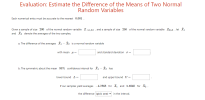 Evaluation: Estimate the Difference of the Means of Two Normal Random Variables Each numerical entry must be accurate to the nearest 0.001 . Given a sample of size 200 of the normal random variable Z_5.1,3.8 , and a sample of size 250 of the normal random variable 26,5.8 , let X1 and X, denote the averages of the two samples. a. The difference of the averages Xi - X2 is a normal random variable with mean = and standard deviation...
a) Determine stability conditions of the disease free equilibrium b) Find the eigenvalues for stability for...
 a) Determine stability conditions of the disease free
equilibrium
b) Find the eigenvalues for stability for the endemic
equilibrium
c) Determine stability conditions for the endemic
equilibrium
d) Explore the sensitivity of the basic reproductive number to
β, γ, and v
e) Explore the sensitivity of the Endemic I* to β, γ, and v
Given parameter values β=.05, γ=.03, v=.1, μ=0.002
f) Calculate the sensitivity of R0 (the basic reproductive
number) to each parameter, and interpret their relative sensitivity
biologically....
a) Determine stability conditions of the disease free
equilibrium
b) Find the eigenvalues for stability for the endemic
equilibrium
c) Determine stability conditions for the endemic
equilibrium
d) Explore the sensitivity of the basic reproductive number to
β, γ, and v
e) Explore the sensitivity of the Endemic I* to β, γ, and v
Given parameter values β=.05, γ=.03, v=.1, μ=0.002
f) Calculate the sensitivity of R0 (the basic reproductive
number) to each parameter, and interpret their relative sensitivity
biologically....
Please help me with those questions Corporate Strategy/ Exploring Strategy: Read the text and answer the...
Please help me with those questions Corporate Strategy/ Exploring Strategy: Read the text and answer the questions below. Are large firms better innovators than small firms? The famous Austrian economist Joseph Schumpeter proposed that large firms are proportionately more innovative than small firms. This proposition is a controversial one. If true, it would discourage laboratory scientists and engineers from leaving their large-firm employers to set up their own ventures. It would encourage large firms like Google to keep on buying...
Suppose that there are no variable costs. Think about what this means. Marginal cost is the...
Suppose that there are no variable costs. Think about what this means. Marginal cost is the additional cost of producing one more unit of a good. 1) If there are only fixed costs, then what is the additional cost of producing an additional unit? 2) If a monopolist is running a business with only fixed costs what is the price elasticity of demand at the profit-maximizing level of output? 3) show that all monopolists facing positive marginal cost produce where...
Suppose that there are no variable costs. Think about what this means. Marginal cost is the...
Suppose that there are no variable costs. Think about what this means. Marginal cost is the additional cost of producing one more unit of a good. 1) If there are only fixed costs, then what is the additional cost of producing an additional unit? 2) If a monopolist is running a business with only fixed costs what is price elasticity of demand at the profit maximizing level of output? 3) show that all monopolists facing positive marginal cost produce where...
 5. Explain the difference between a Nash equilibrium and a dominant strategies equilibrium. Give an example to show how the prisoners' dilemma helps to explain behaviour. 6. Why might a firm set prices based on a markup above average cost rather than equalising marginal costs and marginal benefits? 7. Using a diagram, explain how an external cost of production (i.e. a negative production externality) can be internalised with a tax. |8. Explain the conditions of price discrimination. Give two examples...
 We were unable to transcribe this imagea. (4 pts) Draw the Free-Body Diagram and derive the full non-linear Equation of b. (4 pts) Determine the equilibrium position (s) c. (4 pts)Determine if the equilibrium position(s) are stable or unstable (show your Motion mathematical calculations). d. (4 pts)Write an algorithm (a function) in MATLAB called x_dot that returns the time derivative of the states given the current state (the response to this question is the code that you wrote) Simulate the...
 Evaluation: Estimate the Difference of the Means of Two Normal Random Variables Each numerical entry must be accurate to the nearest 0.001 . Given a sample of size 200 of the normal random variable Z_5.1,3.8 , and a sample of size 250 of the normal random variable 26,5.8 , let X1 and X, denote the averages of the two samples. a. The difference of the averages Xi - X2 is a normal random variable with mean = and standard deviation...
 a) Determine stability conditions of the disease free
equilibrium
b) Find the eigenvalues for stability for the endemic
equilibrium
c) Determine stability conditions for the endemic
equilibrium
d) Explore the sensitivity of the basic reproductive number to
β, γ, and v
e) Explore the sensitivity of the Endemic I* to β, γ, and v
Given parameter values β=.05, γ=.03, v=.1, μ=0.002
f) Calculate the sensitivity of R0 (the basic reproductive
number) to each parameter, and interpret their relative sensitivity
biologically....
a) Determine stability conditions of the disease free
equilibrium
b) Find the eigenvalues for stability for the endemic
equilibrium
c) Determine stability conditions for the endemic
equilibrium
d) Explore the sensitivity of the basic reproductive number to
β, γ, and v
e) Explore the sensitivity of the Endemic I* to β, γ, and v
Given parameter values β=.05, γ=.03, v=.1, μ=0.002
f) Calculate the sensitivity of R0 (the basic reproductive
number) to each parameter, and interpret their relative sensitivity
biologically....
Most questions answered within 3 hours.
-
Where is the error in this code sequence?
String s1 = "Hello";
String s2 = "ello";...
asked 10 months ago -
Financial data for Joel de Paris, Inc., for last year
follow:
Joel de Paris, Inc.
Balance...
asked 10 months ago -
Consider this reaction:
Al2(SO4)3 (aq)+ BaCl3
(aq) Al2Cl6 (aq)- +
3BaSO4(s) . What is the...
asked 10 months ago -
Suppose that Savneet is considering increasing her
recent random sample from 20 car rentals to 40...
asked 10 months ago -
Trucks arrive at an unloading terminal at an average rate of 120
per hour.
Trucks arrive...
asked 10 months ago -
Why are methanol and ethanol completely soluble in water while
octanol is not very little soluble....
asked 10 months ago -
A facilities manager at a university reads in a research report
that the mean amount of...
asked 10 months ago -
When the CuSO4 is rehydrated by adding water to the anhydrous
compound, is this an endothermic...
asked 10 months ago -
A ray of sunlight is passing from diamond into crown glass; the
angle of incidence is...
asked 10 months ago -
A block of mass 0.249 kg is placed on top of a light, vertical
spring of...
asked 10 months ago -
how do the kidneys compensate in the presences of acidosis
a) trigger hyperventilate
b) reserve acid...
asked 10 months ago -
Question 501 pts
The rental rate of capital to the firm increases. Which of the
following...
asked 10 months ago