You download a small HTML file that references 8 small objects (that is, ignore transmission times)....
You download a small HTML file that references 8 small objects (that is, ignore transmission times). All these 8 objects reside on the same server. One RTT is 300 ms. How much time does it take to download all 9 objects using persistent HTTP connection? Assume no pipelining. Give answer in seconds to one decimal digit.
Homework Answers
Persistent connection does not require connection setup again and again. Multiple objects can use same connection.
1 RTT = 300 ms
2RTT is the initial required one for TCP connection and one for
HTML base file.
And for 8 objects it requires -> 8 RTT
Total time = 2 RTT + 8 RTT = 10 RTT
Total time = 10 *300 = 3000 ms = 3.0 seconds
Add Answer to:
You download a small HTML file that references 8 small objects
(that is, ignore transmission times)....
You download a small HTML file that references 8 small objects (that is, ignore transmission times)....
You download a small HTML file that references 8 small objects (that is, ignore transmission times). All these 8 objects reside on the same server. One RTT is 300 ms. How much time does it take to download all 9 objects using nonpersistent but concurrent (max 6) HTTP connections? Give answer in seconds to one decimal digit.
A webpage has 4 objects. The size of the webpage excluding the objects is 10,000 Bytes....
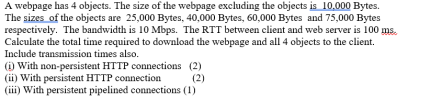 A webpage has 4 objects. The size of the webpage excluding the objects is 10,000 Bytes. The sizes of the objects are 25,000 Bytes, 40,000 Bytes, 60,000 Bytes and 75,000 Bytes respectively. The bandwidth is 10 Mbps. The RTT between client and web server is 100 ms. Calculate the total time required to download the webpage and all 4 objects to the client. Include transmission times also. (i) With non-persistent HTTP connections (ii) With persistent HTTP connection (iii) With persistent...
I just need a walk through for d and e for problem 8 please. Thanks! 8....
I just need a walk through for d and e for problem 8 please. Thanks! 8. Referring to problem P7, suppose the HTML file refernces eight very small objects on the same server. Neglecting transmission times, how much time elapses with a. Non-persistent HTTP with no parallel TCP connections? b. Non-persistent HTTP with the browser configured for 5 parallel connects? c. Persistent HTTP? In 8C, please consider both persistent HTTP with and without pipelining; D. redo a. and c. assuming...
1. Suppose within your web browser you click on a link to obtain a Web page....
 1. Suppose within your web browser you click on a link to obtain a Web page. The Web page associated with the link is an HTML file of very small size, but containing references to eight other objects. Each of these eight objects is also of very small size. Five of the eight embedded objects are on the same server as the base object (Server 1) while the remaining three are on a different server (Server 2). The round-trip time...
Problem # 1 (30 points): Suppose within your Web browser you click on a link to...
 Problem # 1 (30 points): Suppose within your Web browser you click on a link to obtain a web page Suppose that the IP address for the associated URL is not cached in your local host, so that a DNS look- up is necessary to obtain the IP address. Suppose that two (2) DNS servers are visited before your host receives the IP address from DNS; the successive visits incur an RTT of RTT1 and RTT2. Further suppose that the...
Please Help! thanks in advance 1. Suppose within your Web browser you click on a link...
Please Help! thanks in advance 1. Suppose within your Web browser you click on a link to obtain a Web page. The IP address for the associated URL is not cached in your local host, so a DNS lookup is necessary to obtain the IP address. Suppose that n DNS servers are visited before your host receives the IP address from DNS; the successive visits incur a RTT (round-trip time) of RTT1, … , and RTTn. Further suppose that the...
Suppose within your web browser you click on a link to obtain a web page. The...
Suppose within your web browser you click on a link to obtain a web page. The IP address for the associated URL is not cached in your local host, so a DNS look up is necessary to obtain the given IP address. Further suppose that 3 DNS servers are visited before your host receives the IP address form DNS. The round trip time between the client and the ithDNS server is Ti(1≤i≤3), and that between the jthDNS server and the...
1. A user in Chicago, connected to the internet via a 100 Mb/s (b=bits) connection retrieves...
1. A user in Chicago, connected to the internet via a 100 Mb/s (b=bits) connection retrieves a 250 KB (B=bytes) web page from a server in London, where the page references three images of 500 KB each. Assume that the one-way propagation delay is 75 ms. a- Approximately how long does it take for the page (including images) to appear on the user’s screen, assuming non-persistent HTTP using a single connection at a time b- How long does it take...
on calculations can i see how did the expect come to the solution ,all the workout...
on calculations can i see how did the expect come to the solution ,all the workout should be included QUESTION 1 A file of size F = 8 Gbits needs to be distributed to10 peers. Suppose the server has an upload rate of u = 68 Mbps, and that the 10 peers have upload rates of: u1 = 20 Mbps, u2 = 22 Mbps, u3 = 12 Mbps, u4 = 19 Mbps, u5 = 25 Mbps, u6 = 24 Mbps,...
Please Answer all Questions on Networks, They all involve calculation ( 1-9 Questions) "A single router...
Please Answer all Questions on Networks, They all involve calculation ( 1-9 Questions) "A single router is transmitting packets, each of length L bits, over a single link with transmission rate R Mbps to another router at the other end of the link. Suppose that the packet length is L= 12000 bits, and that the link transmission rate along the link to router on the right is R = 1000 Mbps. What is the maximum number of packets per second...
 A webpage has 4 objects. The size of the webpage excluding the objects is 10,000 Bytes. The sizes of the objects are 25,000 Bytes, 40,000 Bytes, 60,000 Bytes and 75,000 Bytes respectively. The bandwidth is 10 Mbps. The RTT between client and web server is 100 ms. Calculate the total time required to download the webpage and all 4 objects to the client. Include transmission times also. (i) With non-persistent HTTP connections (ii) With persistent HTTP connection (iii) With persistent...
 1. Suppose within your web browser you click on a link to obtain a Web page. The Web page associated with the link is an HTML file of very small size, but containing references to eight other objects. Each of these eight objects is also of very small size. Five of the eight embedded objects are on the same server as the base object (Server 1) while the remaining three are on a different server (Server 2). The round-trip time...
 Problem # 1 (30 points): Suppose within your Web browser you click on a link to obtain a web page Suppose that the IP address for the associated URL is not cached in your local host, so that a DNS look- up is necessary to obtain the IP address. Suppose that two (2) DNS servers are visited before your host receives the IP address from DNS; the successive visits incur an RTT of RTT1 and RTT2. Further suppose that the...
Most questions answered within 3 hours.
-
Where is the error in this code sequence?
String s1 = "Hello";
String s2 = "ello";...
asked 10 months ago -
Financial data for Joel de Paris, Inc., for last year
follow:
Joel de Paris, Inc.
Balance...
asked 10 months ago -
Consider this reaction:
Al2(SO4)3 (aq)+ BaCl3
(aq) Al2Cl6 (aq)- +
3BaSO4(s) . What is the...
asked 10 months ago -
Suppose that Savneet is considering increasing her
recent random sample from 20 car rentals to 40...
asked 10 months ago -
Trucks arrive at an unloading terminal at an average rate of 120
per hour.
Trucks arrive...
asked 10 months ago -
Why are methanol and ethanol completely soluble in water while
octanol is not very little soluble....
asked 10 months ago -
A facilities manager at a university reads in a research report
that the mean amount of...
asked 10 months ago -
When the CuSO4 is rehydrated by adding water to the anhydrous
compound, is this an endothermic...
asked 10 months ago -
A ray of sunlight is passing from diamond into crown glass; the
angle of incidence is...
asked 10 months ago -
A block of mass 0.249 kg is placed on top of a light, vertical
spring of...
asked 10 months ago -
how do the kidneys compensate in the presences of acidosis
a) trigger hyperventilate
b) reserve acid...
asked 10 months ago -
Question 501 pts
The rental rate of capital to the firm increases. Which of the
following...
asked 10 months ago