Treasury bills and Treasury notes are an investment security issued by the U.S. government. A Treasury...
Treasury bills and Treasury notes are an investment security issued by the U.S. government. A Treasury bill matures within one year and investors typically roll over the matured Treasury bill and purchase another Treasury bill the same day. Treasury notes have maturities of up to 10 years.
You are considering investing $50,000 in a Treasury bill that you will renew every 6 months or invest in a Treasury note that you will hold until maturity. Your investment time frame is 9 years.
Current investment opportunity interest rates are 5% and are expected to increase to 7% in 6 months. Would you invest in the Treasury bill that you can rollover every 6 months and reinvest or leave your money in the Treasury note that will mature in 9 years? Discuss your reasoning.
Homework Answers

Add Answer to:
Treasury bills and Treasury notes are an investment security
issued by the U.S. government. A Treasury...
Annuities and Loans Treasury bills and Treasury notes are an investment security issued by the U.S....
 Annuities and Loans Treasury bills and Treasury notes are an investment security issued by the U.S. government. A Treasury bill matures within one year and investors typically roll over the matured Treasury bill and purchase another Treasury bill the same day. Treasury notes have maturities of up to 10 years. You are considering investing $50,000 in a Treasury bill that you will renew every 6 months or invest in a Treasury note that you will hold until maturity. Your investment...
You observe the following Treasury bills and bond prices available in Saudi Arabia Bond/Bill
.1. You observe the following Treasury bills and bond prices available in Saudi Arabia Bond/Bill Bond/Bill principalTime to maturityAnnual couponBond price1000.25099.21000.50098.31000.75097.210016.2 (Quarterly payments)1021001.256.6 (Quarterly Payments)102.5a) Calculate continuously compounded zero rates for maturities of 3 months, 6 months, 9 months, 12 months and 15 months. b) Calculate the par yield for the following bonds: I. A 12-month bond that pays coupons semiannually. II. A 12-month bond that pays coupons quarterly. c) What is the continuously compounded yield on the coupon-paying bonds, which mature in 1 and...
Treasury securities are issued and backed by the U.S. government and, therefore, are considered to be...
 Treasury securities are issued and backed by the U.S. government and, therefore, are considered to be the lowest- risk securities on the market. As an investor looking for protection against inflation, you are considering the purchase of inflation-adjusted bonds known as U.S. Treasury Inflation-Protected Securities (TIPS). With these securities, the face value (which is paid at maturity) is regularly adjusted to account for inflation; however, the semiannual interest payment (called the bond dividend) remains the same. You purchased a 10-year...
1. The interest rate on Treasury bills (with short maturities) can be thought of as the...
 1. The interest rate on Treasury bills (with short maturities) can be thought of as the opportunity cost of holding (non-interest bearing) money. We think of the money stock as being determined by the Federal Reserve. In the liquidity preference graph, we put the interest rate on the vertical axis and the amount of money supplied and demanded on the horizontal axis. An increase in the money supply a. shifts the demand for money curve to the left, which causes...
3. An individual has $50,000 to invest. The government treasury bills (T-bills) pay 1.5% interest per...
 3. An individual has $50,000 to invest. The government treasury bills (T-bills) pay 1.5% interest per year. She considers investing in the stock parket instead, by buying a stock that now sells for $45 ench and pays an anun dividend of $7/per stock. She thinks that after 6 years the stock will be selling for $55 each. What is the rate of return of the stock investment and is it a better deal than the T-bills?
Suppose that you invest in a two-year Treasury bond with a coupon rate of 6% and...
Suppose that you invest in a two-year Treasury bond with a coupon rate of 6% and $1,000 par. Suppose that you buy this bond at a price of exactly $1,000. You intend to hold this bond to maturity and reinvest the coupons until the bond matures. You expect to reinvest the coupons in an account that pays an APR of 2.83%, with semi-annual compounding. What is the effective annual rate of return on your investment?
Question 2 We have seen in class that Treasury bills are quoted in the market as...
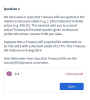 Question 2 We have seen in class that Treasury bills are quoted in the market as discount yields (e.g. 1.33%) instead of in dollar prices (e.g. $99.25). This exercise asks you to convert actual Treasury bill market quotes (given as discount yields) into prices. Assume $100 par value. Suppose that a Treasury bill is quoted for settlement on 10-Feb-2019 with a discount yields of 3.77%. This Treasury bill matures on 6-Aug-2019. Hint: Remember from class that Treasury bills use the...
1. A short-term investment in a U.S. Treasury bill costs $48,800 and will mature six months...
 1. A short-term investment in a U.S. Treasury bill costs $48,800 and will mature six months later at $50,000. Management intends to hold the investment until it matures. The entry to record the initial investment includes a [A] debit to Short-Term Investments for $50,000. [B] debit to Cash for $48,800. [C] credit to Interest Income for $1,200. [D] debit to Short-Term Investments for $48,800. 2. Held-to-maturity securities are valued on the balance sheet at [A] lower of cost or market....
Treasury securities are issued and backed by the U.S. government and, therefore, are considered to be...
Treasury securities are issued and backed by the U.S. government and, therefore, are considered to be the lowest-risk securities on the market. As an investor looking for protection against inflation, you are considering the purchase of inflation-adjusted bonds known as U.S. Treasury Inflation-Protected Securities (TIPS). With these securities, the face value (which is paid at maturity) is regularly adjusted to account for inflation; however, the semiannual interest payment (called the bond dividend) remains the same. You purchased a 10-year $10,000...
Required information Treasury securities are issued and backed by the U.S. government and therefore, are considered...
 Required information Treasury securities are issued and backed by the U.S. government and therefore, are considered to be the lowest-risk securities on the market. As an investor looking for protection against inflation, you are considering the purchase of inflation-adjusted bonds known as U.S. Treasury Inflation Protected Securities (TIPS). With these securities, the face value (which is paid at maturity) is regularly adjusted to account for inflation; however, the semiannual interest payment (called the bond dividend) remains the same. You purchased...
 Annuities and Loans Treasury bills and Treasury notes are an investment security issued by the U.S. government. A Treasury bill matures within one year and investors typically roll over the matured Treasury bill and purchase another Treasury bill the same day. Treasury notes have maturities of up to 10 years. You are considering investing $50,000 in a Treasury bill that you will renew every 6 months or invest in a Treasury note that you will hold until maturity. Your investment...
 Treasury securities are issued and backed by the U.S. government and, therefore, are considered to be the lowest- risk securities on the market. As an investor looking for protection against inflation, you are considering the purchase of inflation-adjusted bonds known as U.S. Treasury Inflation-Protected Securities (TIPS). With these securities, the face value (which is paid at maturity) is regularly adjusted to account for inflation; however, the semiannual interest payment (called the bond dividend) remains the same. You purchased a 10-year...
 1. The interest rate on Treasury bills (with short maturities) can be thought of as the opportunity cost of holding (non-interest bearing) money. We think of the money stock as being determined by the Federal Reserve. In the liquidity preference graph, we put the interest rate on the vertical axis and the amount of money supplied and demanded on the horizontal axis. An increase in the money supply a. shifts the demand for money curve to the left, which causes...
 3. An individual has $50,000 to invest. The government treasury bills (T-bills) pay 1.5% interest per year. She considers investing in the stock parket instead, by buying a stock that now sells for $45 ench and pays an anun dividend of $7/per stock. She thinks that after 6 years the stock will be selling for $55 each. What is the rate of return of the stock investment and is it a better deal than the T-bills?
 Question 2 We have seen in class that Treasury bills are quoted in the market as discount yields (e.g. 1.33%) instead of in dollar prices (e.g. $99.25). This exercise asks you to convert actual Treasury bill market quotes (given as discount yields) into prices. Assume $100 par value. Suppose that a Treasury bill is quoted for settlement on 10-Feb-2019 with a discount yields of 3.77%. This Treasury bill matures on 6-Aug-2019. Hint: Remember from class that Treasury bills use the...
 1. A short-term investment in a U.S. Treasury bill costs $48,800 and will mature six months later at $50,000. Management intends to hold the investment until it matures. The entry to record the initial investment includes a [A] debit to Short-Term Investments for $50,000. [B] debit to Cash for $48,800. [C] credit to Interest Income for $1,200. [D] debit to Short-Term Investments for $48,800. 2. Held-to-maturity securities are valued on the balance sheet at [A] lower of cost or market....
 Required information Treasury securities are issued and backed by the U.S. government and therefore, are considered to be the lowest-risk securities on the market. As an investor looking for protection against inflation, you are considering the purchase of inflation-adjusted bonds known as U.S. Treasury Inflation Protected Securities (TIPS). With these securities, the face value (which is paid at maturity) is regularly adjusted to account for inflation; however, the semiannual interest payment (called the bond dividend) remains the same. You purchased...
Most questions answered within 3 hours.
-
Where is the error in this code sequence?
String s1 = "Hello";
String s2 = "ello";...
asked 10 months ago -
Financial data for Joel de Paris, Inc., for last year
follow:
Joel de Paris, Inc.
Balance...
asked 10 months ago -
Consider this reaction:
Al2(SO4)3 (aq)+ BaCl3
(aq) Al2Cl6 (aq)- +
3BaSO4(s) . What is the...
asked 10 months ago -
Suppose that Savneet is considering increasing her
recent random sample from 20 car rentals to 40...
asked 10 months ago -
Trucks arrive at an unloading terminal at an average rate of 120
per hour.
Trucks arrive...
asked 10 months ago -
Why are methanol and ethanol completely soluble in water while
octanol is not very little soluble....
asked 10 months ago -
A facilities manager at a university reads in a research report
that the mean amount of...
asked 10 months ago -
When the CuSO4 is rehydrated by adding water to the anhydrous
compound, is this an endothermic...
asked 10 months ago -
A ray of sunlight is passing from diamond into crown glass; the
angle of incidence is...
asked 10 months ago -
A block of mass 0.249 kg is placed on top of a light, vertical
spring of...
asked 10 months ago -
how do the kidneys compensate in the presences of acidosis
a) trigger hyperventilate
b) reserve acid...
asked 10 months ago -
Question 501 pts
The rental rate of capital to the firm increases. Which of the
following...
asked 10 months ago