A roller coaster car travels around a vertical loop. At the top of the loop, where...
A roller coaster car travels around a vertical loop. At the top of the loop, where it is upside down, it is moving at a speed of 10 m/s. Given that the loop has a radius of 8.0 m,
a) What is the value of the car’s centripetal acceleration at that instant in time?
b) A 55 kg passenger is in the car. Draw a free‐body diagram showing all the forces acting on the passenger.
c) What is the magnitude of the normal force of the car acting on the passenger?
Homework Answers
a) centripetal acceleration = v^2/r
centripetal acceleration = 10^2/8
centripetal acceleration = 12.5 m/s^2
b)
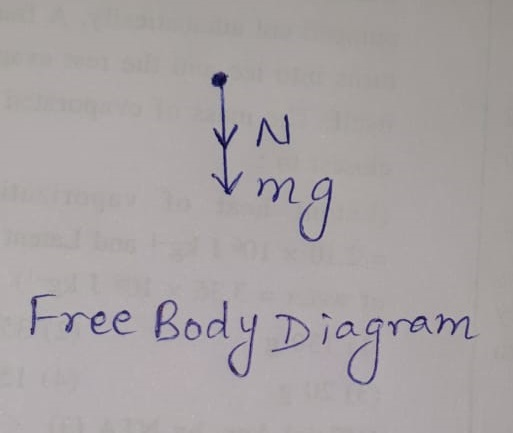
c) magnitude of normal force
magnitude of normal force = mv^2/r - mg
magnitude of normal force = 55 * (12.5 - 9.8)
magnitude of normal force = 149 N
the magnitude of normal force is 149 N
Add Answer to:
A roller coaster car travels around a vertical loop. At the top
of the loop, where...
Can u answer this in details please, thank u! A 2000 kg roller coaster car travels...
Can u answer this in details please, thank u! A 2000 kg roller coaster car travels at a constant 20 m/s speed around a vertical circular track with a 10 meter radius of curvature: A. Draw a free-body diagram of the car at the top of the loop. B. Calculate the normal force on the car at the top of the loop. C. Where along the loop would the normal force be largest on this car?
A car in an amusement park roller coaster ride rolls without friction at the top of...
A car in an amusement park roller coaster ride rolls without friction at the top of a hill. The car begins at a height h from the top of a hill. A the bottom, the car then goes through a vertical loop where the car is upside down at the loop\'s top. If the radius of the loop is 20.0m, what is the minimum height h such that the car moves around the loop without falling off the track at...
A roller-coaster car shown in the figure on the right is released from rest from a...
A roller-coaster car shown in the figure on the right is released from rest from a height h and then moves freely with negligible friction. The roller-coaster track includes a circular loop of radius R in a vertical plane. a. First suppose the car barely makes it around the loop; at the top of the loop, the riders are upside down and feel weightless. Find the required height h of the release point above the bottom of the loop in...
3. A frictionless roller-coaster goes around a circular loop of radius 11 m. It enters the...
 3. A frictionless roller-coaster goes around a circular loop of radius 11 m. It enters the bottom of the loop going 32 m/s. Find the speed of the roller-coaster when it gets to the top of the loop 4. For the loop in the previous problem find the velocity of the roller-coaster as a function of height off the ground. Use that to find the centripetal acceleration as a function of height. Plot the centripetal acceleration as a function of...
What is the speed, in m/s, of the roller coaster at the top of the loop if the radius of curvature there is 20.0 m and the downward acceleration of the car is 1.50 g?
 Modern roller coasters have vertical loops like the one shown in the figure below. The radius of curvature is smaller at the top than on the sides so that the downward centripetal acceleration at the top will be greater than the acceleration due to gravity, keeping the passengers pressed firmly into their seats. What is the speed, in m/s, of the roller coaster at the top of the loop if the radius of curvature there is 20.0 m and the downward...
4. A roller coaster executes a 10 m radius loop-the-loop at a speed of 20 m/s....
4. A roller coaster executes a 10 m radius loop-the-loop at a speed of 20 m/s. How heavy does a 50-kg passenger feel at the top of the loop? (Hint: draw a free body diagram. The apparent weight of the passenger is the normal force on the passenger).
At an amusement park, a car of mass m rolls without friction around a track as...
At an amusement park, a car of mass m rolls without friction around a track as shown. The car starts from rest at point A, a height h = 3R above the bottom of the loop (R is the radius of the loop). Treat the car as a point-like particle. (a) Draw the free body diagram for the car and find the car’s kinetic energy and normal force acting on the car at the top of the loop (point B)....
6. Kingda Ka Roller Coaster (30 points) a) (6 pts) Ignoring friction, sketch a diagram showing...
 6. Kingda Ka Roller Coaster (30 points) a) (6 pts) Ignoring friction, sketch a diagram showing the centripetal, gravitational, and normal forces acting of the passenger train of the Kingda Ka roller coaster as it rounds the bottom of the “Big Dip.” Draw each force with its correct direction. Draw the largest force as the longest vector, and the smallest force as the shortest vector.d) (6 pts) Ignoring friction, sketch a diagram showing the centripetal, gravitational, and normal forces acting of...
A roller coaster car of mass 800 kg when released from rest at point A (height...
 A roller coaster car of mass 800 kg when released from rest at
point A (height h above the ground) slides along the track and
inside the loop of radius 16.0 m. The car never loses contact with
the track.
A) Draw below a free body diagram for the car the car at the top
of the loop.
B) If the normal force acting on the car at the top is 1500 N,
what is the speed of the car...
A roller coaster car of mass 800 kg when released from rest at
point A (height h above the ground) slides along the track and
inside the loop of radius 16.0 m. The car never loses contact with
the track.
A) Draw below a free body diagram for the car the car at the top
of the loop.
B) If the normal force acting on the car at the top is 1500 N,
what is the speed of the car...
A roller coaster car of mass 800 kg when released from rest at point A (height...
 A roller coaster car of mass 800 kg when released from rest at
point A (height h above the ground) slides along the track and
inside the loop of radius 16.0 m. The car never loses contact with
the track.
A) Draw below a free body diagram for the car the car at the top
of the loop.
B) If the normal force acting on the car at the top is 1500 N,
what is the speed of the car...
A roller coaster car of mass 800 kg when released from rest at
point A (height h above the ground) slides along the track and
inside the loop of radius 16.0 m. The car never loses contact with
the track.
A) Draw below a free body diagram for the car the car at the top
of the loop.
B) If the normal force acting on the car at the top is 1500 N,
what is the speed of the car...
 3. A frictionless roller-coaster goes around a circular loop of radius 11 m. It enters the bottom of the loop going 32 m/s. Find the speed of the roller-coaster when it gets to the top of the loop 4. For the loop in the previous problem find the velocity of the roller-coaster as a function of height off the ground. Use that to find the centripetal acceleration as a function of height. Plot the centripetal acceleration as a function of...
 6. Kingda Ka Roller Coaster (30 points) a) (6 pts) Ignoring friction, sketch a diagram showing the centripetal, gravitational, and normal forces acting of the passenger train of the Kingda Ka roller coaster as it rounds the bottom of the “Big Dip.” Draw each force with its correct direction. Draw the largest force as the longest vector, and the smallest force as the shortest vector.d) (6 pts) Ignoring friction, sketch a diagram showing the centripetal, gravitational, and normal forces acting of...
 A roller coaster car of mass 800 kg when released from rest at
point A (height h above the ground) slides along the track and
inside the loop of radius 16.0 m. The car never loses contact with
the track.
A) Draw below a free body diagram for the car the car at the top
of the loop.
B) If the normal force acting on the car at the top is 1500 N,
what is the speed of the car...
A roller coaster car of mass 800 kg when released from rest at
point A (height h above the ground) slides along the track and
inside the loop of radius 16.0 m. The car never loses contact with
the track.
A) Draw below a free body diagram for the car the car at the top
of the loop.
B) If the normal force acting on the car at the top is 1500 N,
what is the speed of the car...
 A roller coaster car of mass 800 kg when released from rest at
point A (height h above the ground) slides along the track and
inside the loop of radius 16.0 m. The car never loses contact with
the track.
A) Draw below a free body diagram for the car the car at the top
of the loop.
B) If the normal force acting on the car at the top is 1500 N,
what is the speed of the car...
A roller coaster car of mass 800 kg when released from rest at
point A (height h above the ground) slides along the track and
inside the loop of radius 16.0 m. The car never loses contact with
the track.
A) Draw below a free body diagram for the car the car at the top
of the loop.
B) If the normal force acting on the car at the top is 1500 N,
what is the speed of the car...
Most questions answered within 3 hours.
-
Where is the error in this code sequence?
String s1 = "Hello";
String s2 = "ello";...
asked 10 months ago -
Financial data for Joel de Paris, Inc., for last year
follow:
Joel de Paris, Inc.
Balance...
asked 10 months ago -
Consider this reaction:
Al2(SO4)3 (aq)+ BaCl3
(aq) Al2Cl6 (aq)- +
3BaSO4(s) . What is the...
asked 10 months ago -
Suppose that Savneet is considering increasing her
recent random sample from 20 car rentals to 40...
asked 10 months ago -
Trucks arrive at an unloading terminal at an average rate of 120
per hour.
Trucks arrive...
asked 10 months ago -
Why are methanol and ethanol completely soluble in water while
octanol is not very little soluble....
asked 10 months ago -
A facilities manager at a university reads in a research report
that the mean amount of...
asked 10 months ago -
When the CuSO4 is rehydrated by adding water to the anhydrous
compound, is this an endothermic...
asked 10 months ago -
A ray of sunlight is passing from diamond into crown glass; the
angle of incidence is...
asked 10 months ago -
A block of mass 0.249 kg is placed on top of a light, vertical
spring of...
asked 10 months ago -
how do the kidneys compensate in the presences of acidosis
a) trigger hyperventilate
b) reserve acid...
asked 10 months ago -
Question 501 pts
The rental rate of capital to the firm increases. Which of the
following...
asked 10 months ago