Is the proportion of people with asthma higher among current smokers compared to non-current smokers? Based...
Is the proportion of people with asthma higher among current
smokers compared to non-current smokers?
Based on that research question, what is the null and alternative
hypothesis.
Homework Answers
let p1 and p2 are proportion of people with asthma among current smokers and non-current smokers .
therefore null hypothesis:Ho: p1 =p2
alternative hypothesis: Ha: p1 >p2
Add Answer to:
Is the proportion of people with asthma higher among current
smokers compared to non-current smokers?
Based...
Is the proportion of people with asthma higher among current smokers compared to non-current smokers? State...
Is the proportion of people with asthma higher among current smokers compared to non-current smokers? State type 1 error in the context of the research question State type 2 error in the context of the research question
4. To test if the proportion of people with insomnia is higher among the users of...
4. To test if the proportion of people with insomnia is higher among the users of a certain antidepressant as compared to such proportion among the people who do not use this treatment, a double blind experiment will be conducted on 1000 subjects randomly divided into groups. a) State the null and the alternative hypotheses. b) What is meant by a double blind study? The following are the results of the study Medication Placebo Insomnia 75 35 No Insomnia 425...
The death rate per 100,000 for lung cancer is 7 among non-smokers and 71 among smokers....
The death rate per 100,000 for lung cancer is 7 among non-smokers and 71 among smokers. The death rate per 100,000 for coronary thrombosis is 422 among non-smokers and 599 among smokers. The prevalence of smoking in the population is 55%. Determine the following: What is the relative risk of dying for a smoker compared to a non-smoker?
The death rate per 100,000 for lung cancer is 7 among non-smokers and 71 among smokers....
The death rate per 100,000 for lung cancer is 7 among non-smokers and 71 among smokers. The death rate per 100,000 for coronary thrombosis is 422 among non-smokers and 599 among smokers. The prevalence of smoking in the population is 55%. 1) What is the relative risk of dying for lung cancer and coronary thrombosis for a smoker compared to a non-smoker? 2) Among smokers, what is the etiologic fraction of lung cancer and coronary thrombosis due to smoking? 3) ...
tudents in A survey is conducted to get an estimate of the proportion of smokers among...
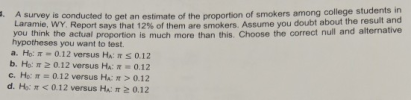 tudents in A survey is conducted to get an estimate of the proportion of smokers among colleges Laramie, WY Report says that 12% of them are smokers. Assume you doubt a you think the actual proportion is much more than this. Choose the correct null and alternative . hypotheses you want to test. a, Ho: π = 0.12 versus HA: π 0.12 b. Ho: TT 2 0.12 versus HA: 0.12 c. Ho: π-0.12 versus HA: π > 0.12 d, Ho:...
The death rate per 100,000 for lung cancer is 7 among non-smokers and 71 among smokers....
The death rate per 100,000 for lung cancer is 7 among non-smokers and 71 among smokers. The death rate per 100,000 for coronary thrombosis is 422 among non-smokers and 599 among smokers. The prevalence of smoking in the population is 55%. Determine the following: a. What is the etiologic fraction of disease due to smoking among individuals with lung cancer? b. What is the etiologic fraction of disease due to smoking among individuals with coronary thrombosis?
The death rate per 100,000 for lung cancer is 7 among non-smokers and 71 among smokers....
The death rate per 100,000 for lung cancer is 7 among non-smokers and 71 among smokers. The death rate per 100,000 for coronary thrombosis is 422 among non-smokers and 599 among smokers. The prevalence of smoking in the population is 55%. Determine the following: a. What is the population etiologic fraction of lung cancer due to smoking? b. What is the population etiologic fraction of coronary thrombosis due to smoking?
Question 7 The chance of having a smoker is 65% compared to non-smokers in n college....
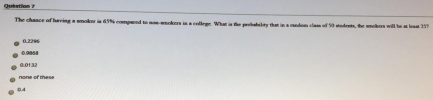 Question 7 The chance of having a smoker is 65% compared to non-smokers in n college. What is the probability that in a random class of 50 students, the smokers will be at least 257 0.2296 0.9868 0.0132 none of these 0.4
The study also provided mortality rates for cardiovascular disease among smokers and non-smokers....
 The study also provided mortality rates for cardiovascular disease among smokers and non-smokers. The following table presents lung cancer mortality data and comparable cardiovascular disease mortality data. Table 2. Mortality rates (per 1,000 person-years), rate ratios, and excess deaths from lung cancer and cardiovascular disease by smoking status, Doll and Hill physician cohort study, Great Britain, 1951-1961. Mortality rate per 1,000 person-years Smokers Non-smokers All Rate ratio Excess deaths Attributable risk per 1,000 person-years smokers 1.23 2.19 percent among 1.30...
A study was conducted to determine the proportion of people who dream in black and white...
A study was conducted to determine the proportion of people who dream in black and white instead of color. Among 315 people over the age of 55, 72 dreamed in black and white and among 302 people under the age of 25, 11 dream in black and white. Use a 0.01 significance level to test the claim that the proportion of people over 55 who dream in black and whit is greater than the proportion for those under 25. 1....
 tudents in A survey is conducted to get an estimate of the proportion of smokers among colleges Laramie, WY Report says that 12% of them are smokers. Assume you doubt a you think the actual proportion is much more than this. Choose the correct null and alternative . hypotheses you want to test. a, Ho: π = 0.12 versus HA: π 0.12 b. Ho: TT 2 0.12 versus HA: 0.12 c. Ho: π-0.12 versus HA: π > 0.12 d, Ho:...
 Question 7 The chance of having a smoker is 65% compared to non-smokers in n college. What is the probability that in a random class of 50 students, the smokers will be at least 257 0.2296 0.9868 0.0132 none of these 0.4
 The study also provided mortality rates for cardiovascular disease among smokers and non-smokers. The following table presents lung cancer mortality data and comparable cardiovascular disease mortality data. Table 2. Mortality rates (per 1,000 person-years), rate ratios, and excess deaths from lung cancer and cardiovascular disease by smoking status, Doll and Hill physician cohort study, Great Britain, 1951-1961. Mortality rate per 1,000 person-years Smokers Non-smokers All Rate ratio Excess deaths Attributable risk per 1,000 person-years smokers 1.23 2.19 percent among 1.30...
Most questions answered within 3 hours.
-
Where is the error in this code sequence?
String s1 = "Hello";
String s2 = "ello";...
asked 11 months ago -
Financial data for Joel de Paris, Inc., for last year
follow:
Joel de Paris, Inc.
Balance...
asked 11 months ago -
Consider this reaction:
Al2(SO4)3 (aq)+ BaCl3
(aq) Al2Cl6 (aq)- +
3BaSO4(s) . What is the...
asked 11 months ago -
Suppose that Savneet is considering increasing her
recent random sample from 20 car rentals to 40...
asked 11 months ago -
Trucks arrive at an unloading terminal at an average rate of 120
per hour.
Trucks arrive...
asked 11 months ago -
Why are methanol and ethanol completely soluble in water while
octanol is not very little soluble....
asked 11 months ago -
A facilities manager at a university reads in a research report
that the mean amount of...
asked 11 months ago -
When the CuSO4 is rehydrated by adding water to the anhydrous
compound, is this an endothermic...
asked 11 months ago -
A ray of sunlight is passing from diamond into crown glass; the
angle of incidence is...
asked 11 months ago -
A block of mass 0.249 kg is placed on top of a light, vertical
spring of...
asked 11 months ago -
how do the kidneys compensate in the presences of acidosis
a) trigger hyperventilate
b) reserve acid...
asked 11 months ago -
Question 501 pts
The rental rate of capital to the firm increases. Which of the
following...
asked 11 months ago