The joint probability density function of X and Y is given by f(x, y) =6/7(x^2+xy/2) for...
The joint probability density function of X and Y is given by f(x, y) =6/7(x^2+xy/2) for 0≤x≤1,0≤y≤2. Verify that this is indeed a joint density function.Compute the density function of X.
Homework Answers


Add Answer to:
The joint probability density function of X and Y is given by
f(x, y) =6/7(x^2+xy/2) for...
The joint probability density function is f(x, y) for 17. Find the mean of X given...
 The joint probability density function is f(x, y) for 17. Find the mean of X given Y = random variables X and Y fax, y) = f(xy *** Q<x<10<x<1 Elsewhere w 14. Random variables X and Y have a density function f(x, y). Find the indicated expected value f(x, y) = 6; (xy+y4) 0<x< 1,0<y<1 0 Elsewhere E(x2y) = 15. The means, standard deviations, and covariance for random variables X, Y, and Z are given below. Lex= 3, uy =...
3. Chapter 6, Problem 9 The joint probability function of X and Y is given by...
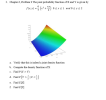 3. Chapter 6, Problem 9 The joint probability function of X and Y is given by f(x,y) =ý (x2 + **) osxs1 and 0 sys2 a. Verify that this is indeed a joint density function b. Compute the density function of X c. Find P(x >Y) d. Find P (Y > 1x <) e. Find E[X] f. Find E[Y]
Find the mean of X given Y = 1/2. The joint probability density function is f(x,...
Find the mean of X given Y = 1/2. The joint probability density function is f(x, y) for random variables X and Y. f(x, y) = { (12/7)(xy + y^2) 0 < x < 1, 0 < y < 1 0 elsewhere
the joint probability density function is given by 1. The joint probability density function (pdf) of...
 the joint probability density
function is given by
1. The joint probability density function (pdf) of X and Y is given by fxy(x,y) = A (1 – xey, 0<x<1,0 < y < 0 (a) Find the constant A. (b) Find the marginal pdfs of X and Y. (c) Find E(X) and E(Y). (d) Find E(XY).
the joint probability density
function is given by
1. The joint probability density function (pdf) of X and Y is given by fxy(x,y) = A (1 – xey, 0<x<1,0 < y < 0 (a) Find the constant A. (b) Find the marginal pdfs of X and Y. (c) Find E(X) and E(Y). (d) Find E(XY).
The joint probability density function of random variables X and Y is given by f(x,y) ={10xy^2...
The joint probability density function of random variables X and Y is given by f(x,y) ={10xy^2 0≤x≤y≤1,0 otherwise. (a) Compute the conditional probability fX|Y(x|y). (b) Compute E(Y) and P(Y >1/2). (c) Let W=X/Y. Compute the density function of W. (d) Are X and Y independent? Justify briefly.
Given the joint probability density function f(x ,y )=k (xy+ 1) for 0<x <1--and--0<y<1 , find...
Given the joint probability density function f(x ,y )=k (xy+ 1) for 0<x <1--and--0<y<1 , find the correlation- r (X,Y) .
Suppose a joint probability density function for two variables X and Y is given as follows:...
 Suppose a joint probability density function for two variables X and Y is given as follows: {24x0, if 0 < x < 1,0 < y < 1 f(x, y) = otherwise Please find the probability p (w > 1) =? 3
A joint probability density function is given by f(x,y)-c-x(2-x-y), for 0 < x < 1 and 0 < y < 1. Find the value of c to make this a valid density function. A joint probability densit...
 A joint probability density function is given by f(x,y)-c-x(2-x-y), for 0 < x < 1 and 0 < y < 1. Find the value of c to make this a valid density function.
A joint probability density function is given by f(x,y)-c-x(2-x-y), for 0
A joint probability density function is given by f(x,y)-c-x(2-x-y), for 0 < x < 1 and 0 < y < 1. Find the value of c to make this a valid density function.
A joint probability density function is given by f(x,y)-c-x(2-x-y), for 0
2. Let X and Y be continuous random variables with joint probability density function fx,y(x,y) 0, otherwise (a) Compute the value of k that will make f(x, y) a legitimate joint probability density f...
 2. Let X and Y be continuous random variables with joint probability density function fx,y(x,y) 0, otherwise (a) Compute the value of k that will make f(x, y) a legitimate joint probability density function. Use f(x.y) with that value of k as the joint probability density function of X, Y in parts (b),(c).(d),(e (b) Find the probability density functions of X and Y. (c) Find the expected values of X, Y and XY (d) Compute the covariance Cov(X,Y) of X...
7. Two random variables X and Y have joint probability density function s(x, y) = $(1...
 7. Two random variables X and Y have joint probability density function s(x, y) = $(1 – xy), 0<x< l; 0<y<l. The marginal pdfs for X and Y are respectively S(x) = {(2-x) 0<x< 1; s()= (2-y) 0<y<l. Determine the conditional expectation E(Y|X = x) and hence determine E(Y) [7] (ii) [3] Verify your answer to part (i) by calculating the value of E(Y) directly from the marginal pdf for Y. [Total 10]
 The joint probability density function is f(x, y) for 17. Find the mean of X given Y = random variables X and Y fax, y) = f(xy *** Q<x<10<x<1 Elsewhere w 14. Random variables X and Y have a density function f(x, y). Find the indicated expected value f(x, y) = 6; (xy+y4) 0<x< 1,0<y<1 0 Elsewhere E(x2y) = 15. The means, standard deviations, and covariance for random variables X, Y, and Z are given below. Lex= 3, uy =...
 3. Chapter 6, Problem 9 The joint probability function of X and Y is given by f(x,y) =ý (x2 + **) osxs1 and 0 sys2 a. Verify that this is indeed a joint density function b. Compute the density function of X c. Find P(x >Y) d. Find P (Y > 1x <) e. Find E[X] f. Find E[Y]
 the joint probability density
function is given by
1. The joint probability density function (pdf) of X and Y is given by fxy(x,y) = A (1 – xey, 0<x<1,0 < y < 0 (a) Find the constant A. (b) Find the marginal pdfs of X and Y. (c) Find E(X) and E(Y). (d) Find E(XY).
the joint probability density
function is given by
1. The joint probability density function (pdf) of X and Y is given by fxy(x,y) = A (1 – xey, 0<x<1,0 < y < 0 (a) Find the constant A. (b) Find the marginal pdfs of X and Y. (c) Find E(X) and E(Y). (d) Find E(XY).
 Suppose a joint probability density function for two variables X and Y is given as follows: {24x0, if 0 < x < 1,0 < y < 1 f(x, y) = otherwise Please find the probability p (w > 1) =? 3
 A joint probability density function is given by f(x,y)-c-x(2-x-y), for 0 < x < 1 and 0 < y < 1. Find the value of c to make this a valid density function.
A joint probability density function is given by f(x,y)-c-x(2-x-y), for 0
A joint probability density function is given by f(x,y)-c-x(2-x-y), for 0 < x < 1 and 0 < y < 1. Find the value of c to make this a valid density function.
A joint probability density function is given by f(x,y)-c-x(2-x-y), for 0
 2. Let X and Y be continuous random variables with joint probability density function fx,y(x,y) 0, otherwise (a) Compute the value of k that will make f(x, y) a legitimate joint probability density function. Use f(x.y) with that value of k as the joint probability density function of X, Y in parts (b),(c).(d),(e (b) Find the probability density functions of X and Y. (c) Find the expected values of X, Y and XY (d) Compute the covariance Cov(X,Y) of X...
 7. Two random variables X and Y have joint probability density function s(x, y) = $(1 – xy), 0<x< l; 0<y<l. The marginal pdfs for X and Y are respectively S(x) = {(2-x) 0<x< 1; s()= (2-y) 0<y<l. Determine the conditional expectation E(Y|X = x) and hence determine E(Y) [7] (ii) [3] Verify your answer to part (i) by calculating the value of E(Y) directly from the marginal pdf for Y. [Total 10]
Most questions answered within 3 hours.
-
Where is the error in this code sequence?
String s1 = "Hello";
String s2 = "ello";...
asked 10 months ago -
Financial data for Joel de Paris, Inc., for last year
follow:
Joel de Paris, Inc.
Balance...
asked 10 months ago -
Consider this reaction:
Al2(SO4)3 (aq)+ BaCl3
(aq) Al2Cl6 (aq)- +
3BaSO4(s) . What is the...
asked 10 months ago -
Suppose that Savneet is considering increasing her
recent random sample from 20 car rentals to 40...
asked 10 months ago -
Trucks arrive at an unloading terminal at an average rate of 120
per hour.
Trucks arrive...
asked 10 months ago -
Why are methanol and ethanol completely soluble in water while
octanol is not very little soluble....
asked 10 months ago -
A facilities manager at a university reads in a research report
that the mean amount of...
asked 10 months ago -
When the CuSO4 is rehydrated by adding water to the anhydrous
compound, is this an endothermic...
asked 10 months ago -
A ray of sunlight is passing from diamond into crown glass; the
angle of incidence is...
asked 10 months ago -
A block of mass 0.249 kg is placed on top of a light, vertical
spring of...
asked 10 months ago -
how do the kidneys compensate in the presences of acidosis
a) trigger hyperventilate
b) reserve acid...
asked 10 months ago -
Question 501 pts
The rental rate of capital to the firm increases. Which of the
following...
asked 10 months ago