The A for any individual investor is the same as that investor's B. For the firm, this...
The A for any individual investor is the same as that investor's B. For the firm, this C is the D it must pay in order to E from these investors.
a. return on equity/ preference/ opportunity cost
b. required return/ return on equity/ premium
c. net income/ required return/ premium
d. retain earning/ cost/ profits
e. obtain legal requirement/ obtain net profits/ obtain capital
Homework Answers
The answer to the given question is provided below:
opportunity cost
required return
required return
cost
obtain capital
Add Answer to:
The A for any individual investor is the same as that
investor's B. For the firm, this...
if an investor has found a possible investments 1. If an investor has found a possible...
 if an investor has found a possible investments
1. If an investor has found a possible investment property with the net income after all operating expenses but before capital recapture from a small apartment house is estimated to be 5480 year: How much would an investor be willing to pay for the property if first mortgages are availa 75% the purchase price at 5.5% interest and the investor's equity capital investment requires return. The remaining life of the buildings is...
if an investor has found a possible investments
1. If an investor has found a possible investment property with the net income after all operating expenses but before capital recapture from a small apartment house is estimated to be 5480 year: How much would an investor be willing to pay for the property if first mortgages are availa 75% the purchase price at 5.5% interest and the investor's equity capital investment requires return. The remaining life of the buildings is...
Question 3: Equity Premium and International Income Covariances i Provide an expression for an individual investor's...
 Question 3: Equity Premium and International Income Covariances i Provide an expression for an individual investor's required return on equity. What does it depend on? How can we explain the equity premium based on this relation? ii) Suppose a German investor is considering whether to buy US stocks. Ignore exchange rate considerations. Suppose their labor income tends to comove with German GDP (gross domestic product), that is, when German GDP is high, their income will be high as well. Assume...
Name Real Estate Valuation Problems 1. If an investor has found a possible investment property with the net income...
 Name Real Estate Valuation Problems 1. If an investor has found a possible investment property with the net income after all operating expenses but before capital recapture from a small apartment house is estimated to be $48,000 per year: How much would an investor be willing to pay for the property if first mortgages are available for 75% the purchase price at 5.5% interest and the investor's equity capital investment requires a 15% return. The remaining life of the buildings...
1- Suppose a firm earns Net Income of $1,200,000. The company pays an Ordinary Dividend of...
1- Suppose a firm earns Net Income of $1,200,000. The company pays an Ordinary Dividend of $400,000 and a Preference Dividend of $200,000. Throughout the financial year, the firm has 100,000 Ordinary Shares and 200,000 Preference Shares. The firm’s Earnings Per Share (EPS) is: 2- Suppose a firm earns Net Income of $1,000,000. The company does not pay dividends. At the start of the financial year the firm had 980,000 Ordinary Shares. On 31 March, the firm issued 20,000 Ordinary...
Which is a true statement B. Debt has $0 marginal cost A. Flotation cost must be...
Which is a true statement B. Debt has $0 marginal cost A. Flotation cost must be considered with retained earnings E. Since taxes are required they are not a factor to investors D. The investor required rate of return is the firm"s costs of capital C. In general the after tax cost of debt is the most expensive component in the cost of capital
Question 8 1 pts The equity cost of capital the return that a firm must offer...
 Question 8 1 pts The equity cost of capital the return that a firm must offer on its stock to compensate equity investors for bearing risk. the price of the firm's stock in the future. the price per share that an investor has to pay in order to purchase the stock today. is another name for the holding period return of a stock.
One way for a firm to reduce its cost of capital is to: d) You can't...
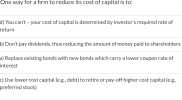 One way for a firm to reduce its cost of capital is to: d) You can't - your cost of capital is determined by investor's required rate of return b) Don't pay dividends, thus reducing the amount of money paid to shareholders a) Replace existing bonds with new bonds which carry a lower coupon rate of interest c) Use lower cost capital (e.g., debt) to retire or pay-off higher cost capital (e.g., preferred stock)
1. An investor has been thinking about starting her own independent women's beautification business. The investor's...
 1. An investor has been thinking about starting her own independent women's beautification business. The investor's problem is to decide how large her business should be. The annual returns will depend on both the size of her business and a number of marketing factors related to the beauty industry and demand for beautification. The following payoff table gives the profits that would be realized during the next year for each of four investment alternatives (in 000'OMR) Size of Station Good...
Investor company owns 35% of investee company voting stock and accounts for the investment under the...
Investor company owns 35% of investee company voting stock and accounts for the investment under the equity method. investors share of investees current net loss exceeds the balance in the investment account. investor should in most cases A. Always recognize a loss equal to 35% of investor's net loss. B. Recognize a loss equal to the remaining balance in the investment account C. Maintain a record of any unrecognized losses to be applied against future net income of the invested...
What is Ben's opportunity cost of capital and excess profit? Ben Cartwright runs the Wild West...
 What is Ben's opportunity cost of capital and excess profit?
Ben Cartwright runs the Wild West Wax Museum in Carson City, Nevada. The museum has been in business for 40 years and is a major tourist attraction. The total value of the museum's capital stock is $3.5 million, which Ben owns o This year, the museum earned a total of S1.4 million after out-of-pocket expenses. Without taking the opportunity cost of capital into account, this means that Ben is earning...
What is Ben's opportunity cost of capital and excess profit?
Ben Cartwright runs the Wild West Wax Museum in Carson City, Nevada. The museum has been in business for 40 years and is a major tourist attraction. The total value of the museum's capital stock is $3.5 million, which Ben owns o This year, the museum earned a total of S1.4 million after out-of-pocket expenses. Without taking the opportunity cost of capital into account, this means that Ben is earning...
 if an investor has found a possible investments
1. If an investor has found a possible investment property with the net income after all operating expenses but before capital recapture from a small apartment house is estimated to be 5480 year: How much would an investor be willing to pay for the property if first mortgages are availa 75% the purchase price at 5.5% interest and the investor's equity capital investment requires return. The remaining life of the buildings is...
if an investor has found a possible investments
1. If an investor has found a possible investment property with the net income after all operating expenses but before capital recapture from a small apartment house is estimated to be 5480 year: How much would an investor be willing to pay for the property if first mortgages are availa 75% the purchase price at 5.5% interest and the investor's equity capital investment requires return. The remaining life of the buildings is...
 Question 3: Equity Premium and International Income Covariances i Provide an expression for an individual investor's required return on equity. What does it depend on? How can we explain the equity premium based on this relation? ii) Suppose a German investor is considering whether to buy US stocks. Ignore exchange rate considerations. Suppose their labor income tends to comove with German GDP (gross domestic product), that is, when German GDP is high, their income will be high as well. Assume...
 Name Real Estate Valuation Problems 1. If an investor has found a possible investment property with the net income after all operating expenses but before capital recapture from a small apartment house is estimated to be $48,000 per year: How much would an investor be willing to pay for the property if first mortgages are available for 75% the purchase price at 5.5% interest and the investor's equity capital investment requires a 15% return. The remaining life of the buildings...
 Question 8 1 pts The equity cost of capital the return that a firm must offer on its stock to compensate equity investors for bearing risk. the price of the firm's stock in the future. the price per share that an investor has to pay in order to purchase the stock today. is another name for the holding period return of a stock.
 One way for a firm to reduce its cost of capital is to: d) You can't - your cost of capital is determined by investor's required rate of return b) Don't pay dividends, thus reducing the amount of money paid to shareholders a) Replace existing bonds with new bonds which carry a lower coupon rate of interest c) Use lower cost capital (e.g., debt) to retire or pay-off higher cost capital (e.g., preferred stock)
 1. An investor has been thinking about starting her own independent women's beautification business. The investor's problem is to decide how large her business should be. The annual returns will depend on both the size of her business and a number of marketing factors related to the beauty industry and demand for beautification. The following payoff table gives the profits that would be realized during the next year for each of four investment alternatives (in 000'OMR) Size of Station Good...
 What is Ben's opportunity cost of capital and excess profit?
Ben Cartwright runs the Wild West Wax Museum in Carson City, Nevada. The museum has been in business for 40 years and is a major tourist attraction. The total value of the museum's capital stock is $3.5 million, which Ben owns o This year, the museum earned a total of S1.4 million after out-of-pocket expenses. Without taking the opportunity cost of capital into account, this means that Ben is earning...
What is Ben's opportunity cost of capital and excess profit?
Ben Cartwright runs the Wild West Wax Museum in Carson City, Nevada. The museum has been in business for 40 years and is a major tourist attraction. The total value of the museum's capital stock is $3.5 million, which Ben owns o This year, the museum earned a total of S1.4 million after out-of-pocket expenses. Without taking the opportunity cost of capital into account, this means that Ben is earning...
Most questions answered within 3 hours.
-
Where is the error in this code sequence?
String s1 = "Hello";
String s2 = "ello";...
asked 10 months ago -
Financial data for Joel de Paris, Inc., for last year
follow:
Joel de Paris, Inc.
Balance...
asked 10 months ago -
Consider this reaction:
Al2(SO4)3 (aq)+ BaCl3
(aq) Al2Cl6 (aq)- +
3BaSO4(s) . What is the...
asked 10 months ago -
Suppose that Savneet is considering increasing her
recent random sample from 20 car rentals to 40...
asked 10 months ago -
Trucks arrive at an unloading terminal at an average rate of 120
per hour.
Trucks arrive...
asked 10 months ago -
Why are methanol and ethanol completely soluble in water while
octanol is not very little soluble....
asked 10 months ago -
A facilities manager at a university reads in a research report
that the mean amount of...
asked 10 months ago -
When the CuSO4 is rehydrated by adding water to the anhydrous
compound, is this an endothermic...
asked 10 months ago -
A ray of sunlight is passing from diamond into crown glass; the
angle of incidence is...
asked 10 months ago -
A block of mass 0.249 kg is placed on top of a light, vertical
spring of...
asked 10 months ago -
how do the kidneys compensate in the presences of acidosis
a) trigger hyperventilate
b) reserve acid...
asked 10 months ago -
Question 501 pts
The rental rate of capital to the firm increases. Which of the
following...
asked 10 months ago