In a lab the following synthesis was performed: [(tBu)H3N]Cl + NaBH4 → (tBu)H2NBH3 + NaCl +...
In a lab the following synthesis was performed: [(tBu)H3N]Cl + NaBH4 → (tBu)H2NBH3 + NaCl + H2 (the reaction occured in THF)
It says the BH3 was created in situ (in reaction mixture), and used in the above reaction as it is generated. How is the BH3 prepared? It says to consider the [(tBu)H3N]+ as an acid and the BH4- as a base
Homework Answers
The preparation of Lewis acid-base adduct of tert-butylamine and borane is prepared over two steps in the laboratory sessions.
In the first step of the synthesis, the intermediate (t-Bu)NH2.HCl is prepared by using tert-Butylamine, absolute ethanol and aqueous HCl solution. It is explained by the following reaction:
Step 1:
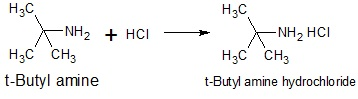
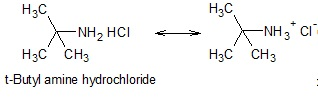
t-Butyl amine hydrochloride can be written as follows:
In Step 2 of the synthesis, The intermediate t-butyl amine hydrochloride reacts with sodium borohydride to give the t-butyl amine: borane adduct as follows:'
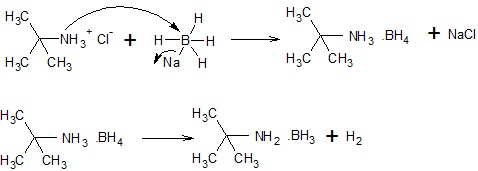
.
Add Answer to:
In a lab the following synthesis was performed: [(tBu)H3N]Cl +
NaBH4 → (tBu)H2NBH3 + NaCl +...
Experiment 12: Synthesis of Benzoic Acid pre-lab (4 pts) 1 (2 pts) Refer to the introduction...
 Experiment 12: Synthesis of Benzoic Acid pre-lab (4 pts) 1 (2 pts) Refer to the introduction on the general process of hydrolysis of nitriles to carboxylic acids. Starting with benzonitrile (shown below), show how it is converted to benzoic acid under basic conditions. N 2) (2 pts) The reaction for the synthesis of benzoic acid via benzonitrile hydrolysis is shown below: 1) NaOH, HO YOH + NaCl 2) HCI, H,0 Benzonitrile Density = 1.0 g/mL MM = 103.04 g/mol Benzoic...
CH 111 - Introduction to Inorganic and Organic Chemistry Lab 10 - Exp. 341 Synthesis of...
 CH 111 - Introduction to Inorganic and Organic Chemistry Lab 10 - Exp. 341 Synthesis of Strontium lodate In this lab, we will perform a synthesis reaction to generate a desired product. Synthesis reactions are performed in many different industries including fertilizers, plastics, pharmaceuticals and many others. The goal in a synthesis reaction is to generate and obtain as much of the desired product as possible. In this synthesis, the reaction between KIO, (potassium iodate) and Sr(NO3)2 (strontium nitrate) produces...
We performed a synthesis of methyl diantilis lab. The first step involved a Sodium Borohydride Reduction...
 We performed a synthesis of methyl diantilis lab. The first step
involved a Sodium Borohydride Reduction of
3-Ethoxy-4-hydroxybenzaldehyde (Ethylvanillin) shown below.
The next step of the experiment involved Etherification of
3-ethoxy-4-hydroxylbenzyl Alcohol using one of four alcohols
(methanol, ethanol, 1-propanol, or 2-propanol). The alcohol I used
was methanol. The reaction is predicted below.
Below is the NMR sample for my product with the integration and
ppm for each peak displayed.
Based on this information, answer the following questions.
a. Check...
We performed a synthesis of methyl diantilis lab. The first step
involved a Sodium Borohydride Reduction of
3-Ethoxy-4-hydroxybenzaldehyde (Ethylvanillin) shown below.
The next step of the experiment involved Etherification of
3-ethoxy-4-hydroxylbenzyl Alcohol using one of four alcohols
(methanol, ethanol, 1-propanol, or 2-propanol). The alcohol I used
was methanol. The reaction is predicted below.
Below is the NMR sample for my product with the integration and
ppm for each peak displayed.
Based on this information, answer the following questions.
a. Check...
Integrated Problem 12.54d X Incorrect. Propose an efficient synthesis for the following transformation: vi CI The...
 Integrated Problem 12.54d X Incorrect. Propose an efficient synthesis for the following transformation: vi CI The transformation above can be performed with some reagent or combination of the reagents listed below. Give the necessary reagent(s) in the correct order, as a string of letters (without spaces or punctuation, such as "EBF"). If there is more than one correct solution, provide just one answer. A B с t-BuOK 1) MeMgBr; 2) H20+ Na2Cr207, H2SO4, H20 NaOH D F G H E...
50 LAB 2 Genetics EXERCISE 10 PROTEIN SYNTHESIS Work with a partner to complete this exercise...
 50 LAB 2 Genetics EXERCISE 10 PROTEIN SYNTHESIS Work with a partner to complete this exercise and answer the questions that follow. You will use the DNA strand from Exercise to make the protein for which it codes STEP 1 Review the imaginary strand of DNA below. Note the complementary base pairs. AGCAATCCGTCTTGG TCGTTAGG CAGAACC STEP 2 Draw the DNA strand separating down the middle las in the beginning of DNA replication STEP 3 Draw the free-floating RNA bases linking...
Synthesis of dimedone This lab exercise will give you practical experience with the generation of...
 Synthesis of dimedone This lab exercise will give you practical experience with the generation of a malonic ester enolate and subsequent reaction with an a,p-unsaturated carbonyl compound. This sequence is known as the Michael reaction. In the presence of sodium methoxide, dimethyl propanedioate (malonic ester/dimethyl malonate) is converted to the corresponding enolate anion and reaction with 4-methylpent-3-en-2-one (mesityl oxide) affords the Michael adduct 1, as shown in the reaction sequence below. Under the basic reaction conditions, the Michael adduct 1...
Synthesis of dimedone This lab exercise will give you practical experience with the generation of...
 Synthesis of dimedone This lab exercise will give you practical experience with the generation of a malonic ester enolate and subsequent reaction with an a,p-unsaturated carbonyl compound. This sequence is known as the Michael reaction. In the presence of sodium methoxide, dimethyl propanedioate (malonic ester/dimethyl malonate) is converted to the corresponding enolate anion and reaction with 4-methylpent-3-en-2-one (mesityl oxide) affords the Michael adduct 1, as shown in the reaction sequence below. Under the basic reaction conditions, the Michael adduct 1...
1. Write down the equilibrium constant expressions, Ke and K, for each of the following reactions:...
 1. Write down the equilibrium constant expressions, Ke and K, for each of the following reactions: (a) H(g)Cl(g) 2 HCl(g) (b) 2 C(s)+O2(g) 2 CO(g Ag (aq)Cl(aq) (c) AgCl(s) (d) 2 O(g) 3 0:(g) 2. A 1.0 L evacuated flask was charged with 0.020 mol of N,O, and 0.060 mol of NO2 at 25.0 C. After equilibrium was reached the NO2 concentration was found to be 0.0140 M. What is the equilibrium constant Ke for the reaction? N2O4(g) 2 NO:(g)...
Postlab Questions Answer the following questions on a separate sheet or in your lab notebook. Make...
 Postlab Questions Answer the following questions on a separate sheet or in your lab notebook. Make sure that the copy page is readable! D) Calculate the percentage yield for both reactions. Show all calculations. 2) What is the color of the reaction at the beginning of reaction? What causes the color? 3) Why do you dissolve maleic acid in diethyl ether and fumaric acid in water? 4) Give the complete reaction mechanisms for the formation of meso and racemic 2,3-...
Draw the structure of the final product(s) of this series of reactions 1pt ernces 1 pt...
 Draw the structure of the final product(s) of this series of reactions 1pt ernces 1 pt 1. Br 1 pt 2.3 equivalents of NaNH 3. mild acid 1 pt 4. BH 5. H202/ NaOH 1 pt 1 pt 1 pt Use the wedge/hash bond tools to indicate stereochemistry where it exists Include H atoms at chiral centers only If a group is achiral, do not use wedged or hashed bonds on it Draw organic species only. Do not include lone...
 Experiment 12: Synthesis of Benzoic Acid pre-lab (4 pts) 1 (2 pts) Refer to the introduction on the general process of hydrolysis of nitriles to carboxylic acids. Starting with benzonitrile (shown below), show how it is converted to benzoic acid under basic conditions. N 2) (2 pts) The reaction for the synthesis of benzoic acid via benzonitrile hydrolysis is shown below: 1) NaOH, HO YOH + NaCl 2) HCI, H,0 Benzonitrile Density = 1.0 g/mL MM = 103.04 g/mol Benzoic...
 CH 111 - Introduction to Inorganic and Organic Chemistry Lab 10 - Exp. 341 Synthesis of Strontium lodate In this lab, we will perform a synthesis reaction to generate a desired product. Synthesis reactions are performed in many different industries including fertilizers, plastics, pharmaceuticals and many others. The goal in a synthesis reaction is to generate and obtain as much of the desired product as possible. In this synthesis, the reaction between KIO, (potassium iodate) and Sr(NO3)2 (strontium nitrate) produces...
 We performed a synthesis of methyl diantilis lab. The first step
involved a Sodium Borohydride Reduction of
3-Ethoxy-4-hydroxybenzaldehyde (Ethylvanillin) shown below.
The next step of the experiment involved Etherification of
3-ethoxy-4-hydroxylbenzyl Alcohol using one of four alcohols
(methanol, ethanol, 1-propanol, or 2-propanol). The alcohol I used
was methanol. The reaction is predicted below.
Below is the NMR sample for my product with the integration and
ppm for each peak displayed.
Based on this information, answer the following questions.
a. Check...
We performed a synthesis of methyl diantilis lab. The first step
involved a Sodium Borohydride Reduction of
3-Ethoxy-4-hydroxybenzaldehyde (Ethylvanillin) shown below.
The next step of the experiment involved Etherification of
3-ethoxy-4-hydroxylbenzyl Alcohol using one of four alcohols
(methanol, ethanol, 1-propanol, or 2-propanol). The alcohol I used
was methanol. The reaction is predicted below.
Below is the NMR sample for my product with the integration and
ppm for each peak displayed.
Based on this information, answer the following questions.
a. Check...
 Integrated Problem 12.54d X Incorrect. Propose an efficient synthesis for the following transformation: vi CI The transformation above can be performed with some reagent or combination of the reagents listed below. Give the necessary reagent(s) in the correct order, as a string of letters (without spaces or punctuation, such as "EBF"). If there is more than one correct solution, provide just one answer. A B с t-BuOK 1) MeMgBr; 2) H20+ Na2Cr207, H2SO4, H20 NaOH D F G H E...
 50 LAB 2 Genetics EXERCISE 10 PROTEIN SYNTHESIS Work with a partner to complete this exercise and answer the questions that follow. You will use the DNA strand from Exercise to make the protein for which it codes STEP 1 Review the imaginary strand of DNA below. Note the complementary base pairs. AGCAATCCGTCTTGG TCGTTAGG CAGAACC STEP 2 Draw the DNA strand separating down the middle las in the beginning of DNA replication STEP 3 Draw the free-floating RNA bases linking...
 Synthesis of dimedone This lab exercise will give you practical experience with the generation of a malonic ester enolate and subsequent reaction with an a,p-unsaturated carbonyl compound. This sequence is known as the Michael reaction. In the presence of sodium methoxide, dimethyl propanedioate (malonic ester/dimethyl malonate) is converted to the corresponding enolate anion and reaction with 4-methylpent-3-en-2-one (mesityl oxide) affords the Michael adduct 1, as shown in the reaction sequence below. Under the basic reaction conditions, the Michael adduct 1...
 Synthesis of dimedone This lab exercise will give you practical experience with the generation of a malonic ester enolate and subsequent reaction with an a,p-unsaturated carbonyl compound. This sequence is known as the Michael reaction. In the presence of sodium methoxide, dimethyl propanedioate (malonic ester/dimethyl malonate) is converted to the corresponding enolate anion and reaction with 4-methylpent-3-en-2-one (mesityl oxide) affords the Michael adduct 1, as shown in the reaction sequence below. Under the basic reaction conditions, the Michael adduct 1...
 1. Write down the equilibrium constant expressions, Ke and K, for each of the following reactions: (a) H(g)Cl(g) 2 HCl(g) (b) 2 C(s)+O2(g) 2 CO(g Ag (aq)Cl(aq) (c) AgCl(s) (d) 2 O(g) 3 0:(g) 2. A 1.0 L evacuated flask was charged with 0.020 mol of N,O, and 0.060 mol of NO2 at 25.0 C. After equilibrium was reached the NO2 concentration was found to be 0.0140 M. What is the equilibrium constant Ke for the reaction? N2O4(g) 2 NO:(g)...
 Postlab Questions Answer the following questions on a separate sheet or in your lab notebook. Make sure that the copy page is readable! D) Calculate the percentage yield for both reactions. Show all calculations. 2) What is the color of the reaction at the beginning of reaction? What causes the color? 3) Why do you dissolve maleic acid in diethyl ether and fumaric acid in water? 4) Give the complete reaction mechanisms for the formation of meso and racemic 2,3-...
 Draw the structure of the final product(s) of this series of reactions 1pt ernces 1 pt 1. Br 1 pt 2.3 equivalents of NaNH 3. mild acid 1 pt 4. BH 5. H202/ NaOH 1 pt 1 pt 1 pt Use the wedge/hash bond tools to indicate stereochemistry where it exists Include H atoms at chiral centers only If a group is achiral, do not use wedged or hashed bonds on it Draw organic species only. Do not include lone...
Most questions answered within 3 hours.
-
Where is the error in this code sequence?
String s1 = "Hello";
String s2 = "ello";...
asked 10 months ago -
Financial data for Joel de Paris, Inc., for last year
follow:
Joel de Paris, Inc.
Balance...
asked 10 months ago -
Consider this reaction:
Al2(SO4)3 (aq)+ BaCl3
(aq) Al2Cl6 (aq)- +
3BaSO4(s) . What is the...
asked 10 months ago -
Suppose that Savneet is considering increasing her
recent random sample from 20 car rentals to 40...
asked 10 months ago -
Trucks arrive at an unloading terminal at an average rate of 120
per hour.
Trucks arrive...
asked 10 months ago -
Why are methanol and ethanol completely soluble in water while
octanol is not very little soluble....
asked 10 months ago -
A facilities manager at a university reads in a research report
that the mean amount of...
asked 10 months ago -
When the CuSO4 is rehydrated by adding water to the anhydrous
compound, is this an endothermic...
asked 10 months ago -
A ray of sunlight is passing from diamond into crown glass; the
angle of incidence is...
asked 10 months ago -
A block of mass 0.249 kg is placed on top of a light, vertical
spring of...
asked 10 months ago -
how do the kidneys compensate in the presences of acidosis
a) trigger hyperventilate
b) reserve acid...
asked 10 months ago -
Question 501 pts
The rental rate of capital to the firm increases. Which of the
following...
asked 10 months ago