Ka and Kb are inversely related. Thus, if Ka is small, Kb must be large. However,...
Ka and Kb are inversely related. Thus, if Ka is small, Kb must be large. However, the textbook says that (CO3)2- is a weak base and its conjugate, HCO3-, is a weak acid. How is this possible? Since HCO3- is a weak acid, Ka should be small. Since Ka and Kb are inversely related, shouldnt the Kb of the conjugate base to the weak acid HCO3- be large, making it a strong base?
Homework Answers
 HCo3- is weak
acid because it cannot further convert into hydrogen
ions.
HCo3- is weak
acid because it cannot further convert into hydrogen
ions.
Add Answer to:
Ka and Kb are inversely related. Thus, if Ka is small, Kb must
be large. However,...
Design a buffer that has a pH of 4.45 using one of the weak base/conjugate acid...
Design a buffer that has a pH of 4.45 using one of the weak base/conjugate acid systems shown below. Weak Base Kb Conjugate Acid Ka pKa CH3NH2 4.2×10⁻⁴ CH3NH3+ 2.4×10⁻¹¹ 10.62 C6H15O3N 5.9×10⁻⁷ C6H15O3NH+ 1.7×10⁻⁸ 7.77 C5H5N 1.5×10⁻⁹ C5H5NH+ 6.7×10⁻⁶ 5.17 How many grams of the chloride salt of the conjugate acid must be combined with how many grams of the weak base, to produce 1.00 L of a buffer that is 1.00 M in the weak base? grams chloride...
1. Design a buffer that has a pH of 4.48 using one of the weak base/conjugate...
1. Design a buffer that has a pH of 4.48 using one of the weak base/conjugate acid systems shown below. Weak Base Kb Conjugate Acid Ka pKa CH3NH2 4.2 x 10⁻⁴ CH3NH3+ 2.4 x 10⁻¹¹ 10.62 C6H15O3N 5.9 x 10⁻⁷ C6H15O3NH+ 1.7 x 10⁻⁸ 7.77 C5H5N 1.5 x 10⁻⁹ C5H5NH+ 6.7 x 10⁻⁶ 5.17 How many grams of the chloride salt of the conjugate acid must be combined with how many grams of the weak base, to produce 1.00 L...
help with 5 and 6 please 5. Choose the effective pH range of a HF/Naf buffer. For HF, Ka = 3.5 x 10⁻⁴ 6. If a small...
 help with 5 and 6 please
5. Choose the effective pH range of a HF/Naf buffer. For HF, Ka = 3.5 x 10⁻⁴ 6. If a small amount of a strong acid is added to buffer made up of a weak acid, HA, and the sodium salt of its conjugate base, NaA, the pH of the buffer solution does not change appreciably because a) the Ka of HA is changed. b) the strong acid reacts with Ato give HA, which...
help with 5 and 6 please
5. Choose the effective pH range of a HF/Naf buffer. For HF, Ka = 3.5 x 10⁻⁴ 6. If a small amount of a strong acid is added to buffer made up of a weak acid, HA, and the sodium salt of its conjugate base, NaA, the pH of the buffer solution does not change appreciably because a) the Ka of HA is changed. b) the strong acid reacts with Ato give HA, which...
is a solution that resists changes in pH when a small amount of acid or base...
 is a solution that resists changes in pH when a small amount of acid or base is added to best buffer solutions are prepared from weak acids and their conjugate base added as a sodium of potassium salt. Most biological systems must maintain a very narrow range of pH; therefore, buffers allow the biological solution to function correctly. Blood is a good example of a biological system that must maintain a pH in a very narrow range from 7.3 to...
Buffers are solutions designed to resist changes in pH from the addition of small amounts of acids or bases
Buffers are solutions designed to resist changes in pH from the addition of small amounts of acids or bases. Buffers are comprised of a solution of a weak acid with its conjugate base. When an outside base is added to the buffer, the weak acid in the buffer neutralizes the hydroxide ion of the base, thus retarding its ability to raise the solution's pH. When an outside acid is added to the buffer, the conjugate base of the buffer neutralizes...
in some cases, there may be a mixture of two or more acids. When this happens,...
 in some cases, there may be a mixture of two or more acids. When this happens, the stronger acid will dissociate completely, so you should be able to calculate how much H,0 is in solution as a result. Writing out the equation for the dissociation often helps The weak acid will attempt to dissociate and is governed by the equilibrium (K,). You should write out the equation for the weak acid Now-write in the values for the concentrations that you'll...
The correct answer is the 3rd one. NO3- has more charges and thus is more unstable...
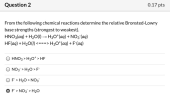 The
correct answer is the 3rd one.
NO3- has more charges and thus is more unstable than water, so
wouldn't it be more likely for it to accept H+, making it a
stronger Bronsted-Lowry base compared to H20? (aka, Why is water
better at accepting H+ than NO3-?)
F- should be the strongest Bronsted-lowry base because HF is a
weak acid and thus its CB is more unstable (that's why it doens't
really want to donate its H+) -> an...
The
correct answer is the 3rd one.
NO3- has more charges and thus is more unstable than water, so
wouldn't it be more likely for it to accept H+, making it a
stronger Bronsted-Lowry base compared to H20? (aka, Why is water
better at accepting H+ than NO3-?)
F- should be the strongest Bronsted-lowry base because HF is a
weak acid and thus its CB is more unstable (that's why it doens't
really want to donate its H+) -> an...
Ka for hypochlorous acid, HClO, is 3.0 x 10^-8. Calculate the pH after 10.0, 20.0, 30.0,...
Ka for hypochlorous acid, HClO, is 3.0 x 10^-8. Calculate the pH after 10.0, 20.0, 30.0, and 40.0 ml of 0.100M NaOH have been added to 40.0ml of 0.100M HClO. Expert Answer GoldenApple6699 GoldenApple6699 answered this Was this answer helpful? 8 0 766 answers At any point between 0 and 40 mL of NaOH added, you will have a solution containing both HClO and ClO- ... that's a buffer system (a weak acid and its conjugate base) and the pH...
1. A comic book villain is holding you at gun point and is making you drink...
1. A comic book villain is holding you at gun point and is making you drink a sample of acid. She gives you a beaker with 100ml of a strong acid with pH=5. She also gives you a beaker of a strong base with a pH=10. You can add as much of the strong base to the strong acid as you want, and you must then drink the solution. You'd be best off trying to make the solution neutral before...
A buffer solution is able to maintain a constant pH when small amounts of acid or...
 A buffer solution is able to maintain a constant pH when small amounts of acid or base are added to the buffer. Consider what happens when 1 mL of a 5 M solution is added or 0.005 mol of HCl are added to a 100.0 mL solution acetic acid buffer that contains 0.0100 mol of Acetic acid, HC,H,O,, and 0.0100 mol of sodium acetate, NaC,H,O,. The initial concentration of both the acid and the base are 0.0100 mol/ 0.1000 L...
 help with 5 and 6 please
5. Choose the effective pH range of a HF/Naf buffer. For HF, Ka = 3.5 x 10⁻⁴ 6. If a small amount of a strong acid is added to buffer made up of a weak acid, HA, and the sodium salt of its conjugate base, NaA, the pH of the buffer solution does not change appreciably because a) the Ka of HA is changed. b) the strong acid reacts with Ato give HA, which...
help with 5 and 6 please
5. Choose the effective pH range of a HF/Naf buffer. For HF, Ka = 3.5 x 10⁻⁴ 6. If a small amount of a strong acid is added to buffer made up of a weak acid, HA, and the sodium salt of its conjugate base, NaA, the pH of the buffer solution does not change appreciably because a) the Ka of HA is changed. b) the strong acid reacts with Ato give HA, which...
 is a solution that resists changes in pH when a small amount of acid or base is added to best buffer solutions are prepared from weak acids and their conjugate base added as a sodium of potassium salt. Most biological systems must maintain a very narrow range of pH; therefore, buffers allow the biological solution to function correctly. Blood is a good example of a biological system that must maintain a pH in a very narrow range from 7.3 to...
 in some cases, there may be a mixture of two or more acids. When this happens, the stronger acid will dissociate completely, so you should be able to calculate how much H,0 is in solution as a result. Writing out the equation for the dissociation often helps The weak acid will attempt to dissociate and is governed by the equilibrium (K,). You should write out the equation for the weak acid Now-write in the values for the concentrations that you'll...
 The
correct answer is the 3rd one.
NO3- has more charges and thus is more unstable than water, so
wouldn't it be more likely for it to accept H+, making it a
stronger Bronsted-Lowry base compared to H20? (aka, Why is water
better at accepting H+ than NO3-?)
F- should be the strongest Bronsted-lowry base because HF is a
weak acid and thus its CB is more unstable (that's why it doens't
really want to donate its H+) -> an...
The
correct answer is the 3rd one.
NO3- has more charges and thus is more unstable than water, so
wouldn't it be more likely for it to accept H+, making it a
stronger Bronsted-Lowry base compared to H20? (aka, Why is water
better at accepting H+ than NO3-?)
F- should be the strongest Bronsted-lowry base because HF is a
weak acid and thus its CB is more unstable (that's why it doens't
really want to donate its H+) -> an...
 A buffer solution is able to maintain a constant pH when small amounts of acid or base are added to the buffer. Consider what happens when 1 mL of a 5 M solution is added or 0.005 mol of HCl are added to a 100.0 mL solution acetic acid buffer that contains 0.0100 mol of Acetic acid, HC,H,O,, and 0.0100 mol of sodium acetate, NaC,H,O,. The initial concentration of both the acid and the base are 0.0100 mol/ 0.1000 L...
Most questions answered within 3 hours.
-
Where is the error in this code sequence?
String s1 = "Hello";
String s2 = "ello";...
asked 11 months ago -
Financial data for Joel de Paris, Inc., for last year
follow:
Joel de Paris, Inc.
Balance...
asked 11 months ago -
Consider this reaction:
Al2(SO4)3 (aq)+ BaCl3
(aq) Al2Cl6 (aq)- +
3BaSO4(s) . What is the...
asked 11 months ago -
Suppose that Savneet is considering increasing her
recent random sample from 20 car rentals to 40...
asked 11 months ago -
Trucks arrive at an unloading terminal at an average rate of 120
per hour.
Trucks arrive...
asked 11 months ago -
Why are methanol and ethanol completely soluble in water while
octanol is not very little soluble....
asked 11 months ago -
A facilities manager at a university reads in a research report
that the mean amount of...
asked 11 months ago -
When the CuSO4 is rehydrated by adding water to the anhydrous
compound, is this an endothermic...
asked 11 months ago -
A ray of sunlight is passing from diamond into crown glass; the
angle of incidence is...
asked 11 months ago -
A block of mass 0.249 kg is placed on top of a light, vertical
spring of...
asked 11 months ago -
how do the kidneys compensate in the presences of acidosis
a) trigger hyperventilate
b) reserve acid...
asked 11 months ago -
Question 501 pts
The rental rate of capital to the firm increases. Which of the
following...
asked 11 months ago