10.2 g of Pb(NO3)2 are dissolved in 100 mL of water, and added to 250.0 mL...
10.2 g of Pb(NO3)2 are dissolved in 100 mL of water, and added to 250.0 mL of a 0.250 M solution of KI. Determine the mass in grams of PbI2 produced, and find the number of moles of the excess reagent.
I could only find the net ionic equation of: Pb 2+ (aq) + 2 I- (aq) -> PbI2 (s)
Homework Answers
First calculate mole of both reactant and find limiting reagent.
Mass of PbI2 = 14.2 grams
Moles of excess reagent = 0.0625 mole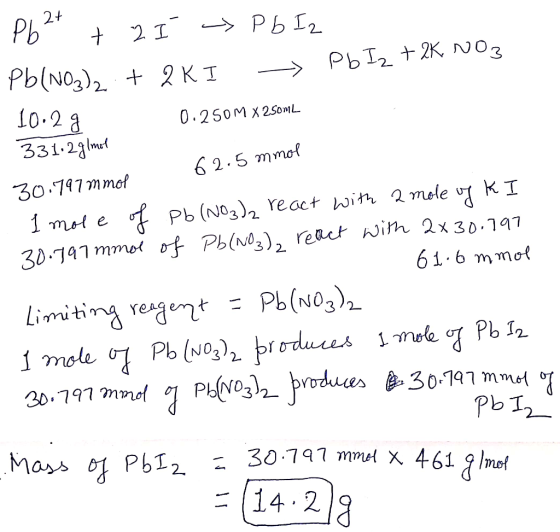
Add Answer to:
10.2 g of Pb(NO3)2 are dissolved in 100 mL of water, and added
to 250.0 mL...
Consider the balanced equation of KI reacting with Pb(NO3)2 to form a precipitate. 2KI(aq)+Pb(NO3)2(aq)⟶PbI2(s)+2KNO3(aq) What mass...
Consider the balanced equation of KI reacting with Pb(NO3)2 to form a precipitate. 2KI(aq)+Pb(NO3)2(aq)⟶PbI2(s)+2KNO3(aq) What mass of PbI2 can be formed by adding 0.413 L of a 0.140 M solution of KI to a solution of excess Pb(NO3)2?
1. A 75.0-mL sample of 0.200 M Lead(II) nitrate, Pb(NO3)2, is reacted with 75.0 mL of...
1. A 75.0-mL sample of 0.200 M Lead(II) nitrate, Pb(NO3)2, is reacted with 75.0 mL of 0.450 M KI solution and the following precipitation reaction occurs. Pb(NO3)2(aq) + 2KI(aq) → PbI2(s) + 2KNO3(aq) (a) Determine the limiting reactant. (b) How many grams of PbI2 will be formed if the yield is 100%? (c) What is the percent yield if 6.45 g of PbI2 were obtained? (2) K2Cr2O7(aq) + FeCl2(aq) → CrCl3(aq) + Fe(NO3)3(aq) (a) Determine the net ionic reactions and...
A 1.04 g sample of KBr is dissolved in water to give 155 mL of solution....
A 1.04 g sample of KBr is dissolved in water to give 155 mL of solution. This solution is then added to 165 mL of 0.015 M aqueous Pb(NO3)2, in an attempt to remove the toxic lead(II) ions from the solution via precipitation as insoluble PbBr2(s). The precipitation reaction that occurs is: PB2+(aq) + 2Br(aq) --> PbBr2(s) What is the maximum mass of product that could be isolated by filtration after the reaction occurs?
When a solution of Lead Nitrate, Pb(NO3)2 , is mixed with a solution of sodium iodide,...
When a solution of Lead Nitrate, Pb(NO3)2 , is mixed with a solution of sodium iodide, NaI, a precipitate of lead iodide, PbI2 , is formed. a) Write the chemical equation for this reaction showing the state of all reactants and products. b) If 1 mol of Pb(NO3)2 reacts with 2 mols of NaI, what is the amount of PbI2 that will be formed? c) If 1 mol of Pb(NO3)2 reacts with 2 mols of NaI, which compound would be...
If 15.0 mL of 8.80×10⁻⁴ M Pb(NO3)2 are added to 22.0 mL of 3.10×10⁻⁵ M KI,...
If 15.0 mL of 8.80×10⁻⁴ M Pb(NO3)2 are added to 22.0 mL of 3.10×10⁻⁵ M KI, will solid PbI2 (Ksp = 8.7×10⁻⁹) precipitate? If a precipitate will not form, what iodide ion concentration will cause a precipitate of lead iodide to form? If a precipitate will form, what is the minimum [I-] that could have been present without initiating precipitation? Assume the total volume used in the above example. M
A precipitation reaction occurs when 749 mL of 0.846 M Pb(NO3)2 reacts with 375 mL of...
 A precipitation reaction occurs when 749 mL of 0.846 M Pb(NO3)2 reacts with 375 mL of 0.810 M KI, as shown by the following equation. Pb(NO3)2(aq) + 2 Kl(aq) – PbL,(s) + 2 KNO, (aq) Identify the limiting reactant. O Pb(NO3)2 ОРЫ, OKI O KNO, Calculate the theoretical yield of Pol, from the reaction. mass of Pble: Calculate the percent yield of Pbl, if 50.6 g of Pol, are formed experimentally. percent yield of Pbl Suppose 57.2 mL of a...
A solution containing 1.25 g of KI is combined with a solution containing 2.42 g of...
A solution containing 1.25 g of KI is combined with a solution containing 2.42 g of Pb(NO3)2. What mass of PbI2 would result using the following equation? 2KI(aq) + Pb(NO3)2(aq) = 2 KNO3(aq) + PbI2(s).
QUESTION 1 43.2 mL of aqueous 0.255 M Pb(NO3)2 is mixed with 36.1 mL of 0.415...
QUESTION 1 43.2 mL of aqueous 0.255 M Pb(NO3)2 is mixed with 36.1 mL of 0.415 M NaCl. The equation for the precipitate reaction is: Pb(NO3)2 (aq) + 2 NaCl (aq) --> PbCl2 (s) + 2 NaNO3 (aq) How many moles of PbCl2 are formed? (with correct sig figs) QUESTION 2 What volume (in mL!!!) of 1.28 M HCl is required to react with 3.33 g of zinc (65.41 g/mol) according to the following reaction? Zn(s) + 2 HCl (aq)...
For the reaction 2 KI + Pb(NO), — Pol, + 2 KNO, how many grams of lead(II) nitrate, Pb(NO3)2, are needed to react...
 For the reaction 2 KI + Pb(NO), — Pol, + 2 KNO, how many grams of lead(II) nitrate, Pb(NO3)2, are needed to react completely with 39.3 g of potassium iodide, KI? mass: 2 KI + Pb(NO3)2 Pol, + 2 KNO how many grams of lead(II) nitrate, Pb(NO3)2, are needed to react completely with 39.3 g of potassium iodide, KI? mass: Attem Small quantities of oxygen can be prepared in the laboratory by heating potassium chlorate, KCIO,(s). The equation for the...
For the chemical reaction 2KI+Pb(NO3)2⟶PbI2+2KNO3 how many moles of lead(II) iodide (PbI2) are produced from 8.0...
For the chemical reaction 2KI+Pb(NO3)2⟶PbI2+2KNO3 how many moles of lead(II) iodide (PbI2) are produced from 8.0 mol of potassium iodide (KI)?
 A precipitation reaction occurs when 749 mL of 0.846 M Pb(NO3)2 reacts with 375 mL of 0.810 M KI, as shown by the following equation. Pb(NO3)2(aq) + 2 Kl(aq) – PbL,(s) + 2 KNO, (aq) Identify the limiting reactant. O Pb(NO3)2 ОРЫ, OKI O KNO, Calculate the theoretical yield of Pol, from the reaction. mass of Pble: Calculate the percent yield of Pbl, if 50.6 g of Pol, are formed experimentally. percent yield of Pbl Suppose 57.2 mL of a...
 For the reaction 2 KI + Pb(NO), — Pol, + 2 KNO, how many grams of lead(II) nitrate, Pb(NO3)2, are needed to react completely with 39.3 g of potassium iodide, KI? mass: 2 KI + Pb(NO3)2 Pol, + 2 KNO how many grams of lead(II) nitrate, Pb(NO3)2, are needed to react completely with 39.3 g of potassium iodide, KI? mass: Attem Small quantities of oxygen can be prepared in the laboratory by heating potassium chlorate, KCIO,(s). The equation for the...
Most questions answered within 3 hours.
-
Where is the error in this code sequence?
String s1 = "Hello";
String s2 = "ello";...
asked 11 months ago -
Financial data for Joel de Paris, Inc., for last year
follow:
Joel de Paris, Inc.
Balance...
asked 11 months ago -
Consider this reaction:
Al2(SO4)3 (aq)+ BaCl3
(aq) Al2Cl6 (aq)- +
3BaSO4(s) . What is the...
asked 11 months ago -
Suppose that Savneet is considering increasing her
recent random sample from 20 car rentals to 40...
asked 11 months ago -
Trucks arrive at an unloading terminal at an average rate of 120
per hour.
Trucks arrive...
asked 11 months ago -
Why are methanol and ethanol completely soluble in water while
octanol is not very little soluble....
asked 11 months ago -
A facilities manager at a university reads in a research report
that the mean amount of...
asked 11 months ago -
When the CuSO4 is rehydrated by adding water to the anhydrous
compound, is this an endothermic...
asked 11 months ago -
A ray of sunlight is passing from diamond into crown glass; the
angle of incidence is...
asked 11 months ago -
A block of mass 0.249 kg is placed on top of a light, vertical
spring of...
asked 11 months ago -
how do the kidneys compensate in the presences of acidosis
a) trigger hyperventilate
b) reserve acid...
asked 11 months ago -
Question 501 pts
The rental rate of capital to the firm increases. Which of the
following...
asked 11 months ago