Write the chemical equation for what happens when you dissolve the following solutes in water: NaCl,...
Write the chemical equation for what happens when you dissolve the following solutes in water: NaCl, C12H22O11, CaCl2 , and Fe(NO3)3. You may assume that the ionic compounds are strong electrolytes. Specify the theoretical van’t Hoff factor for each solute.
Homework Answers

Add Answer to:
Write the chemical equation for what happens when you dissolve
the following solutes in water: NaCl,...
For the following ionic compounds, write a balanced equation for their hydration in water. CaCl2 Express...
For the following ionic compounds, write a balanced equation for their hydration in water. CaCl2 Express your answer as a chemical equation. Identify all of the phases in your answer. NaOH Express your answer as a chemical equation. Identify all of the phases in your answer. KBr Express your answer as a chemical equation. Identify all of the phases in your answer. Fe(NO3)3 Express your answer as a chemical equation. Identify all of the phases in your answer.
Why does Ph3CO-MgBr+ dissolve when HCl is added? Write a chemical equation to describe what happens....
Why does Ph3CO-MgBr+ dissolve when HCl is added? Write a chemical equation to describe what happens. Does it dissolve in the water layer or the ether layer? Is the final product, tripehnylmethanol, soluble in ether or water? Explain your answer. Please Please answer everything what question is asking and explain answers thoroughly. Thank you.
What occurs at the molecular/ionic level when a) NaCl and b) C2H5OH dissolve in water. Write...
What occurs at the molecular/ionic level when a) NaCl and b) C2H5OH dissolve in water. Write the dissociation equation when it dissolves in solution
Determine what particles (cations, anions, molecules,etc.) exist when each of the following solutes is dissolved in...
Determine what particles (cations, anions, molecules,etc.) exist when each of the following solutes is dissolved in water. Write the chemical formula for each particle. Solute Formula Solute Formula NaCl P4O10 NH4Br NaOH Fe(C2H3O2)3 K3PO4 NH3 H2O2 CsClO3 NO2 C6H5OH
1. Solubility in WATER Check solubility of four solutes in water (H2O). For each solute record...
1. Solubility in WATER Check solubility of four solutes in water (H2O). For each solute record how many teaspoons dissolved in 1/2 cup of water. NaCl: Start out with 4 small glasses (cups) and add 1/2 cup of water to each. Put 1/2 level teaspoon (tsp) of salt (NaCl) into the first cup and stir. If it dissolves within 1 minute; add another 1/2 tsp of salt and stir. Count the number of 1/2 tsps you are adding. Repeat until...
List of Electrolytes: NaCl, H3PO4, HC2H3O2(also written as CH3COOH), H3BO3, C2H6O2, CaCl2, CH3OH, HCl, and AlCl3,...
 List of Electrolytes:
NaCl, H3PO4, HC2H3O2(also written as CH3COOH), H3BO3, C2H6O2,
CaCl2, CH3OH, HCl, and AlCl3, Tap Water and DI Water
3. a) What can be concluded about how your acids are classified (are they strong, weak, or non-electrolytes?) b) Write a balanced equation for the dissociation of each of the acids, as was done for the ionic compounds. Here assume complete dissociation, disregarding the conductivity data for now. (HINT: Remember polyatomic ions! There should not be more than two...
List of Electrolytes:
NaCl, H3PO4, HC2H3O2(also written as CH3COOH), H3BO3, C2H6O2,
CaCl2, CH3OH, HCl, and AlCl3, Tap Water and DI Water
3. a) What can be concluded about how your acids are classified (are they strong, weak, or non-electrolytes?) b) Write a balanced equation for the dissociation of each of the acids, as was done for the ionic compounds. Here assume complete dissociation, disregarding the conductivity data for now. (HINT: Remember polyatomic ions! There should not be more than two...
Write the chemical equation that determines the acid/base chemistry when you dissolve the soluble salt lithium...
Write the chemical equation that determines the acid/base chemistry when you dissolve the soluble salt lithium formate in water. Predict whether the resulting solution will be acidic, basic, or neutral at 25 degrees C.
The following soluble salts are strong electrolytes. For each, write a balanced equation for their dissociation in water...
The following soluble salts are strong electrolytes. For each, write a balanced equation for their dissociation in water. A. KI Express your answer as a chemical equation. Identify all of the phases in your answer. B. NaNO3 Express your answer as a chemical equation. Identify all of the phases in your answer. C. FeCl3 Express your answer as a chemical equation. Identify all of the phases in your answer. D. Mg(NO3)2 Express your answer as a chemical equation. Identify all...
Write the net ionic equation that represents what happens when sodium hydroxide dissolves in water. If...
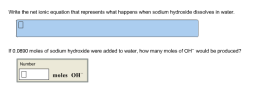 Write the net ionic equation that represents what happens when sodium hydroxide dissolves in water. If 0.0890 moles of sodium hydroxide were added to water, how many moles of OH^- would be produced?
Write a balanced equation for each of the following reactions. 1)When carbonate salts dissolve in water,...
Write a balanced equation for each of the following reactions. 1)When carbonate salts dissolve in water, they produce basic solutions. Write a balanced net ionic equation for each of the following reactions. 1)Dilute nitric acid reacts with zinc metal with formation of nitrous oxide. 2)Concentrated nitric acid reacts with sulfur with formation of nitrogen dioxide. 3)Concentrated nitric acid oxidizes sulfur dioxide with formation of nitric oxide. 4)Hydrazine is burned in excess fluorine gas, forming NF3. 5)Hydrazine reduces CrO2−4 to Cr...
 List of Electrolytes:
NaCl, H3PO4, HC2H3O2(also written as CH3COOH), H3BO3, C2H6O2,
CaCl2, CH3OH, HCl, and AlCl3, Tap Water and DI Water
3. a) What can be concluded about how your acids are classified (are they strong, weak, or non-electrolytes?) b) Write a balanced equation for the dissociation of each of the acids, as was done for the ionic compounds. Here assume complete dissociation, disregarding the conductivity data for now. (HINT: Remember polyatomic ions! There should not be more than two...
List of Electrolytes:
NaCl, H3PO4, HC2H3O2(also written as CH3COOH), H3BO3, C2H6O2,
CaCl2, CH3OH, HCl, and AlCl3, Tap Water and DI Water
3. a) What can be concluded about how your acids are classified (are they strong, weak, or non-electrolytes?) b) Write a balanced equation for the dissociation of each of the acids, as was done for the ionic compounds. Here assume complete dissociation, disregarding the conductivity data for now. (HINT: Remember polyatomic ions! There should not be more than two...
 Write the net ionic equation that represents what happens when sodium hydroxide dissolves in water. If 0.0890 moles of sodium hydroxide were added to water, how many moles of OH^- would be produced?
Most questions answered within 3 hours.
-
Where is the error in this code sequence?
String s1 = "Hello";
String s2 = "ello";...
asked 10 months ago -
Financial data for Joel de Paris, Inc., for last year
follow:
Joel de Paris, Inc.
Balance...
asked 10 months ago -
Consider this reaction:
Al2(SO4)3 (aq)+ BaCl3
(aq) Al2Cl6 (aq)- +
3BaSO4(s) . What is the...
asked 10 months ago -
Suppose that Savneet is considering increasing her
recent random sample from 20 car rentals to 40...
asked 10 months ago -
Trucks arrive at an unloading terminal at an average rate of 120
per hour.
Trucks arrive...
asked 10 months ago -
Why are methanol and ethanol completely soluble in water while
octanol is not very little soluble....
asked 10 months ago -
A facilities manager at a university reads in a research report
that the mean amount of...
asked 10 months ago -
When the CuSO4 is rehydrated by adding water to the anhydrous
compound, is this an endothermic...
asked 10 months ago -
A ray of sunlight is passing from diamond into crown glass; the
angle of incidence is...
asked 10 months ago -
A block of mass 0.249 kg is placed on top of a light, vertical
spring of...
asked 10 months ago -
how do the kidneys compensate in the presences of acidosis
a) trigger hyperventilate
b) reserve acid...
asked 10 months ago -
Question 501 pts
The rental rate of capital to the firm increases. Which of the
following...
asked 10 months ago