Consider a class Fraction of fractions. Each fraction is signed and has a numerator and a...
Consider a class Fraction of fractions. Each fraction is signed and has a numerator and a denominator that are integers. Your class should be able to add, subtract, multiply, and divide two fractions. These methods should have a fraction as a parameter and should return the result of the operation as a fraction. The class should also be able to find the reciprocal of a fraction, compare two fractions, decide whether two fractions are equal, and convert a fraction to a string.
Your class should handle denominators that are zero. Fractions should always occur in lowest terms, and the class should be responsible for this requirement. For example, if the user tries to create a fraction such as 4/8, the class should set the fraction to 1/2. Likewise, the results of all arithmetic operations should be in lowest terms. Note that a fraction can be improper—that is, have a numerator that is larger than its denominator. Such a fraction, however, should be in lowest terms.
Design the class Fraction. Begin by writing a CRC card for this class. Then write a Java interface that declares each public method.
To reduce a fraction such as 4/8 to lowest terms, you need to divide both the numerator and the denominator by their greatest common denominator. The greatest common denominator of 4 and 8 is 4, so when you divide the numerator and denominator of 4/8 by 4, you get the fraction 1/2. The following recursive algorithm finds the greatest common denominator of two positive integers:
Algorithm gcd(integerOne, integerTwo)
if (integerOne % integerTwo == 0)
result = integerTwo
else
result = gcd(integerTwo, integerOne % integerTwo) return result
It will be easier to determine the correct sign of a fraction if you force the fraction’s denominator to be positive. However, your implementation must handle negative denominators that the client might provide.
Write a program that adequately demonstrates your class.
Homework Answers
|
Fraction |
|
Responsibilities |
|
Set the fraction |
|
Add two fractions |
|
Subtract two fractions |
|
Multiply two fractions |
|
Divide two fractions |
|
Reciprocal of a fraction |
|
Compare two fractions |
|
Convert fraction to string |
|
Minimize the fraction |
|
Display the fraction |
|
Collaborations |
/* Code */
class Fraction
{
/*Instance variables n=numerator and
d=Denominator*/
int n;
int d;
/* Parameterless constructor */
Fraction()
{
n=0;
d=1;
}
/* Parameterized constructor */
Fraction(int n, int d)
{
try{
if(d==0) throw new
ArithmeticException(); // checking denominator is zero or not. If
zero then throw ArithmeticException
/* checking denominator is negative or not. If denominator is positive then make sure it to be positive*/
if(d<0) {
d=-d;
n=-n;
}
/* Minimize the fraction */
int g=gcd(n,d);
this.n=n/g;
this.d=d/g;
}
catch(ArithmeticException e)
{
System.out.println("Denominator is zoro");
}
}
/* Method to display the fraction */
public void show()
{
System.out.println("Fraction
is:"+n+"/"+d);
}
/* Method to add two fractions */
public Fraction add(Fraction f)
{
Fraction temp = new
Fraction();
temp.n = this.n * f.d + f.n *
this.d;
temp.d = this.d * f.d;
temp.minimize();
return temp;
}
/* Method to subtract two fractions
*/
public Fraction subtract(Fraction f)
{
Fraction temp = new
Fraction();
temp.n = this.n * f.d - f.n *
this.d;
temp.d = this.d * f.d;
temp.minimize();
return temp;
}
/* Method to multiplication two fractions
*/
public Fraction mult(Fraction f)
{
Fraction temp = new
Fraction();
temp.n = f.n * this.n;
temp.d = f.d * this.d;
temp.minimize();
return temp;
}
/* Method to division two fractions
*/
public Fraction div(Fraction f)
{
Fraction temp = new
Fraction();
temp.n = f.d * this.n;
temp.d = f.n * this.d;
temp.minimize();
return temp;
}
/* Method to find reciprocal of a fraction
*/
public Fraction reciprocal()
{
Fraction temp = new
Fraction();
temp.n = this.d;
temp.d = this.n;
return temp;
}
/* Method to compare two fractions
*/
public boolean compareTo(Fraction f)
{
if(this.n == f.n &&
this.d==f.d) return true;
else return false;
}
/* Method to minimize a fraction */
public void minimize()
{
int g=gcd(this.n,this.d);
this.n /= g;
this.d /= g;
}
/* Method to find our gcd of two numbers
*/
static int gcd(int a, int b)
{
if(a==0) return b;
return gcd(b%a,a);
}
/* Method to convert from fraction to string
*/
public String toString()
{
return "Fraction
is:"+n+"/"+d;
}
}
class Demo{
public static void main (String[] args) {
/* create two fraction objects
*/
Fraction f1 = new
Fraction(2,4);
Fraction f2 = new Fraction(1,2);
/* display the fraction objects
*/
f1.show();
f2.show();
System.out.println("Result of
addition");
Fraction f3 = f1.add(f2);
f3.show();
System.out.println("Result of
subtraction");
Fraction f4 =
f1.subtract(f2);
f4.show();
System.out.println("Result of
multiplication");
Fraction f5 = f1.mult(f2);
f5.show();
System.out.println("Result of
division");
Fraction f6 = f1.div(f2);
f6.show();
System.out.println("Result of
reciprocal");
Fraction f7 = f1.reciprocal();
f7.show();
System.out.println("Result of
fraction comparison");
boolean b = f1.compareTo(f2);
System.out.println(b);
System.out.println("Convert to string");
System.out.println("F1="+f1.toString());
}
}
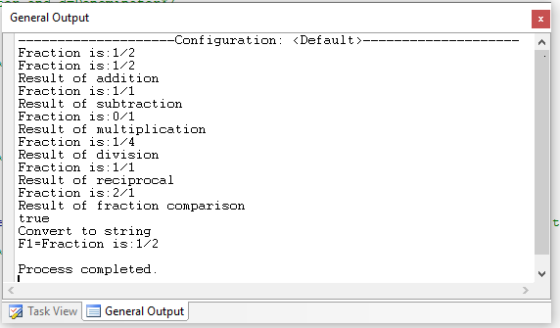
/* Snapshot of output screen */
Add Answer to:
Consider a class Fraction of fractions. Each fraction is signed
and has a numerator and a...
I need help with the following Java code Consider a class Fraction of fractions. Each fraction...
I need help with the following Java code Consider a class Fraction of fractions. Each fraction is signed and has a numerator and a denominator that are integers. Your class should be able to add, subtract, multiply, and divide two fractions. These methods should have a fraction as a parameter and should return the result of the operation as a fraction. The class should also be able to find the reciprocal of a fraction, compare two fractions, decide whether two...
Create a fraction class. This will have two attributes, a numerator and a denominator, both int....
Create a fraction class. This will have two attributes, a numerator and a denominator, both int. This class will have constructors accessors and mutators (for the attributes) a toString method which will allow us to print the fraction in the form 3/4 an Add method so we can add two fractions a subtract method (subtracts one fraction from the other) a multiply method (multiply two fractions) a divide method (divides one fraction by the other) DO NOT (for now) worry...
C++ Problem 1 Write a function to calculate the greatest common divisor (GCD) of two integers...
C++ Problem 1 Write a function to calculate the greatest common divisor (GCD) of two integers using Euclid’s algorithm (also known as the Euclidean algorithm). Write a main () function that requests two integers from the user, calls your function to compute the GCD, and outputs the return value of the function (all user input and output should be done in main ()). In particular, you will find this pseudocode for calculating the GCD, which should be useful to you:...
Design a class named Fraction. This class is used to represent a ratio of two integers,...
Design a class named Fraction. This class is used to represent a ratio of two integers, such as 6 / 9. Include accessors and mutators that allow the user to get and set the numerator and the denominator. Also include a member method that returns the value of the numerator divided by the denominator as double (for example, 0.666…). Include an additional member method that returns the value of the fraction reduced to lowest terms as string. For example, instead...
java only no c++ Write a Fraction class whose objects will represent fractions. You should provide...
java only no c++ Write a Fraction class whose objects will represent fractions. You should provide the following class methods: Two constructors, a parameter-less constructor that assigns the value 0 to the Fraction, and a constructor that takes two parameters. The first parameter will represent the initial numerator of the Fraction, and the second parameter will represent the initial denominator of the Fraction. Arithmetic operations that add, subtract, multiply, and divide Fractions. These should be implemented as value returning methods...
Must write in Java - ignore the Junit tests Write a program that works with fractions....
Must write in Java - ignore the Junit tests Write a program that works with fractions. You are first to implement three methods, each to perform a different calculation on a pair of fractions: subtract, multiply, and divide. For each of these methods, you are supplied two fractions as arguments, each a two-element array (the numerator is at index 0, the denominator is at index 1), and you are to return a resulting, simplified fraction as a new two-element array...
This in in C# There are two classes, class Fraction and class FractionDemo The user needs...
This in in C# There are two classes, class Fraction and class FractionDemo The user needs to be able to input a value for the numerator and the denominator Create a Fraction class with private fields that hold a positive int numerator and a positive int denominator. In addition, create Properties for each field with the set mutator such that the numerator is greater than or equal to 0 and the denominator is greater than 0 (illegal values should be...
Write a Fraction class. An example of a fraction is 1/2. Note that C/C++ will convert...
 Write a Fraction class. An example of a fraction is 1/2. Note that C/C++ will convert it to 0.5, but for this problem, it should still be displayed as 1/2. You should have at least the following two private member variables: numerator (top part), and denominator (bottom part). Overload the following operators: ==, +, << and >>. Also, implement the default constructor and a second constructor that takes two arguments for the numerator and the denominator. Make sure the denominator...
Need help with Java for Fraction exercise
Add another public method called add to your Fraction class. This method adds another fraction to the ‘calling object’. Thus, the method will take a Fraction class object as a parameter, add this parameter fraction to the calling object (fraction), and return a Fraction object as a result. HINT: We can use cross multiplication to determine the numerator of the resultant Fraction. The denominator of the resultant Fraction is simply the multiplication of the denominators of the two other Fractions.Add...
Consider the following code for a Fraction class: self. numerator = 0 self tsn return self. denominator # Greatest Common Divisor def GCD (self, m, n): while n != 0: m=t return m def reduce(self...
 Consider the following code for a Fraction class: self. numerator = 0 self tsn return self. denominator # Greatest Common Divisor def GCD (self, m, n): while n != 0: m=t return m def reduce(self): gcd - self.GCD(self._numerator, self._denominator) self. numerator int(self,_numerator / gcd) self'-denominator înt (self-denominator, gcd) def_str (self): 프 str(self-numerator). "ItDenominator, return "Numerator : str(self,-deno 프, . minator) Write a Unittest framework class to test the GCD method presented in the Fraction class Upload your answer code to...
 Write a Fraction class. An example of a fraction is 1/2. Note that C/C++ will convert it to 0.5, but for this problem, it should still be displayed as 1/2. You should have at least the following two private member variables: numerator (top part), and denominator (bottom part). Overload the following operators: ==, +, << and >>. Also, implement the default constructor and a second constructor that takes two arguments for the numerator and the denominator. Make sure the denominator...
 Consider the following code for a Fraction class: self. numerator = 0 self tsn return self. denominator # Greatest Common Divisor def GCD (self, m, n): while n != 0: m=t return m def reduce(self): gcd - self.GCD(self._numerator, self._denominator) self. numerator int(self,_numerator / gcd) self'-denominator înt (self-denominator, gcd) def_str (self): 프 str(self-numerator). "ItDenominator, return "Numerator : str(self,-deno 프, . minator) Write a Unittest framework class to test the GCD method presented in the Fraction class Upload your answer code to...
Most questions answered within 3 hours.
-
Where is the error in this code sequence?
String s1 = "Hello";
String s2 = "ello";...
asked 11 months ago -
Financial data for Joel de Paris, Inc., for last year
follow:
Joel de Paris, Inc.
Balance...
asked 11 months ago -
Consider this reaction:
Al2(SO4)3 (aq)+ BaCl3
(aq) Al2Cl6 (aq)- +
3BaSO4(s) . What is the...
asked 11 months ago -
Suppose that Savneet is considering increasing her
recent random sample from 20 car rentals to 40...
asked 11 months ago -
Trucks arrive at an unloading terminal at an average rate of 120
per hour.
Trucks arrive...
asked 11 months ago -
Why are methanol and ethanol completely soluble in water while
octanol is not very little soluble....
asked 11 months ago -
A facilities manager at a university reads in a research report
that the mean amount of...
asked 11 months ago -
When the CuSO4 is rehydrated by adding water to the anhydrous
compound, is this an endothermic...
asked 11 months ago -
A ray of sunlight is passing from diamond into crown glass; the
angle of incidence is...
asked 11 months ago -
A block of mass 0.249 kg is placed on top of a light, vertical
spring of...
asked 11 months ago -
how do the kidneys compensate in the presences of acidosis
a) trigger hyperventilate
b) reserve acid...
asked 11 months ago -
Question 501 pts
The rental rate of capital to the firm increases. Which of the
following...
asked 11 months ago