Specific enolates of unsymmetrical ketones can be obtained by reduction of an alpha, beta-unsaturated ketone (enone)...
Specific enolates of unsymmetrical ketones can be obtained by reduction of an alpha, beta-unsaturated ketone (enone) with lithium-(0) in liquefied ammonia. Alkylation of the derived enolate gives an alpha-alkyl derivative of the corresponding saturated ketone, which is not the same as that obtained by a base-mediated enolization/alkylation of the saturated ketone itself.
Provide an explanation for the turnover in the regiochemical course of the alkylation reactions.
Homework Answers
Enone reduction by dissolved metal (Li/NH3);
metal The dissolving metal reduction (Li/NH3) of enones by lithium metal in liquid ammonia is C=C bond of the enone is reduced, with the C=O bond remaining unaffected. Alcohol is required as a proton source and, in total, two electrons and two protons are added in a stepwise manner, giving net addition of a molecule of hydrogen to the double bond.
Sodium metal gives a single electron which forms a radical anion that is protonated by the alcohol to form a radical. A second electron transfer forms an anion that can undergo tautomerization to an enolate.
The enolate is stable to further reduction and protonation during the work-up will give a ketone. But reaction with an alkyl halide is more useful, because of the enolate forms only where the double bond of the enone was, regioselective alkylation becomes possible.
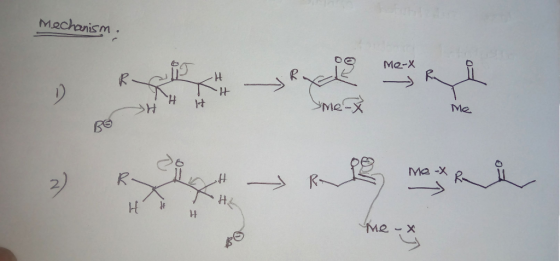
 In the above two reactions,
one side of ketone only alkylation reaction happened. Another side
of the ketone not affected by alkylation. Thus Specific
enolates of unsymmetrical ketones can be obtained by reduction of
an alpha, beta-unsaturated ketone (enone) with lithium-(0) in
liquefied ammonia.
In the above two reactions,
one side of ketone only alkylation reaction happened. Another side
of the ketone not affected by alkylation. Thus Specific
enolates of unsymmetrical ketones can be obtained by reduction of
an alpha, beta-unsaturated ketone (enone) with lithium-(0) in
liquefied ammonia.
Simple ketone on alkylation gives two different product;
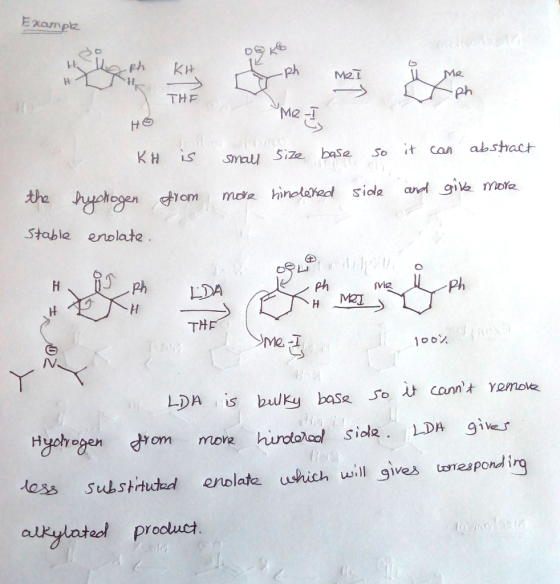
From the above reaction, we can confirm that simple ketone gives different regiometric products. The regioisomers are formed based on the which base we are used for making enolates.
The bulky base gives a less substituted product
The small base gives a more substituted product.
Add Answer to:
Specific enolates of unsymmetrical ketones can be obtained by
reduction of an alpha, beta-unsaturated ketone (enone)...
Rheosmin is a saturated ketone obtained from an alpha,beta-unsaturated ketone (a crossed aldol condensation product) which...
 Rheosmin is a saturated ketone obtained from an
alpha,beta-unsaturated ketone (a crossed aldol condensation
product) which is capable of undergoing hydrogenation to yield a
saturated ketone (Rheosmin). Using this technique, identify the
reagents needed to prepare Rheosmin via crossed aldol reaction.
Rheosmin 4-(4-hydroxyphenyl)butan-2-one
Rheosmin is a saturated ketone obtained from an
alpha,beta-unsaturated ketone (a crossed aldol condensation
product) which is capable of undergoing hydrogenation to yield a
saturated ketone (Rheosmin). Using this technique, identify the
reagents needed to prepare Rheosmin via crossed aldol reaction.
Rheosmin 4-(4-hydroxyphenyl)butan-2-one
 Rheosmin is a saturated ketone obtained from an
alpha,beta-unsaturated ketone (a crossed aldol condensation
product) which is capable of undergoing hydrogenation to yield a
saturated ketone (Rheosmin). Using this technique, identify the
reagents needed to prepare Rheosmin via crossed aldol reaction.
Rheosmin 4-(4-hydroxyphenyl)butan-2-one
Rheosmin is a saturated ketone obtained from an
alpha,beta-unsaturated ketone (a crossed aldol condensation
product) which is capable of undergoing hydrogenation to yield a
saturated ketone (Rheosmin). Using this technique, identify the
reagents needed to prepare Rheosmin via crossed aldol reaction.
Rheosmin 4-(4-hydroxyphenyl)butan-2-one
Most questions answered within 3 hours.
-
Where is the error in this code sequence?
String s1 = "Hello";
String s2 = "ello";...
asked 11 months ago -
Financial data for Joel de Paris, Inc., for last year
follow:
Joel de Paris, Inc.
Balance...
asked 11 months ago -
Consider this reaction:
Al2(SO4)3 (aq)+ BaCl3
(aq) Al2Cl6 (aq)- +
3BaSO4(s) . What is the...
asked 11 months ago -
Suppose that Savneet is considering increasing her
recent random sample from 20 car rentals to 40...
asked 11 months ago -
Trucks arrive at an unloading terminal at an average rate of 120
per hour.
Trucks arrive...
asked 11 months ago -
Why are methanol and ethanol completely soluble in water while
octanol is not very little soluble....
asked 11 months ago -
A facilities manager at a university reads in a research report
that the mean amount of...
asked 11 months ago -
When the CuSO4 is rehydrated by adding water to the anhydrous
compound, is this an endothermic...
asked 11 months ago -
A ray of sunlight is passing from diamond into crown glass; the
angle of incidence is...
asked 11 months ago -
A block of mass 0.249 kg is placed on top of a light, vertical
spring of...
asked 11 months ago -
how do the kidneys compensate in the presences of acidosis
a) trigger hyperventilate
b) reserve acid...
asked 11 months ago -
Question 501 pts
The rental rate of capital to the firm increases. Which of the
following...
asked 11 months ago