Suppose that a price-searcher firm had consumers who were all identical to each other. The individual...
Suppose that a price-searcher firm had consumers who were all identical to each other. The individual consumer's demand function is given by: qD= 40-4P. The firm decides to try a second-degree price discrimination scheme. The first 18 units will have a price of $5.50. After that, any units a consumer purchases will be only $2.75. The firm has a constant marginal cost of $1.00per unit.
Calculate the consumer surplus.
Homework Answers
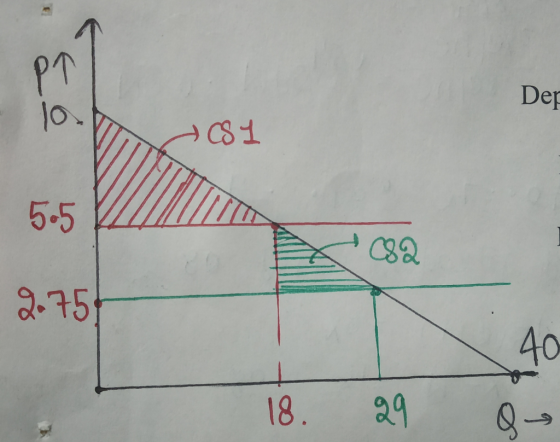
When P = 2.75, Q = 40 - 4*2.75 = 29
So total units from 18 to 29 are sold at Price = 2.75.
so total CS = CS1 + CS2
= [.5*(10-5.5)*18 ] + [ .5*(5.5-2.75)*(29-18)]
= 40.5 + 15.125
= 55.625
Add Answer to:
Suppose that a price-searcher firm had consumers who were all
identical to each other. The individual...
Suppose that a price-searcher firm had consumers who were all identical to each other. The individual...
Suppose that a price-searcher firm had consumers who were all identical to each other. The individual consumer's demand function is given by: qD= 40 -3P. The firm decides to try a second-degree price discrimination scheme. The first 18 units will have a price of $7.33. After that, any units a consumer purchases will be only $2.33. The firm has a constant marginal cost of $1.33 per unit. Calculate the consumer surplus
Suppose that a price-searcher firm had consumers who were all identical to each other. The individual...
 Suppose that a price-searcher firm had consumers who were all identical to each other. The individual consumer's demand function is given by: p= 20 -5P. The firm decides to try a second-degree price discrimination scheme. The first 9 units will have a price of $2.20. After that, any units a consumer purchases will be only $1.40. The firm has a constant marginal cost of $0.20 per unit. Calculate the consumer surplus. (Do not include a "S" sign in your response....
Question 11 Suppose that a price-searcher firm had consumers who were all identical to each other....
 Question 11 Suppose that a price-searcher firm had consumers who were all identical to each other. The individual consumer's demand function is given by: qp- 40 -3P. The firm decides to try a second-degree price discrimination scheme. The first 18 units will have a price of $7.33. After that, any units a consumer purchases will be only $2.33. The firm has a constant marginal cost of $1.33 per unit. Calculate the consumer surplus. Tries remaining:2 Points out of 8.33 Flag...
Question 11 Tries remaining: 2 Points out of 8.33 P Flag question Suppose that a price-searcher...
 Question 11 Tries remaining: 2 Points out of 8.33 P Flag question Suppose that a price-searcher firm had consumers who were all identical to each other. The individual consumer's demand function is givenby: 10 -5P. The firm decides to try a second-degree price discrimination scheme. The first 2 units will have a price of $1.60. After that, any units a consumer purchases will be only $1.20. The firm has a constant marginal cost of $1.00 per unit. Calculate the consumer...
Suppose that a price-searcher firm was going to use a first degree price discrimination strategy. The...
 Suppose that a price-searcher firm was going to use a first degree price discrimination strategy. The demand for their product is given by: Qp= 170-P. The firm has a constant marginal cost of $21.00 per unit. Calculate the producer surplus the firm would earn from this strategy. (Do not include a "$" sign in your response. Round to the nearest two decimal places if necessary.) Answer: Check
Question 12 Tries remaining: 2 Points out of 8.33 A price-searcher firm wants to try a...
 Question 12 Tries remaining: 2 Points out of 8.33 A price-searcher firm wants to try a two-part tariff. The firm's marginal cost is a constant $10 and it will charge that as the per unit price. To complicate things, the firm has two different groups of consumers. There are 10 consumers who have a demand function given by: qp-16-0.5P. There are also 40 consumers who have a demand function given by: qp-8-0.25P Flag question If the firm charges a fee...
Problem 1. Second Degree price discrimination Suppose all consumers are identical and market demand given by...
 Problem 1. Second Degree price discrimination Suppose all consumers are identical and market demand given by p = 100-q. The monopoly's cost function is C(q) q2. (a) Suppose the monopolist cannot discriminate prices and must set a uniform price. Compute price and quantity set by the monopolist. Compute the profit of the monopoly. b) Suppose now that the monopoly can set a two-part tariff. Find the optimal two-part tariff. Compute the profit of the monopolist Problem 2. Third Degree price...
D Question 17 1 pts Consider a monopolist that has two types of consumers. The first, students have a demand curve give...
 D Question 17 1 pts Consider a monopolist that has two types of consumers. The first, students have a demand curve given by the following: QA-120-2P. The second type of consumer are non-students who have the following demand curve: QB-200-4P. If the monopolist has constant marginal and average cost equal to 10, which of the following is true if the monopolist practices third degree price discrimination? Total profit earned equals 2150. Total profit earned equals 2250 Total profnt earned equals...
D Question 15 1 pts Consider a monopolist that has two types of consumers. The first, students have a demand curve give...
 D Question 15 1 pts Consider a monopolist that has two types of consumers. The first, students have a demand curve given by the following: QA-120-2P. The second type of consumer is non-students who have the following demand curve: QB-200-4P. If the monopolist has constant marginal and average cost equal to 10, which of the following is truef the monopolist practices third degree price discrimination? The price charged to student equals 35 and non-students equals 60 The price charged to...
4. In the competit ve market for widgets there are 50 identical consumers and 200 iden tical firms. Each individual...
 4. In the competit ve market for widgets there are 50 identical consumers and 200 iden tical firms. Each individual consumer has the following demand function for widgets P(P) 100 2P where qD is the quantity an individual consumes and P is the widget's price. Each firm has the following cost function: C() 100 2qq (a) (3 points) Find the market demand function for widgets QP(P). Find the industry supply function for widgets Qs(P), make sure to find each firm's...
 Suppose that a price-searcher firm had consumers who were all identical to each other. The individual consumer's demand function is given by: p= 20 -5P. The firm decides to try a second-degree price discrimination scheme. The first 9 units will have a price of $2.20. After that, any units a consumer purchases will be only $1.40. The firm has a constant marginal cost of $0.20 per unit. Calculate the consumer surplus. (Do not include a "S" sign in your response....
 Question 11 Suppose that a price-searcher firm had consumers who were all identical to each other. The individual consumer's demand function is given by: qp- 40 -3P. The firm decides to try a second-degree price discrimination scheme. The first 18 units will have a price of $7.33. After that, any units a consumer purchases will be only $2.33. The firm has a constant marginal cost of $1.33 per unit. Calculate the consumer surplus. Tries remaining:2 Points out of 8.33 Flag...
 Question 11 Tries remaining: 2 Points out of 8.33 P Flag question Suppose that a price-searcher firm had consumers who were all identical to each other. The individual consumer's demand function is givenby: 10 -5P. The firm decides to try a second-degree price discrimination scheme. The first 2 units will have a price of $1.60. After that, any units a consumer purchases will be only $1.20. The firm has a constant marginal cost of $1.00 per unit. Calculate the consumer...
 Suppose that a price-searcher firm was going to use a first degree price discrimination strategy. The demand for their product is given by: Qp= 170-P. The firm has a constant marginal cost of $21.00 per unit. Calculate the producer surplus the firm would earn from this strategy. (Do not include a "$" sign in your response. Round to the nearest two decimal places if necessary.) Answer: Check
 Question 12 Tries remaining: 2 Points out of 8.33 A price-searcher firm wants to try a two-part tariff. The firm's marginal cost is a constant $10 and it will charge that as the per unit price. To complicate things, the firm has two different groups of consumers. There are 10 consumers who have a demand function given by: qp-16-0.5P. There are also 40 consumers who have a demand function given by: qp-8-0.25P Flag question If the firm charges a fee...
 Problem 1. Second Degree price discrimination Suppose all consumers are identical and market demand given by p = 100-q. The monopoly's cost function is C(q) q2. (a) Suppose the monopolist cannot discriminate prices and must set a uniform price. Compute price and quantity set by the monopolist. Compute the profit of the monopoly. b) Suppose now that the monopoly can set a two-part tariff. Find the optimal two-part tariff. Compute the profit of the monopolist Problem 2. Third Degree price...
 D Question 17 1 pts Consider a monopolist that has two types of consumers. The first, students have a demand curve given by the following: QA-120-2P. The second type of consumer are non-students who have the following demand curve: QB-200-4P. If the monopolist has constant marginal and average cost equal to 10, which of the following is true if the monopolist practices third degree price discrimination? Total profit earned equals 2150. Total profit earned equals 2250 Total profnt earned equals...
 D Question 15 1 pts Consider a monopolist that has two types of consumers. The first, students have a demand curve given by the following: QA-120-2P. The second type of consumer is non-students who have the following demand curve: QB-200-4P. If the monopolist has constant marginal and average cost equal to 10, which of the following is truef the monopolist practices third degree price discrimination? The price charged to student equals 35 and non-students equals 60 The price charged to...
 4. In the competit ve market for widgets there are 50 identical consumers and 200 iden tical firms. Each individual consumer has the following demand function for widgets P(P) 100 2P where qD is the quantity an individual consumes and P is the widget's price. Each firm has the following cost function: C() 100 2qq (a) (3 points) Find the market demand function for widgets QP(P). Find the industry supply function for widgets Qs(P), make sure to find each firm's...
Most questions answered within 3 hours.
-
Where is the error in this code sequence?
String s1 = "Hello";
String s2 = "ello";...
asked 11 months ago -
Financial data for Joel de Paris, Inc., for last year
follow:
Joel de Paris, Inc.
Balance...
asked 11 months ago -
Consider this reaction:
Al2(SO4)3 (aq)+ BaCl3
(aq) Al2Cl6 (aq)- +
3BaSO4(s) . What is the...
asked 11 months ago -
Suppose that Savneet is considering increasing her
recent random sample from 20 car rentals to 40...
asked 11 months ago -
Trucks arrive at an unloading terminal at an average rate of 120
per hour.
Trucks arrive...
asked 11 months ago -
Why are methanol and ethanol completely soluble in water while
octanol is not very little soluble....
asked 11 months ago -
A facilities manager at a university reads in a research report
that the mean amount of...
asked 11 months ago -
When the CuSO4 is rehydrated by adding water to the anhydrous
compound, is this an endothermic...
asked 11 months ago -
A ray of sunlight is passing from diamond into crown glass; the
angle of incidence is...
asked 11 months ago -
A block of mass 0.249 kg is placed on top of a light, vertical
spring of...
asked 11 months ago -
how do the kidneys compensate in the presences of acidosis
a) trigger hyperventilate
b) reserve acid...
asked 11 months ago -
Question 501 pts
The rental rate of capital to the firm increases. Which of the
following...
asked 11 months ago