One of the following contractual provisions in the corporate bond decreases the required rate of return...
One of the following contractual provisions in the corporate bond decreases the required rate of return if other factors are constant. What is it?
(1) Make-whole call provision
(2) Step-up bond
(3) Subordinate debenture
(4) Payment-in-kind bond
Homework Answers
1. MAKE - WHOLE CALL PROVISION
A make whole call provision is a type of call provision on a bond allowing the issuer to pay off remaining debt early. The issuer typically has to make a lump sum payment to the investor derived from a formula based on the net present value (NPV) of future coupon payments that will not be paid incrementally because of the call combined with the principal payment the investor would have received at maturity. A lump sum payment paid to an investor in a make whole call provision is equal to the NPV of these future payments as agreed upon in the make whole call provision within the indenture. The NPV is calculated based on the market discount rate. So when it decides to wind up the tenure and pay them at the present value leads to the decrease in the required rate of return therefore.
Add Answer to:
One of the following contractual provisions in the corporate
bond decreases the required rate of return...
How does the following feature of a bond affect the required rate of return on the bond? Explain. a. Call provision b. Put provision c. Sinking fund
How does the following feature of a bond affect the required rate of return on the bond? Explain. a. Call provision b. Put provision c. Sinking fund
Mrs. G is looking to invest in a corporate bond, or a callable corporate bond. She...
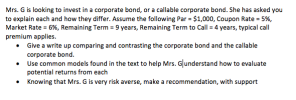 Mrs. G is looking to invest in a corporate bond, or a callable corporate bond. She has asked you to explain each and how they differ. Assume the following Par = $1,000, Coupon Rate = 5%, Market Rate = 6%, Remaining Term = 9 years, Remaining Term to Call = 4 years, typical call premium applies. • Give a write up comparing and contrasting the corporate bond and the callable corporate bond. • Use common models found in the text...
7. A low coupon bond will have more price elasticity i.e., more sensitive to interest rate...
 7. A low coupon bond will have more price elasticity i.e., more sensitive to interest rate changes) than a high coupon bond. 8. Other things held constant, increasing a stock's required rate of return will increase the price you are willing to pay for the stock. 9. The price of an outstanding corporate bond decreases as the yield on similar securities with similar maturity and risk increases. 10. According to the "green video" on the recent financial crisis, one of...
Which of the following statements is not true? When referring to bonds, expected rate of return...
Which of the following statements is not true? When referring to bonds, expected rate of return and yield to maturity are often used interchangeably. The par value of a corporate bond indicates the payment that the issuer promises to make to the bondholder at maturity. The sum of the present values of an investment's expected future cash flows is known as the investment’s intrinsic value. The restrictive provisions contained in the bond indenture protect the common stockholders. To determine the...
An investor purchases one municipal bond and one corporate bond that pay rates of return of...
An investor purchases one municipal bond and one corporate bond that pay rates of return of 7% and 8.5%, respectively. If the investor is in the 20% tax bracket, his after-tax rates of return on the municipal and corporate bonds would be, respectively, _____. An investor buys a T-bill at a bank discount quote of 5.40 with 90 days to maturity. The investor's actual annual rate of return on this investment is _____. What is the tax exempt equivalent yield...
Analyze the 20-year, 8% coupon rate (annual payment), $1,000 par value bond. The bond currently sells...
 Analyze the 20-year, 8% coupon rate (annual payment), $1,000 par value bond. The bond currently sells for $1,318. What's the bond's yield to maturity? o o 5.36% 5.68% o 6.75% o 7.85% A 10-year corporate bond has an annual coupon payment of 8%. The bond is currently selling at par ($1.000). Which of the following statement is NOT correct? The bond's yield to maturity is 8%. The bond's current yield is 8%. If the bond's yield to maturity remains constant,...
All but which one of the following will tend to reduce the required yield on a...
All but which one of the following will tend to reduce the required yield on a corporate bond? A.) A sinking fund where the issuer may repurchase a given fraction of the outstanding bonds each year. B.) A call provision with a five year deferred call. C.) A requirement that all future debt issues must be subordinated to the current debt. D.) A sinking fund where the issuer sets aside money each year to ensure the bond principal can be...
PANSION PLANS ase FINANCING EAST COAST YACHTS'S EXPANSION P WITH A BOND ISSUE er 3), Larissa...
 PANSION PLANS ase FINANCING EAST COAST YACHTS'S EXPANSION P WITH A BOND ISSUE er 3), Larissa After Dan's EFN analysis for East Coast Yachts (see the Mini Case in Chapter 3). LA has decided to expand the company's operations. She has asked Dan to enlist an underw to help sell $50 million in new 20-year bonds to finance new construction. Dan has en into discussions with Kendahl Shoemaker, an underwriter from the firm of Crowe & Malla about which bond...
Variable Name options are: "Bond' semiannual coupon payment" "bonds annual coupon payment" "bondholders required return" For...
 Variable Name options are:
"Bond' semiannual coupon payment" "bonds annual coupon payment"
"bondholders required return"
For example, assume Noah wants to earn a return of 15.75% and is offered the opportunity to purchase a $1,000 par value bond that pays a 18.00% coupon rate (distributed semiannually) with three years remaining to maturity. The following formula can be used to compute the bond's intrinsic value Intrinsic Value zGL t 7. 07 Complete the following table by identifying the appropriate corresponding variables...
Variable Name options are:
"Bond' semiannual coupon payment" "bonds annual coupon payment"
"bondholders required return"
For example, assume Noah wants to earn a return of 15.75% and is offered the opportunity to purchase a $1,000 par value bond that pays a 18.00% coupon rate (distributed semiannually) with three years remaining to maturity. The following formula can be used to compute the bond's intrinsic value Intrinsic Value zGL t 7. 07 Complete the following table by identifying the appropriate corresponding variables...
A $1,000 corporate bond has a maturity date 20 years from now and a coupon rate...
A $1,000 corporate bond has a maturity date 20 years from now and a coupon rate of 6 percent paid annually. Calculate the value of the bond if the required rate of return is a) 4% b) 6% c) 8%. Strip the bond into an interest only bond and a face value only bond. That is, create a bond that consists only of the coupon interest payments and one that consists only of the face value. Calculate the value of...
 Mrs. G is looking to invest in a corporate bond, or a callable corporate bond. She has asked you to explain each and how they differ. Assume the following Par = $1,000, Coupon Rate = 5%, Market Rate = 6%, Remaining Term = 9 years, Remaining Term to Call = 4 years, typical call premium applies. • Give a write up comparing and contrasting the corporate bond and the callable corporate bond. • Use common models found in the text...
 7. A low coupon bond will have more price elasticity i.e., more sensitive to interest rate changes) than a high coupon bond. 8. Other things held constant, increasing a stock's required rate of return will increase the price you are willing to pay for the stock. 9. The price of an outstanding corporate bond decreases as the yield on similar securities with similar maturity and risk increases. 10. According to the "green video" on the recent financial crisis, one of...
 Analyze the 20-year, 8% coupon rate (annual payment), $1,000 par value bond. The bond currently sells for $1,318. What's the bond's yield to maturity? o o 5.36% 5.68% o 6.75% o 7.85% A 10-year corporate bond has an annual coupon payment of 8%. The bond is currently selling at par ($1.000). Which of the following statement is NOT correct? The bond's yield to maturity is 8%. The bond's current yield is 8%. If the bond's yield to maturity remains constant,...
 PANSION PLANS ase FINANCING EAST COAST YACHTS'S EXPANSION P WITH A BOND ISSUE er 3), Larissa After Dan's EFN analysis for East Coast Yachts (see the Mini Case in Chapter 3). LA has decided to expand the company's operations. She has asked Dan to enlist an underw to help sell $50 million in new 20-year bonds to finance new construction. Dan has en into discussions with Kendahl Shoemaker, an underwriter from the firm of Crowe & Malla about which bond...
 Variable Name options are:
"Bond' semiannual coupon payment" "bonds annual coupon payment"
"bondholders required return"
For example, assume Noah wants to earn a return of 15.75% and is offered the opportunity to purchase a $1,000 par value bond that pays a 18.00% coupon rate (distributed semiannually) with three years remaining to maturity. The following formula can be used to compute the bond's intrinsic value Intrinsic Value zGL t 7. 07 Complete the following table by identifying the appropriate corresponding variables...
Variable Name options are:
"Bond' semiannual coupon payment" "bonds annual coupon payment"
"bondholders required return"
For example, assume Noah wants to earn a return of 15.75% and is offered the opportunity to purchase a $1,000 par value bond that pays a 18.00% coupon rate (distributed semiannually) with three years remaining to maturity. The following formula can be used to compute the bond's intrinsic value Intrinsic Value zGL t 7. 07 Complete the following table by identifying the appropriate corresponding variables...
Most questions answered within 3 hours.
-
Where is the error in this code sequence?
String s1 = "Hello";
String s2 = "ello";...
asked 11 months ago -
Financial data for Joel de Paris, Inc., for last year
follow:
Joel de Paris, Inc.
Balance...
asked 11 months ago -
Consider this reaction:
Al2(SO4)3 (aq)+ BaCl3
(aq) Al2Cl6 (aq)- +
3BaSO4(s) . What is the...
asked 11 months ago -
Suppose that Savneet is considering increasing her
recent random sample from 20 car rentals to 40...
asked 11 months ago -
Trucks arrive at an unloading terminal at an average rate of 120
per hour.
Trucks arrive...
asked 11 months ago -
Why are methanol and ethanol completely soluble in water while
octanol is not very little soluble....
asked 11 months ago -
A facilities manager at a university reads in a research report
that the mean amount of...
asked 11 months ago -
When the CuSO4 is rehydrated by adding water to the anhydrous
compound, is this an endothermic...
asked 11 months ago -
A ray of sunlight is passing from diamond into crown glass; the
angle of incidence is...
asked 11 months ago -
A block of mass 0.249 kg is placed on top of a light, vertical
spring of...
asked 11 months ago -
how do the kidneys compensate in the presences of acidosis
a) trigger hyperventilate
b) reserve acid...
asked 11 months ago -
Question 501 pts
The rental rate of capital to the firm increases. Which of the
following...
asked 11 months ago