The FBI wants to determine the effectiveness of their 1010 Most Wanted list. To do so,...
The FBI wants to determine the effectiveness of their 1010 Most Wanted list. To do so, they need to find out the fraction of people who appear on the list that are actually caught. In an earlier study, the population proportion was estimated to be 0.38
How large a sample would be required in order to estimate the fraction of people who are captured after appearing on the 1010 Most Wanted list at the 95% confidence level with an error of at most 0.04? Round your answer up to the next integer.
Homework Answers
From standard normal tables, we have:
P(-1.96 < Z < 1.96) = 0.95
The margin of error here is computed as:
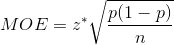

Therefore 566 is the sample size required here.
Add Answer to:
The FBI wants to determine the effectiveness of their 1010 Most
Wanted list. To do so,...
The FBI wants to determine the effectiveness of their 10 Most Wanted list. To do so,...
The FBI wants to determine the effectiveness of their 10 Most Wanted list. To do so, they need to find out the fraction of people who appear on the list that are actually caught. In an earlier study, the population proportion was estimated to be 0.31. How large a sample would be required in order to estimate the fraction of people who are captured after appearing on the 10 Most Wanted list at the 98% confidence level with an error...
The FBI wants to determine the effectiveness of their 1010 Most Wanted list. To do so,...
The FBI wants to determine the effectiveness of their 1010 Most Wanted list. To do so, they need to find out the fraction of people who appear on the list that are actually caught. Step 2 of 2 : Suppose a sample of 1753 suspected criminals is drawn. Of these people, 701 were captured. Using the data, construct the 99% confidence interval for the population proportion of people who are captured after appearing on the 1010 Most Wanted list. Round...
The FBI wants to determine the effectiveness of their 10 Most Wanted list. To do so,...
The FBI wants to determine the effectiveness of their 10 Most Wanted list. To do so, they need to find out the fraction of people who appear on the list that are actually caught. Step 1 of 2: Suppose a sample of 547 suspected criminals is drawn. Of these people, 362 were not captured. Using the data, estimate the proportion of people who were caught after being on the 10 Most Wanted list. Enter your answer as a fraction or...
The FBI wants to determine the effectiveness of their 1010 Most Wanted list. To do so,...
The FBI wants to determine the effectiveness of their 1010 Most Wanted list. To do so, they need to find out the fraction of people who appear on the list that are actually caught. Step 1 of 2 : Suppose a sample of 791791 suspected criminals is drawn. Of these people, 546546 were not captured. Using the data, estimate the proportion of people who were caught after being on the 1010 Most Wanted list. Enter your answer as a fraction...
The FBI wants to determine the effectiveness of their 10 Most Wanted list. To do so,...
The FBI wants to determine the effectiveness of their 10 Most Wanted list. To do so, they need to find out the fraction of people who appear on the list that are actually caught. Step 2 of 2 : Suppose a sample of 577 suspected criminals is drawn. Of these people, 318 were not captured. Using the data, construct the 95% confidence interval for the population proportion of people who are captured after appearing on the 10 Most Wanted list....
The FBI wants to determine the effectiveness of their 1010 Most Wanted list. To do so,...
The FBI wants to determine the effectiveness of their 1010 Most Wanted list. To do so, they need to find out the fraction of people who appear on the list that are actually caught. Step 1 of 2 : Suppose a sample of 349 suspected criminals is drawn. Of these people, 255 were not captured. Using the data, estimate the proportion of people who were caught after being on the 10 Most Wanted list. Enter your answer as a fraction...
The FBI wants to determine the effectiveness of their 10 Most Wanted list. To do so,...
The FBI wants to determine the effectiveness of their 10 Most Wanted list. To do so, they need to find out the fraction of people who appear on the list that are actually caught. Step 1 of 2 : Suppose a sample of 782 suspected criminals is drawn. Of these people, 273 were captured. Using the data, estimate the proportion of people who were caught after being on the 10 Most Wanted list. Enter your answer as a fraction or...
The FBI wants to determine the effectiveness of their 10 Most Wanted list. To do so,...
The FBI wants to determine the effectiveness of their 10 Most Wanted list. To do so, they need to find out the fraction of people who appear on the list that are actually caught. Step 1 of 2: Suppose a sample of 283 suspected criminals is drawn. Of these people, 93 were captured. Using the data, estimate the proportion of people who were caught after being on the 1010 Most Wanted list. Enter your answer as a fraction or a...
The FBI wants to determine the effectiveness of their 10 Most Wanted list. To do so,...
The FBI wants to determine the effectiveness of their 10 Most Wanted list. To do so, they need to find out the fraction of people who appear on the list that are actually caught. Step 2 of 2 : Suppose a sample of 465 suspected criminals is drawn. Of these people, 111 were captured. Using the data, construct the 85% confidence interval for the population proportion of people who are captured after appearing on the 10 Most Wanted list. Round...
The FBI wants to determine the effectiveness of their 10 Most Wanted list. To do so,...
The FBI wants to determine the effectiveness of their 10 Most Wanted list. To do so, they need to find out the fraction of people who appear on the list that are actually caught. Step 2 of 2 : Suppose a sample of 739 suspected criminals is drawn. Of these people, 236 were captured. Using the data, construct the 98% confidence interval for the population proportion of people who are captured after appearing on the 10 Most Wanted list. Round...
Most questions answered within 3 hours.
-
Where is the error in this code sequence?
String s1 = "Hello";
String s2 = "ello";...
asked 11 months ago -
Financial data for Joel de Paris, Inc., for last year
follow:
Joel de Paris, Inc.
Balance...
asked 11 months ago -
Consider this reaction:
Al2(SO4)3 (aq)+ BaCl3
(aq) Al2Cl6 (aq)- +
3BaSO4(s) . What is the...
asked 11 months ago -
Suppose that Savneet is considering increasing her
recent random sample from 20 car rentals to 40...
asked 11 months ago -
Trucks arrive at an unloading terminal at an average rate of 120
per hour.
Trucks arrive...
asked 11 months ago -
Why are methanol and ethanol completely soluble in water while
octanol is not very little soluble....
asked 11 months ago -
A facilities manager at a university reads in a research report
that the mean amount of...
asked 11 months ago -
When the CuSO4 is rehydrated by adding water to the anhydrous
compound, is this an endothermic...
asked 11 months ago -
A ray of sunlight is passing from diamond into crown glass; the
angle of incidence is...
asked 11 months ago -
A block of mass 0.249 kg is placed on top of a light, vertical
spring of...
asked 11 months ago -
how do the kidneys compensate in the presences of acidosis
a) trigger hyperventilate
b) reserve acid...
asked 11 months ago -
Question 501 pts
The rental rate of capital to the firm increases. Which of the
following...
asked 11 months ago