Given the following, find the epicentral distance for lag time of 64, 50 and 72 seconds.
Given the following, find the epicentral distance for lag time of 64, 50 and 72 seconds.
Homework Answers
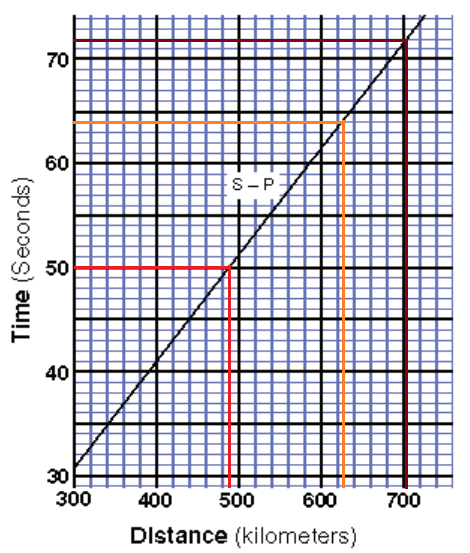
As per the intercepts shown in the above figure the epicentral distance corresponding to various lag time is shown below:
50 seconds = 485 kilometres
64 seconds = 625 kilometres
72 seconds = 703 kilometres
Add Answer to:
Given the following, find the epicentral distance for lag time
of 64, 50 and 72 seconds.
Given the system above, determine the zero location for a lead/lag compensator so the system meets the desired responses: Settles at about 2 seconds Has a percent overshoot of about 50% The plant ha...
 Given the system above, determine the zero location for a
lead/lag compensator so the system meets the desired responses:
Settles at about 2 seconds
Has a percent overshoot of about 50%
The plant has a transfer function of: Gp = (s+14) / (
(s+0)*(s+4) )
Assume that the pole of the lead/lag compensator has a pole at
s = -1.
QUESTION 5 1- GC(s) Gp(s) Y(S) R(S) Given the system above, determine the zero location for a lead/lag compensator so...
Given the system above, determine the zero location for a
lead/lag compensator so the system meets the desired responses:
Settles at about 2 seconds
Has a percent overshoot of about 50%
The plant has a transfer function of: Gp = (s+14) / (
(s+0)*(s+4) )
Assume that the pole of the lead/lag compensator has a pole at
s = -1.
QUESTION 5 1- GC(s) Gp(s) Y(S) R(S) Given the system above, determine the zero location for a lead/lag compensator so...
10. The time,t,in seconds varies directly with the square root of the distance, d, in feet...
 10. The time,t,in seconds varies directly with the square root of the distance, d, in feet that a dropped ball has fallen. It takes 2 seconds for a ball to fall 64 feet. a. Find a formula to model this situation. b. How long would it take for the ball to fall 100 feet?
67 72 56 70 53 30 50 40 50 64 The values in the table are...
 67 72 56 70 53 30 50 40 50 64 The values in the table are part of a study with adults exercise group at a local YMCA. These are the ages (in years) of a sample of people who are part of the study. Based on this data please complete the following: 1. What are the mean, variance, and standard deviation of the sample? a. b. Please sketch the normal curve values for this sample. c. Find the z-scores...
(1 point) The heights of a ball (in feet) at time t (in seconds) is given...
 (1 point) The heights of a ball (in feet) at time t (in seconds) is given by the formula s(t) = 64 - 16(t - 1)2. Consider the following average rate of change expression. AV = $(1) – 8(0.5) 1 -0.5 (a) Compute the value of AV: (b) What are the units on AV? A. feet per second squared B. meters per second C. meters D. feet per second E. seconds F. meters per second squared G. feet (c) What...
According to the USA Swimming association, the distribution of finishing time, in seconds, for a 50-yard...
According to the USA Swimming association, the distribution of finishing time, in seconds, for a 50-yard Freestyle competition for girls 8 years and under is approximately bell-shaped with a mean of 41 seconds and a standard deviation of 5 seconds. 1. Which of the following graphical techniques would be better to help assess if a “bell-shaped” distribution is a reasonable model for the underlying population of such finishing times? Bar Chart Histogram Pie Chart Boxplot 2. Natalie is a 7...
According to the USA Swimming association, the distribution of finishing time, in seconds, for a 50-yard...
According to the USA Swimming association, the distribution of finishing time, in seconds, for a 50-yard Freestyle competition for girls 8 years and under is approximately bell-shaped with a mean of 41 seconds and a standard deviation of 5 seconds. 1. Natalie is a 7 year old girl that participated in a 50-yard Freestyle competition and her finishing time is 36 seconds. Based on the stated model, approximately, what percentage of the 50-yard Freestyle finishing times for girls 8 years...
For the set of tasks given below, do the following: Task Task Time(seconds) Immediate Predecessor A...
For the set of tasks given below, do the following: Task Task Time(seconds) Immediate Predecessor A 45 - B 11 A C 9 B D 50 - E 26 D F 11 E G 12 C H 10 C I 9 F, G, H J 10 I 193 b. Determine the minimum and maximum cycle times in seconds for a desired output of 500 units in a seven-hour day. (Round your answers to 1 decimal place.) I have not been...
#2 & 3. How do I determine the distance at t=4 seconds and the slope at...
 #2 & 3. How do I determine the distance at t=4
seconds and the slope at t=6? show work please.
QUESTIONS: 1. Given the following data, plot a distance vs. time graph for the given situation. Position vs. Time A student 1m away from a motion detector walks away from the motion detector for 3 seconds with a speed of 2m/s,. The student then stops, ponders the value of this lab for the next2 seconds. The student, remembering they left...
#2 & 3. How do I determine the distance at t=4
seconds and the slope at t=6? show work please.
QUESTIONS: 1. Given the following data, plot a distance vs. time graph for the given situation. Position vs. Time A student 1m away from a motion detector walks away from the motion detector for 3 seconds with a speed of 2m/s,. The student then stops, ponders the value of this lab for the next2 seconds. The student, remembering they left...
How much time in seconds does it take to travel this straight line distance? Another similar...
 How much time in seconds does it take to travel this straight line distance? Another similar elevator has been designed to travel a distance of 255 meters It has an acceleration of 0 879 meter per second squared It has a maximum speed of 360 meters per minute. This means that once reaches its maximum speed, i continues the rest of the journey at this maximum speed Hint - you have to do this in two separate parts as you...
Given the system above, determine the gain K for a lead/lag compensator so the system meets the desired responses: Settles at about 2 seconds Has a percent overshoot of about 33% The plant has a tra...
 Given the system above, determine the gain K for a lead/lag
compensator so the system meets the desired responses:
Settles at about 2 seconds
Has a percent overshoot of about 33%
The plant has a transfer function of: Gp = (s+18) / (
(s+1)*(s+8) )
Assume that the pole of the lead/lag compensator has a pole at
s = -5.
1 Gc(s) R(S) Gp(s) Y(S) Given the system above, determine the gain K for a lead/lag compensator so the system...
Given the system above, determine the gain K for a lead/lag
compensator so the system meets the desired responses:
Settles at about 2 seconds
Has a percent overshoot of about 33%
The plant has a transfer function of: Gp = (s+18) / (
(s+1)*(s+8) )
Assume that the pole of the lead/lag compensator has a pole at
s = -5.
1 Gc(s) R(S) Gp(s) Y(S) Given the system above, determine the gain K for a lead/lag compensator so the system...
 Given the system above, determine the zero location for a
lead/lag compensator so the system meets the desired responses:
Settles at about 2 seconds
Has a percent overshoot of about 50%
The plant has a transfer function of: Gp = (s+14) / (
(s+0)*(s+4) )
Assume that the pole of the lead/lag compensator has a pole at
s = -1.
QUESTION 5 1- GC(s) Gp(s) Y(S) R(S) Given the system above, determine the zero location for a lead/lag compensator so...
Given the system above, determine the zero location for a
lead/lag compensator so the system meets the desired responses:
Settles at about 2 seconds
Has a percent overshoot of about 50%
The plant has a transfer function of: Gp = (s+14) / (
(s+0)*(s+4) )
Assume that the pole of the lead/lag compensator has a pole at
s = -1.
QUESTION 5 1- GC(s) Gp(s) Y(S) R(S) Given the system above, determine the zero location for a lead/lag compensator so...
 10. The time,t,in seconds varies directly with the square root of the distance, d, in feet that a dropped ball has fallen. It takes 2 seconds for a ball to fall 64 feet. a. Find a formula to model this situation. b. How long would it take for the ball to fall 100 feet?
 67 72 56 70 53 30 50 40 50 64 The values in the table are part of a study with adults exercise group at a local YMCA. These are the ages (in years) of a sample of people who are part of the study. Based on this data please complete the following: 1. What are the mean, variance, and standard deviation of the sample? a. b. Please sketch the normal curve values for this sample. c. Find the z-scores...
 (1 point) The heights of a ball (in feet) at time t (in seconds) is given by the formula s(t) = 64 - 16(t - 1)2. Consider the following average rate of change expression. AV = $(1) – 8(0.5) 1 -0.5 (a) Compute the value of AV: (b) What are the units on AV? A. feet per second squared B. meters per second C. meters D. feet per second E. seconds F. meters per second squared G. feet (c) What...
 #2 & 3. How do I determine the distance at t=4
seconds and the slope at t=6? show work please.
QUESTIONS: 1. Given the following data, plot a distance vs. time graph for the given situation. Position vs. Time A student 1m away from a motion detector walks away from the motion detector for 3 seconds with a speed of 2m/s,. The student then stops, ponders the value of this lab for the next2 seconds. The student, remembering they left...
#2 & 3. How do I determine the distance at t=4
seconds and the slope at t=6? show work please.
QUESTIONS: 1. Given the following data, plot a distance vs. time graph for the given situation. Position vs. Time A student 1m away from a motion detector walks away from the motion detector for 3 seconds with a speed of 2m/s,. The student then stops, ponders the value of this lab for the next2 seconds. The student, remembering they left...
 How much time in seconds does it take to travel this straight line distance? Another similar elevator has been designed to travel a distance of 255 meters It has an acceleration of 0 879 meter per second squared It has a maximum speed of 360 meters per minute. This means that once reaches its maximum speed, i continues the rest of the journey at this maximum speed Hint - you have to do this in two separate parts as you...
 Given the system above, determine the gain K for a lead/lag
compensator so the system meets the desired responses:
Settles at about 2 seconds
Has a percent overshoot of about 33%
The plant has a transfer function of: Gp = (s+18) / (
(s+1)*(s+8) )
Assume that the pole of the lead/lag compensator has a pole at
s = -5.
1 Gc(s) R(S) Gp(s) Y(S) Given the system above, determine the gain K for a lead/lag compensator so the system...
Given the system above, determine the gain K for a lead/lag
compensator so the system meets the desired responses:
Settles at about 2 seconds
Has a percent overshoot of about 33%
The plant has a transfer function of: Gp = (s+18) / (
(s+1)*(s+8) )
Assume that the pole of the lead/lag compensator has a pole at
s = -5.
1 Gc(s) R(S) Gp(s) Y(S) Given the system above, determine the gain K for a lead/lag compensator so the system...
Most questions answered within 3 hours.
-
Where is the error in this code sequence?
String s1 = "Hello";
String s2 = "ello";...
asked 10 months ago -
Financial data for Joel de Paris, Inc., for last year
follow:
Joel de Paris, Inc.
Balance...
asked 10 months ago -
Consider this reaction:
Al2(SO4)3 (aq)+ BaCl3
(aq) Al2Cl6 (aq)- +
3BaSO4(s) . What is the...
asked 10 months ago -
Suppose that Savneet is considering increasing her
recent random sample from 20 car rentals to 40...
asked 10 months ago -
Trucks arrive at an unloading terminal at an average rate of 120
per hour.
Trucks arrive...
asked 10 months ago -
Why are methanol and ethanol completely soluble in water while
octanol is not very little soluble....
asked 10 months ago -
A facilities manager at a university reads in a research report
that the mean amount of...
asked 10 months ago -
When the CuSO4 is rehydrated by adding water to the anhydrous
compound, is this an endothermic...
asked 10 months ago -
A ray of sunlight is passing from diamond into crown glass; the
angle of incidence is...
asked 10 months ago -
A block of mass 0.249 kg is placed on top of a light, vertical
spring of...
asked 10 months ago -
how do the kidneys compensate in the presences of acidosis
a) trigger hyperventilate
b) reserve acid...
asked 10 months ago -
Question 501 pts
The rental rate of capital to the firm increases. Which of the
following...
asked 10 months ago