Deriving an equation for the magnetic field inside a solenoid Question was: A very long solenoid...
Deriving an equation for the magnetic field inside a solenoid
Question was: A very long solenoid is made of closely-spaced loops with a radius R. If the solenoid carries a current I, find the magnetic field inside the solenoid.
Please explain the process in detail.
Homework Answers
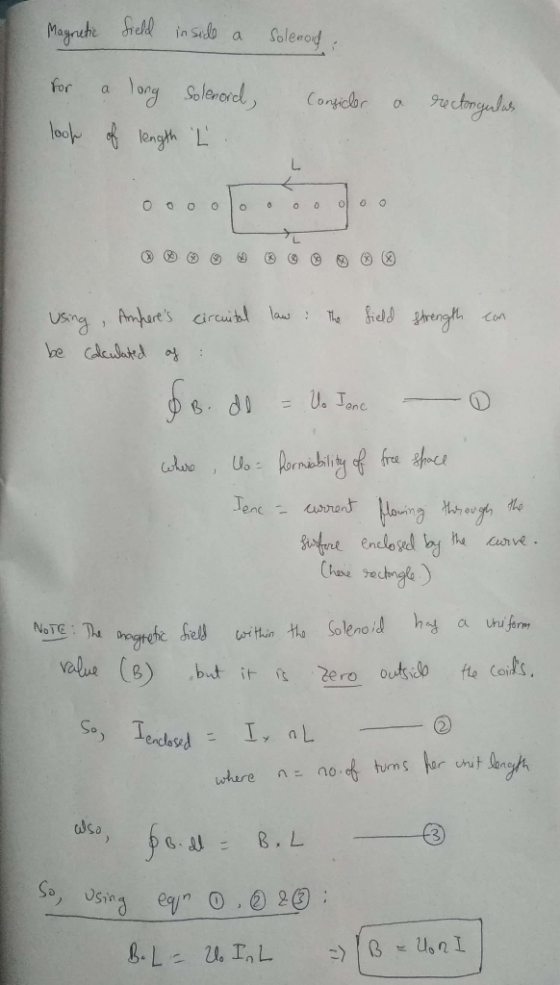
So, the magnetic field inside a long solenoid depends on only n (number of turns per unit length), I (current through the solenoid) but it doesn't depend on the radius, R of the solenoid.
Add Answer to:
Deriving an equation for the magnetic field inside a
solenoid
Question was: A very long solenoid...
Magnetic Field inside a Very Long Solenoid Learning Goal: To apply Ampère's law to find the magnetic field inside an i...
 Magnetic Field inside a Very
Long Solenoid Learning Goal: To apply Ampère's law to find the
magnetic field inside an infinite solenoid. In this problem we will
apply Ampère's law, written ?B? (r? )?dl? =?0Iencl, to calculate
the magnetic field inside a very long solenoid (only a relatively
short segment of the solenoid is shown in the pictures). The
segment of the solenoid shown in (Figure 1) has length L, diameter
D, and n turns per unit length with each...
Magnetic Field inside a Very
Long Solenoid Learning Goal: To apply Ampère's law to find the
magnetic field inside an infinite solenoid. In this problem we will
apply Ampère's law, written ?B? (r? )?dl? =?0Iencl, to calculate
the magnetic field inside a very long solenoid (only a relatively
short segment of the solenoid is shown in the pictures). The
segment of the solenoid shown in (Figure 1) has length L, diameter
D, and n turns per unit length with each...
Calculate the magnetic field inside and outside an infinitely long solenoid of radius R that carr...
Calculate the magnetic field inside and outside an infinitely long solenoid of radius R that carries a current I and has N windings per meter (pretend that the windings are circular). Make sure that you use symmetry to show that some components of the magnetic field are zero, and indicate the symmetry operations you use to do so. Also makes sure that you make drawings of the 3 Amperian loops that you use and indicate which part of the integrals...
2 pts Question 7 What is the magnetic field inside a 5.00-m-long solenoid that has 1000...
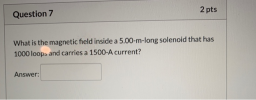 2 pts Question 7 What is the magnetic field inside a 5.00-m-long solenoid that has 1000 loops and carries a 1500-A current? Answer:
Magnetic Field inside a Very Long Solenoid
A.Which figure shows the loop that the must beused as the Ampèrean loop for finding for inside the solenoid?B.Find , the z component ofthe magnetic field insidethe solenoid where Ampère's law applies.Express your answer in terms of,,,,and physical constants such as.C.The magnetic field inside a solenoidcan be found exactly using Ampère's law only if thesolenoid is infinitely long. Otherwise, the Biot-Savartlaw must beused to find an exact answer. In practice, the field can bedetermined with very little error by using...
To apply Ampère's law to find the magnetic field inside an infinite solenoid. In this problem we ...
 To apply Ampère's law to find the magnetic field inside an
infinite solenoid.In this problem we will apply Ampère's law, written∮B⃗ (r⃗ )⋅dl⃗ =μ0Iencl,to calculate the magnetic field inside a very long solenoid
(only a relatively short segment of the solenoid is shown in the
pictures). The segment of the solenoid shown in (Figure 1) has
length L, diameter D, and n turns per unit length with each
carrying current I. It is usual to assume that the component of...
To apply Ampère's law to find the magnetic field inside an
infinite solenoid.In this problem we will apply Ampère's law, written∮B⃗ (r⃗ )⋅dl⃗ =μ0Iencl,to calculate the magnetic field inside a very long solenoid
(only a relatively short segment of the solenoid is shown in the
pictures). The segment of the solenoid shown in (Figure 1) has
length L, diameter D, and n turns per unit length with each
carrying current I. It is usual to assume that the component of...
The magnetic field inside of a solenoid has a magnitude of 0.3 T. The solenoid is...
 The magnetic field inside of a solenoid has a magnitude of 0.3 T. The solenoid is 2 cm long made up of 300 loops of wire. 1592.35 A 0.06 A 4.77 A 15.92 A The magnetic field lines around a bar magnet go from north to south. True False
Problem 5. (4 points) Electric field induced by a changing magnetic field in a solenoid. long...
 Problem 5. (4 points) Electric field induced by a changing magnetic field in a solenoid. long solenoid of radius R = 10 cm has n = 100 turns/cm and carries a time-varying current that varies sinusoidally as I- Imax cos (2rft), where Imax- 10 A is the maximum current and f-60 Hz is the frequency of the alternating current source. What is the maximum magnitude of the induced electric field inside the solenoid, a distance r- 1.3 cm from its...
A solenoid 3.0 cm long consists of 14,000 loops of wire. If the magnetic field inside...
A solenoid 3.0 cm long consists of 14,000 loops of wire. If the magnetic field inside the solenoid is 3.0 T, what is the magnitude of the current that flows through it? Group of answer choices 5.1 A 34 A 9.3 A 2.7 A
3 The magnetic field inside a toroidal solenoid is not uniform as for the long, straight...
 3 The magnetic field inside a toroidal solenoid is not uniform as for the long, straight solenoid. Over the cross-sectional area of the toroid the magnetic field is stronger near the inner HoNI radius of the torus and somewhat weaker near the outer radius according to B(r) 2Tr So we cannot technically use the simple expression P2 = BAfor the flux through one turn of wire. Nevertheless, the textbook uses an approximate constant value for an equivalent uniform magnetic field...
Find the magnetic field (in cylindrical coordinates) both inside and outside of a very long cylindrical...
Find the magnetic field (in cylindrical coordinates) both inside and outside of a very long cylindrical wire of radius R on the z-axis. Inside the wire, current density is given by ? (?) = ?0 (1 − (3?)/(2?) ) ?̂
 Magnetic Field inside a Very
Long Solenoid Learning Goal: To apply Ampère's law to find the
magnetic field inside an infinite solenoid. In this problem we will
apply Ampère's law, written ?B? (r? )?dl? =?0Iencl, to calculate
the magnetic field inside a very long solenoid (only a relatively
short segment of the solenoid is shown in the pictures). The
segment of the solenoid shown in (Figure 1) has length L, diameter
D, and n turns per unit length with each...
Magnetic Field inside a Very
Long Solenoid Learning Goal: To apply Ampère's law to find the
magnetic field inside an infinite solenoid. In this problem we will
apply Ampère's law, written ?B? (r? )?dl? =?0Iencl, to calculate
the magnetic field inside a very long solenoid (only a relatively
short segment of the solenoid is shown in the pictures). The
segment of the solenoid shown in (Figure 1) has length L, diameter
D, and n turns per unit length with each...
 2 pts Question 7 What is the magnetic field inside a 5.00-m-long solenoid that has 1000 loops and carries a 1500-A current? Answer:
 To apply Ampère's law to find the magnetic field inside an
infinite solenoid.In this problem we will apply Ampère's law, written∮B⃗ (r⃗ )⋅dl⃗ =μ0Iencl,to calculate the magnetic field inside a very long solenoid
(only a relatively short segment of the solenoid is shown in the
pictures). The segment of the solenoid shown in (Figure 1) has
length L, diameter D, and n turns per unit length with each
carrying current I. It is usual to assume that the component of...
To apply Ampère's law to find the magnetic field inside an
infinite solenoid.In this problem we will apply Ampère's law, written∮B⃗ (r⃗ )⋅dl⃗ =μ0Iencl,to calculate the magnetic field inside a very long solenoid
(only a relatively short segment of the solenoid is shown in the
pictures). The segment of the solenoid shown in (Figure 1) has
length L, diameter D, and n turns per unit length with each
carrying current I. It is usual to assume that the component of...
 The magnetic field inside of a solenoid has a magnitude of 0.3 T. The solenoid is 2 cm long made up of 300 loops of wire. 1592.35 A 0.06 A 4.77 A 15.92 A The magnetic field lines around a bar magnet go from north to south. True False
 Problem 5. (4 points) Electric field induced by a changing magnetic field in a solenoid. long solenoid of radius R = 10 cm has n = 100 turns/cm and carries a time-varying current that varies sinusoidally as I- Imax cos (2rft), where Imax- 10 A is the maximum current and f-60 Hz is the frequency of the alternating current source. What is the maximum magnitude of the induced electric field inside the solenoid, a distance r- 1.3 cm from its...
 3 The magnetic field inside a toroidal solenoid is not uniform as for the long, straight solenoid. Over the cross-sectional area of the toroid the magnetic field is stronger near the inner HoNI radius of the torus and somewhat weaker near the outer radius according to B(r) 2Tr So we cannot technically use the simple expression P2 = BAfor the flux through one turn of wire. Nevertheless, the textbook uses an approximate constant value for an equivalent uniform magnetic field...
Most questions answered within 3 hours.
-
Where is the error in this code sequence?
String s1 = "Hello";
String s2 = "ello";...
asked 10 months ago -
Financial data for Joel de Paris, Inc., for last year
follow:
Joel de Paris, Inc.
Balance...
asked 10 months ago -
Consider this reaction:
Al2(SO4)3 (aq)+ BaCl3
(aq) Al2Cl6 (aq)- +
3BaSO4(s) . What is the...
asked 10 months ago -
Suppose that Savneet is considering increasing her
recent random sample from 20 car rentals to 40...
asked 10 months ago -
Trucks arrive at an unloading terminal at an average rate of 120
per hour.
Trucks arrive...
asked 10 months ago -
Why are methanol and ethanol completely soluble in water while
octanol is not very little soluble....
asked 10 months ago -
A facilities manager at a university reads in a research report
that the mean amount of...
asked 10 months ago -
When the CuSO4 is rehydrated by adding water to the anhydrous
compound, is this an endothermic...
asked 10 months ago -
A ray of sunlight is passing from diamond into crown glass; the
angle of incidence is...
asked 10 months ago -
A block of mass 0.249 kg is placed on top of a light, vertical
spring of...
asked 10 months ago -
how do the kidneys compensate in the presences of acidosis
a) trigger hyperventilate
b) reserve acid...
asked 10 months ago -
Question 501 pts
The rental rate of capital to the firm increases. Which of the
following...
asked 10 months ago