This problem deals with the Karger-Klein-Tarjan MST algorithm (KKT): Suppose that we modify KKT so that...
This problem deals with the Karger-Klein-Tarjan MST algorithm (KKT):
Suppose that we modify KKT so that instead of running two Boruvka ˙ steps, we only run one. Can we still claim that the expected running time of the algorithm is O(m)? Explain your answer.
Homework Answers
so on that each pass takes time via a single pass through the edges and followed by a pass over the edges to be colored blue
One can easily prove by induction that, after pass k of Boruvka's algorithm, each blue tree contains at least 2^k vertices , which implies that Boruvka's algorithm stops after at most lgn passes and runs intime at o(m)time per pass
Add Answer to:
This problem deals with the Karger-Klein-Tarjan MST algorithm
(KKT):
Suppose that we modify KKT so that...
The algorithm for the Closest Point Pair problem (that we discussed in class) is careful to...
The algorithm for the Closest Point Pair problem (that we discussed in class) is careful to ensure that it does O(n) work outside of the recursive calls. In this problem, I want to investigate the consequences of not being this careful, on the running time of algorithm for his problem. Specifically, suppose that instead of sorting the points initially (outside the recursion), we sort the points as needed (by x-coordinate and by y-coordinate) inside the recursive calls. (a) Write down...
Problem 1 (5+15 points) Consider the set P of n points and suppose we are given...
Problem 1 (5+15 points) Consider the set P of n points and suppose we are given the points of P one point at a time. After receiving each point, we compute the convex hull of the points seen so far. (a) As a naive approach, we could run Graham’s scan once for each point, with a total running time of O(n2 log n). Write down the pesuedocode for this algorithm. (b) Develop an O(n2) algorithm to solve the problem. Write...
Suppose a problem can be solved by an algorithm in O(n2) as well as another algorithm...
Suppose a problem can be solved by an algorithm in O(n2) as well as another algorithm in O(2n). Will one algorithm always outperform the other? Give an example of a polynomial problem. Give an example of a nonpolynomial problem. Give an example of an NP problem that as yet has not been shown to be a polynomial problem. If the time complexity of algorithm X is greater than that of algorithm Y, is algorithm X necessarily harder to understand than...
Suppose that, in a divide-and-conquer algorithm, we always divide an instance of size n of a...
 Suppose that, in a divide-and-conquer algorithm, we always
divide an instance of size n of a problem into 5 sub-instances of
size n/3, and the dividing and combining steps take a time
in Θ(n n). Write a recurrence equation for the running time T
(n) , and solve the
equation for T (n)
2. Suppose that, in a divide-and-conquer algorithm, we always divide an instance of size n of a problem into 5 sub-instances of size n/3, and the dividing...
Suppose that, in a divide-and-conquer algorithm, we always
divide an instance of size n of a problem into 5 sub-instances of
size n/3, and the dividing and combining steps take a time
in Θ(n n). Write a recurrence equation for the running time T
(n) , and solve the
equation for T (n)
2. Suppose that, in a divide-and-conquer algorithm, we always divide an instance of size n of a problem into 5 sub-instances of size n/3, and the dividing...
Algorithm Question: The following questions are on minimum spanning tree. (a) Suppose we have an undirected...
Algorithm Question: The following questions are on minimum spanning tree. (a) Suppose we have an undirected graph with weights that can be either positive or negative. Do Prim’s and Kruskal’s algorithim produce a MST for such a graph? Explain. (b) Prove that for any weighted undirected graph such that the weights are distinct (no two edges have the same weight), the minimal spanning tree is unique.
Suppose that, in a divide-and-conquer algorithm, we always divide an instance of size n of &nb
Suppose that, in a divide-and-conquer algorithm, we always divide an instance of size n of a problem into n subinstances of size n/3, and the dividing and combining steps take linear time. Write a recurrence equation for the running time T(n), and solve this recurrence equation for T(n). Show your solution in order notation. please help solve this..
Decrease-by-Half Algorithm We can solve the same problem using a decrease-by-half algorithm. This...
 Convert the pseudocode into a C++ function
Decrease-by-Half Algorithm We can solve the same problem using a decrease-by-half algorithm. This algorithm is based on the following ideas: In the base case, n 1 and the only possible solution is b 0, e 1 In the general case, divide V into a left and rnight half; then the maximum subarray can be in one of three places: o entirely in the left half; o entirely in the right half; or o...
Convert the pseudocode into a C++ function
Decrease-by-Half Algorithm We can solve the same problem using a decrease-by-half algorithm. This algorithm is based on the following ideas: In the base case, n 1 and the only possible solution is b 0, e 1 In the general case, divide V into a left and rnight half; then the maximum subarray can be in one of three places: o entirely in the left half; o entirely in the right half; or o...
It is due in 2 hours.. Thanks ! Suppose that an algorithm runs on a tree...
 It is due in 2 hours.. Thanks !
Suppose that an algorithm runs on a tree containing n nodes. What is the time complexity of the algorithm if the time spent per node in the tree is proportional to the number of grandchildren of the node? (Assume that the algorithm spends O(1) time for every node that does not have a grandchild.) In modern software development, a useful utility called make is usually employed to manage the compilation order of...
It is due in 2 hours.. Thanks !
Suppose that an algorithm runs on a tree containing n nodes. What is the time complexity of the algorithm if the time spent per node in the tree is proportional to the number of grandchildren of the node? (Assume that the algorithm spends O(1) time for every node that does not have a grandchild.) In modern software development, a useful utility called make is usually employed to manage the compilation order of...
I want you to now remember the following partitioning problem we considered a while ago. You...
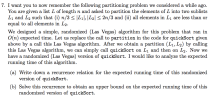 I want you to now remember the following partitioning problem we considered a while ago. You are given a list L of length n and asked to partition the elements of L into two sublists L_1 and L_2 such that (i) n/3 lessthanorequalto |L_1|, |L_2| lessthanorequalto 2n/3 and (ii) all elements in L_1 are less than or equal to all elements in L_2. We designed a simple, randomized (Las Vegas) algorithm for this problem that ran in O(n) expected time....
Suppose we have a staircase with n steps (we start on the ground, so we need...
Suppose we have a staircase with n steps (we start on the ground, so we need n total steps to reach the top). We can take as many steps forward at a time, but we will never step backwards. How many ways are there to reach the top? Give your answer as a function of n. For example, if n=3, then the answer is 4. The four options are the following: (1) take one step, take one step, take one...
 Suppose that, in a divide-and-conquer algorithm, we always
divide an instance of size n of a problem into 5 sub-instances of
size n/3, and the dividing and combining steps take a time
in Θ(n n). Write a recurrence equation for the running time T
(n) , and solve the
equation for T (n)
2. Suppose that, in a divide-and-conquer algorithm, we always divide an instance of size n of a problem into 5 sub-instances of size n/3, and the dividing...
Suppose that, in a divide-and-conquer algorithm, we always
divide an instance of size n of a problem into 5 sub-instances of
size n/3, and the dividing and combining steps take a time
in Θ(n n). Write a recurrence equation for the running time T
(n) , and solve the
equation for T (n)
2. Suppose that, in a divide-and-conquer algorithm, we always divide an instance of size n of a problem into 5 sub-instances of size n/3, and the dividing...
 Convert the pseudocode into a C++ function
Decrease-by-Half Algorithm We can solve the same problem using a decrease-by-half algorithm. This algorithm is based on the following ideas: In the base case, n 1 and the only possible solution is b 0, e 1 In the general case, divide V into a left and rnight half; then the maximum subarray can be in one of three places: o entirely in the left half; o entirely in the right half; or o...
Convert the pseudocode into a C++ function
Decrease-by-Half Algorithm We can solve the same problem using a decrease-by-half algorithm. This algorithm is based on the following ideas: In the base case, n 1 and the only possible solution is b 0, e 1 In the general case, divide V into a left and rnight half; then the maximum subarray can be in one of three places: o entirely in the left half; o entirely in the right half; or o...
 It is due in 2 hours.. Thanks !
Suppose that an algorithm runs on a tree containing n nodes. What is the time complexity of the algorithm if the time spent per node in the tree is proportional to the number of grandchildren of the node? (Assume that the algorithm spends O(1) time for every node that does not have a grandchild.) In modern software development, a useful utility called make is usually employed to manage the compilation order of...
It is due in 2 hours.. Thanks !
Suppose that an algorithm runs on a tree containing n nodes. What is the time complexity of the algorithm if the time spent per node in the tree is proportional to the number of grandchildren of the node? (Assume that the algorithm spends O(1) time for every node that does not have a grandchild.) In modern software development, a useful utility called make is usually employed to manage the compilation order of...
 I want you to now remember the following partitioning problem we considered a while ago. You are given a list L of length n and asked to partition the elements of L into two sublists L_1 and L_2 such that (i) n/3 lessthanorequalto |L_1|, |L_2| lessthanorequalto 2n/3 and (ii) all elements in L_1 are less than or equal to all elements in L_2. We designed a simple, randomized (Las Vegas) algorithm for this problem that ran in O(n) expected time....
Most questions answered within 3 hours.
-
Where is the error in this code sequence?
String s1 = "Hello";
String s2 = "ello";...
asked 10 months ago -
Financial data for Joel de Paris, Inc., for last year
follow:
Joel de Paris, Inc.
Balance...
asked 10 months ago -
Consider this reaction:
Al2(SO4)3 (aq)+ BaCl3
(aq) Al2Cl6 (aq)- +
3BaSO4(s) . What is the...
asked 10 months ago -
Suppose that Savneet is considering increasing her
recent random sample from 20 car rentals to 40...
asked 10 months ago -
Trucks arrive at an unloading terminal at an average rate of 120
per hour.
Trucks arrive...
asked 10 months ago -
Why are methanol and ethanol completely soluble in water while
octanol is not very little soluble....
asked 10 months ago -
A facilities manager at a university reads in a research report
that the mean amount of...
asked 10 months ago -
When the CuSO4 is rehydrated by adding water to the anhydrous
compound, is this an endothermic...
asked 10 months ago -
A ray of sunlight is passing from diamond into crown glass; the
angle of incidence is...
asked 10 months ago -
A block of mass 0.249 kg is placed on top of a light, vertical
spring of...
asked 10 months ago -
how do the kidneys compensate in the presences of acidosis
a) trigger hyperventilate
b) reserve acid...
asked 10 months ago -
Question 501 pts
The rental rate of capital to the firm increases. Which of the
following...
asked 10 months ago