Why can't vinyl alcohols normally polymerize into polyvinyl alcohol? what happens then? Thank you in advance!
Why can't vinyl alcohols normally polymerize into polyvinyl alcohol? what happens then? Thank you in advance!
Homework Answers
Ans :-
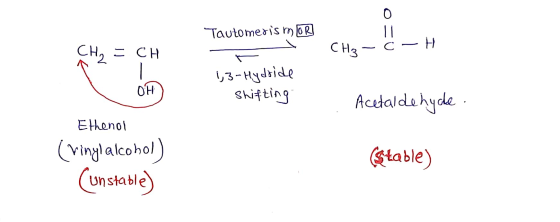
Polyvinyl alcohol (PVA) is the synthetic polymer which is not directly obtained by vinyl alcohol like polyvinyl chloride (PVC) and Polystyrene. Because, vinyl alcohol is highly unstable and therefore easily undergoes tautomerism to convert in its stable form that is acetaldehyde.
As,
Add Answer to:
Why can't vinyl alcohols normally polymerize into polyvinyl
alcohol? what happens then? Thank you in advance!
Thank you in advance. Much appreciated. Consider the dehydration of the following alcohols using a strong...
 Thank you in advance. Much appreciated.
Consider the dehydration of the following alcohols using a strong mineral acid as the catalyst and (a) place a circle around the alcohols that will dehydrate according to E1 mechanism, (b) place a box around the alcohols that will dehydrate according to E2 mechanism, and (c) place a triangle around the alcohols that will dehydrate according to both E1 and E2 mechanisms.
Thank you in advance. Much appreciated.
Consider the dehydration of the following alcohols using a strong mineral acid as the catalyst and (a) place a circle around the alcohols that will dehydrate according to E1 mechanism, (b) place a box around the alcohols that will dehydrate according to E2 mechanism, and (c) place a triangle around the alcohols that will dehydrate according to both E1 and E2 mechanisms.
Why can't the Fed control the money supply perfectly? What are reserve requirements? What happens when...
Why can't the Fed control the money supply perfectly? What are reserve requirements? What happens when the Fed raises reserve requirements?
thank you in advance :) What is meant by the term risk-free interest? Why is the...
 thank you in advance :)
What is meant by the term risk-free interest? Why is the U.S. Treasury bill yield used as the risk free interest rate?
thank you in advance :)
What is meant by the term risk-free interest? Why is the U.S. Treasury bill yield used as the risk free interest rate?
please write the major product for these problems and explain why. thank you in advance !...
 please write the major product for these problems and explain why.
thank you in advance !
U Delete Spam ... 7 Which reagent can cause the following transformation ? Page 3 нсон Hc OH A) KC0 B) NaBH: C) LAH. D) HNO; 8)Reaction of ethylmagnesium bromide with H2CO (formaldehyde) followed by treatment with A) a primary alcohol B) a secondary alcohol C) a tertiary alcohol D) an ether water gives 9) Nickel has 10 valence electrons. The formula for Nickel...
please write the major product for these problems and explain why.
thank you in advance !
U Delete Spam ... 7 Which reagent can cause the following transformation ? Page 3 нсон Hc OH A) KC0 B) NaBH: C) LAH. D) HNO; 8)Reaction of ethylmagnesium bromide with H2CO (formaldehyde) followed by treatment with A) a primary alcohol B) a secondary alcohol C) a tertiary alcohol D) an ether water gives 9) Nickel has 10 valence electrons. The formula for Nickel...
please show all steps thank you! Vinyl chloride, C2HaCl, is a carcinogen which can be found...
 please show all steps thank you!
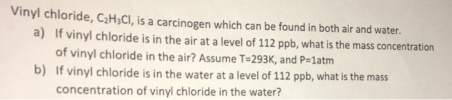
Vinyl chloride, C2HaCl, is a carcinogen which can be found in both air and water. a) If vinyl chloride is in the air at a level of 112 ppb, what is the mass concentration of vinyl chloride in the air? Assume T-293K, and P-1atm b) If vinyl chloride is in the water at a level of 112 ppb, what is the mas concentration of vinyl chloride in the water?
please show all steps thank you!
Vinyl chloride, C2HaCl, is a carcinogen which can be found in both air and water. a) If vinyl chloride is in the air at a level of 112 ppb, what is the mass concentration of vinyl chloride in the air? Assume T-293K, and P-1atm b) If vinyl chloride is in the water at a level of 112 ppb, what is the mas concentration of vinyl chloride in the water?
I know that Grignard reagents can react with alcohol, BUT why can't we generate a Grignard...
I know that Grignard reagents can react with alcohol, BUT why can't we generate a Grignard reagent from a molecule containing an OH functional group? Could you use an example or a mechanism to explain this concept?
Can someone help me with these? Thank you in advance! 1. The circuit shown here can't...
 Can someone help me with these? Thank you in advance!
1. The circuit shown here can't be reduced, since none of the resistors are connected in series or in parallel with each other. The unlabeled arrows show the direction of current in resistors 2, 4, and 5. Use Kirchhoff's junction or loop rules to answer questions (a)-(c) below. Show work for all calculations, and briefly explain your reasoning on current direction in (a) and (b). The symbols Ii, h, etc....
Can someone help me with these? Thank you in advance!
1. The circuit shown here can't be reduced, since none of the resistors are connected in series or in parallel with each other. The unlabeled arrows show the direction of current in resistors 2, 4, and 5. Use Kirchhoff's junction or loop rules to answer questions (a)-(c) below. Show work for all calculations, and briefly explain your reasoning on current direction in (a) and (b). The symbols Ii, h, etc....
What are the reactions ( or Solubility) of these 3 alcohols with 58% H3PO4: if you...
What are the reactions ( or Solubility) of these 3 alcohols with 58% H3PO4: if you can >> what is the observation in the experiment? 1- ethanol (ethanol ). 2- n-butyl alcohol (butanol). 3- n- hexyl alcohol (hexanol).
Studying for my organic chemistry final and can't seem to get this structure right. Thank you...
Studying for my organic chemistry final and can't seem to get this structure right. Thank you in advance! Draw the repeating unit of "polymeric diol" if it is derived from 1,2-epoxypropane.
i dont know how to answer this, thank you in advance! alerlahre 6. Esters react with...
 i dont know how to answer this, thank you in advance!
alerlahre 6. Esters react with water in the presence of acid to the generic reaction below). If you added water at the start of your reaction, what impact, if any, do you think it would have had on the amount of aspirin you produced? produce alcohols and carboxylic acids (see Н* R-OH +H20 R' R ОН R'
i dont know how to answer this, thank you in advance!
alerlahre 6. Esters react with water in the presence of acid to the generic reaction below). If you added water at the start of your reaction, what impact, if any, do you think it would have had on the amount of aspirin you produced? produce alcohols and carboxylic acids (see Н* R-OH +H20 R' R ОН R'
 Thank you in advance. Much appreciated.
Consider the dehydration of the following alcohols using a strong mineral acid as the catalyst and (a) place a circle around the alcohols that will dehydrate according to E1 mechanism, (b) place a box around the alcohols that will dehydrate according to E2 mechanism, and (c) place a triangle around the alcohols that will dehydrate according to both E1 and E2 mechanisms.
Thank you in advance. Much appreciated.
Consider the dehydration of the following alcohols using a strong mineral acid as the catalyst and (a) place a circle around the alcohols that will dehydrate according to E1 mechanism, (b) place a box around the alcohols that will dehydrate according to E2 mechanism, and (c) place a triangle around the alcohols that will dehydrate according to both E1 and E2 mechanisms.
 thank you in advance :)
What is meant by the term risk-free interest? Why is the U.S. Treasury bill yield used as the risk free interest rate?
thank you in advance :)
What is meant by the term risk-free interest? Why is the U.S. Treasury bill yield used as the risk free interest rate?
 please write the major product for these problems and explain why.
thank you in advance !
U Delete Spam ... 7 Which reagent can cause the following transformation ? Page 3 нсон Hc OH A) KC0 B) NaBH: C) LAH. D) HNO; 8)Reaction of ethylmagnesium bromide with H2CO (formaldehyde) followed by treatment with A) a primary alcohol B) a secondary alcohol C) a tertiary alcohol D) an ether water gives 9) Nickel has 10 valence electrons. The formula for Nickel...
please write the major product for these problems and explain why.
thank you in advance !
U Delete Spam ... 7 Which reagent can cause the following transformation ? Page 3 нсон Hc OH A) KC0 B) NaBH: C) LAH. D) HNO; 8)Reaction of ethylmagnesium bromide with H2CO (formaldehyde) followed by treatment with A) a primary alcohol B) a secondary alcohol C) a tertiary alcohol D) an ether water gives 9) Nickel has 10 valence electrons. The formula for Nickel...
 please show all steps thank you!
Vinyl chloride, C2HaCl, is a carcinogen which can be found in both air and water. a) If vinyl chloride is in the air at a level of 112 ppb, what is the mass concentration of vinyl chloride in the air? Assume T-293K, and P-1atm b) If vinyl chloride is in the water at a level of 112 ppb, what is the mas concentration of vinyl chloride in the water?
please show all steps thank you!
Vinyl chloride, C2HaCl, is a carcinogen which can be found in both air and water. a) If vinyl chloride is in the air at a level of 112 ppb, what is the mass concentration of vinyl chloride in the air? Assume T-293K, and P-1atm b) If vinyl chloride is in the water at a level of 112 ppb, what is the mas concentration of vinyl chloride in the water?
 Can someone help me with these? Thank you in advance!
1. The circuit shown here can't be reduced, since none of the resistors are connected in series or in parallel with each other. The unlabeled arrows show the direction of current in resistors 2, 4, and 5. Use Kirchhoff's junction or loop rules to answer questions (a)-(c) below. Show work for all calculations, and briefly explain your reasoning on current direction in (a) and (b). The symbols Ii, h, etc....
Can someone help me with these? Thank you in advance!
1. The circuit shown here can't be reduced, since none of the resistors are connected in series or in parallel with each other. The unlabeled arrows show the direction of current in resistors 2, 4, and 5. Use Kirchhoff's junction or loop rules to answer questions (a)-(c) below. Show work for all calculations, and briefly explain your reasoning on current direction in (a) and (b). The symbols Ii, h, etc....
 i dont know how to answer this, thank you in advance!
alerlahre 6. Esters react with water in the presence of acid to the generic reaction below). If you added water at the start of your reaction, what impact, if any, do you think it would have had on the amount of aspirin you produced? produce alcohols and carboxylic acids (see Н* R-OH +H20 R' R ОН R'
i dont know how to answer this, thank you in advance!
alerlahre 6. Esters react with water in the presence of acid to the generic reaction below). If you added water at the start of your reaction, what impact, if any, do you think it would have had on the amount of aspirin you produced? produce alcohols and carboxylic acids (see Н* R-OH +H20 R' R ОН R'
Most questions answered within 3 hours.
-
Where is the error in this code sequence?
String s1 = "Hello";
String s2 = "ello";...
asked 10 months ago -
Financial data for Joel de Paris, Inc., for last year
follow:
Joel de Paris, Inc.
Balance...
asked 10 months ago -
Consider this reaction:
Al2(SO4)3 (aq)+ BaCl3
(aq) Al2Cl6 (aq)- +
3BaSO4(s) . What is the...
asked 10 months ago -
Suppose that Savneet is considering increasing her
recent random sample from 20 car rentals to 40...
asked 10 months ago -
Trucks arrive at an unloading terminal at an average rate of 120
per hour.
Trucks arrive...
asked 10 months ago -
Why are methanol and ethanol completely soluble in water while
octanol is not very little soluble....
asked 10 months ago -
A facilities manager at a university reads in a research report
that the mean amount of...
asked 10 months ago -
When the CuSO4 is rehydrated by adding water to the anhydrous
compound, is this an endothermic...
asked 10 months ago -
A ray of sunlight is passing from diamond into crown glass; the
angle of incidence is...
asked 10 months ago -
A block of mass 0.249 kg is placed on top of a light, vertical
spring of...
asked 10 months ago -
how do the kidneys compensate in the presences of acidosis
a) trigger hyperventilate
b) reserve acid...
asked 10 months ago -
Question 501 pts
The rental rate of capital to the firm increases. Which of the
following...
asked 10 months ago