During a 3-months period, the price index increases from 120.8 to 124.0. During the same period,...
During a 3-months period, the price index increases from 120.8 to 124.0. During the same period, a stock increases in price for $100 to $120.5. What is the real rate of return for the stock for the 3 month period? Express your answer as a percentage, for example, 3.18% should be entered as 3.18 without the percentage sign.
The answer is 17 but I do not know how to calculate it.
Homework Answers
Increase price = 120.5
Price after eliminating inflation factor = 120.5*120.8/124
= 117.39
Real rate of return = (117.39-100)/100
= 17.39%
Add Answer to:
During a 3-months period, the price index increases from 120.8
to 124.0. During the same period,...
Question 5 (1 point) During a 3-months period, the price index increases from 120.8 to 121.5. During the same period...
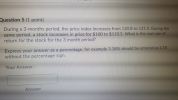 Question 5 (1 point) During a 3-months period, the price index increases from 120.8 to 121.5. During the same period, a stock increases in price for $100 to $110.5. What is the real rate of return for the stock for the 3 month period? Express your answer as a percentage, for example 3.18% should be entered as 3.18 without the percentage sign. Your Answer: Answer
Question 4 (1 point) A stock DEF has the following payoffs probabilities: Probability 0.2 0.5 0.3...
 Question 4 (1 point) A stock DEF has the following payoffs probabilities: Probability 0.2 0.5 0.3 Payoff $100 $130 $200 What is the Expected Payoff to the stock? Your Answer: Answer Question 5 (1 point) During a 3-months period, the price index increases from 120.8 to 121.5. During the same period, a stock increases in price for $100 to $110.5. What is the real rate of return for the stock for the 3 month period? Express your answer as a...
You can buy a Treasury-bill for $98.75, and in three months the T-bill pays you $100....
You can buy a Treasury-bill for $98.75, and in three months the T-bill pays you $100. What is the 3-month Nominal Risk Free Rate? Express your answer as a percentage, for example 3.18% should be entered as 3.18 without the percentage sign.
A stock has a beta of 1.4, the market expected return is 7%, and the riskfree...
A stock has a beta of 1.4, the market expected return is 7%, and the riskfree rate is 3%. What is the expected rate of return according to CAPM? Express your answer as a percentage; for example, 3.18% should be entered as 3.18 without the percentage sign.
Question 6 (1 point) A stock has a beta of 2.4, the market expected return is...
 Question 6 (1 point) A stock has a beta of 2.4, the market expected return is 8% and the riskfree rate is 2%. What is the expected rate of return according to CAPM? Express your answer as a percentage, for example 3.18% should be entered as 3.18 without the percentage sign. Your Answer: Answer Question 7 (1 point) Suppose the covariance between the returns of the stock GHI and the returns to the market is 0.00064 and the standard deviation...
the spot price of the market index is $900. After 3 months the market index is...
the spot price of the market index is $900. After 3 months the market index is priced at $920. The annual rate of interest on treasuries is 2.4% (0.2% per month). the premium on the long put, with an exercise price of $930, is $8.00. At what index price does a long put investor have the same payoff as a short index investor? Assume the short position has a breakeven price of $930.
Suppose you hold a stock for seven months. You calculate that your holding period return is...
Suppose you hold a stock for seven months. You calculate that your holding period return is 14%. What is your annualized return? Enter your answer as a percentage, without the percent sign. Round your answer to two decimal places. 6.7.0
Mary purchased 100 shares of Sweet Pea Co. stock at a price of $47.84 six months...
Mary purchased 100 shares of Sweet Pea Co. stock at a price of $47.84 six months ago. She sold all stocks today for $43.66. During that period the stock paid dividends of $1.21 per share. What is Mary’s effective annual rate? Round the answers to two decimal places in percentage form. (Write the percentage sign in the "units" box) Your Answer:
21. In 2012, newspapers reported that the annual Consumer Price Index in 2011 was 120.0. From...
 21. In 2012, newspapers reported that the annual Consumer Price Index in 2011 was 120.0. From this, we can conclude that a typical market basket in 2011 more than the same market would have cost basket purchased in a. 20%; the base year b. 120%; the base year c. 120%; 2010 d. 20%; 2010 22. The table below gives information on the the prices of three common school supplies in 2010 and 2011 and the quantities of each school supply...
Refers to the information below: S&R index level today (t=0) 900 Forward price (T=3 months) 918...
Refers to the information below: S&R index level today (t=0) 900 Forward price (T=3 months) 918 Annualized 3-month interest rate 8% p.a. Call option Premium (Strike = 900) 62.57 Put option Premium (Strike = 900) 44.92 Dividend Yield 0% S&R index level 3 months later 930 (i) What is your profit 3 months later if you have taken a long position on the stock at t=0? (ii) What is your profit 3 months later if you have taken a short...
 Question 5 (1 point) During a 3-months period, the price index increases from 120.8 to 121.5. During the same period, a stock increases in price for $100 to $110.5. What is the real rate of return for the stock for the 3 month period? Express your answer as a percentage, for example 3.18% should be entered as 3.18 without the percentage sign. Your Answer: Answer
 Question 4 (1 point) A stock DEF has the following payoffs probabilities: Probability 0.2 0.5 0.3 Payoff $100 $130 $200 What is the Expected Payoff to the stock? Your Answer: Answer Question 5 (1 point) During a 3-months period, the price index increases from 120.8 to 121.5. During the same period, a stock increases in price for $100 to $110.5. What is the real rate of return for the stock for the 3 month period? Express your answer as a...
 Question 6 (1 point) A stock has a beta of 2.4, the market expected return is 8% and the riskfree rate is 2%. What is the expected rate of return according to CAPM? Express your answer as a percentage, for example 3.18% should be entered as 3.18 without the percentage sign. Your Answer: Answer Question 7 (1 point) Suppose the covariance between the returns of the stock GHI and the returns to the market is 0.00064 and the standard deviation...
 21. In 2012, newspapers reported that the annual Consumer Price Index in 2011 was 120.0. From this, we can conclude that a typical market basket in 2011 more than the same market would have cost basket purchased in a. 20%; the base year b. 120%; the base year c. 120%; 2010 d. 20%; 2010 22. The table below gives information on the the prices of three common school supplies in 2010 and 2011 and the quantities of each school supply...
Most questions answered within 3 hours.
-
Where is the error in this code sequence?
String s1 = "Hello";
String s2 = "ello";...
asked 10 months ago -
Financial data for Joel de Paris, Inc., for last year
follow:
Joel de Paris, Inc.
Balance...
asked 10 months ago -
Consider this reaction:
Al2(SO4)3 (aq)+ BaCl3
(aq) Al2Cl6 (aq)- +
3BaSO4(s) . What is the...
asked 10 months ago -
Suppose that Savneet is considering increasing her
recent random sample from 20 car rentals to 40...
asked 10 months ago -
Trucks arrive at an unloading terminal at an average rate of 120
per hour.
Trucks arrive...
asked 10 months ago -
Why are methanol and ethanol completely soluble in water while
octanol is not very little soluble....
asked 10 months ago -
A facilities manager at a university reads in a research report
that the mean amount of...
asked 10 months ago -
When the CuSO4 is rehydrated by adding water to the anhydrous
compound, is this an endothermic...
asked 10 months ago -
A ray of sunlight is passing from diamond into crown glass; the
angle of incidence is...
asked 10 months ago -
A block of mass 0.249 kg is placed on top of a light, vertical
spring of...
asked 10 months ago -
how do the kidneys compensate in the presences of acidosis
a) trigger hyperventilate
b) reserve acid...
asked 10 months ago -
Question 501 pts
The rental rate of capital to the firm increases. Which of the
following...
asked 10 months ago