Linux commands questions help 1.Find all files under the current directory which ends in '.dat' (just...
Linux commands questions help
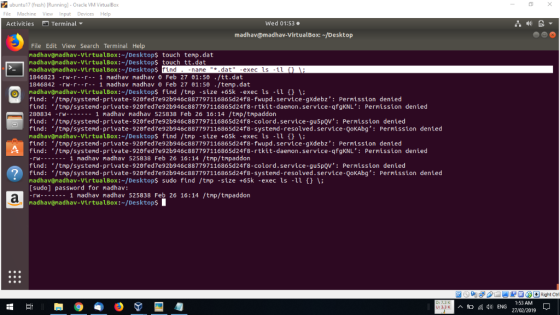
1.Find all files under the current directory which ends in '.dat' (just the .dat not the single quotes as well) and use -exec to create a listing of each file's inode number.
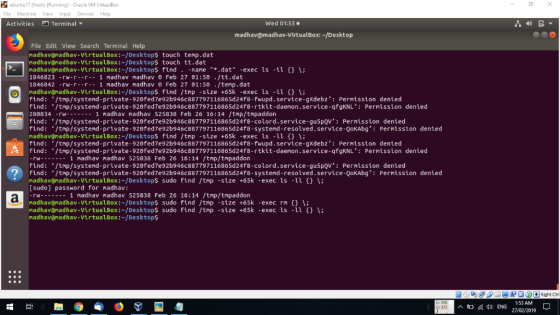
2. Find all files under the /tmp directory whose size is greater than 65 kilobytes and use -exec with an appropriate command to delete these files.
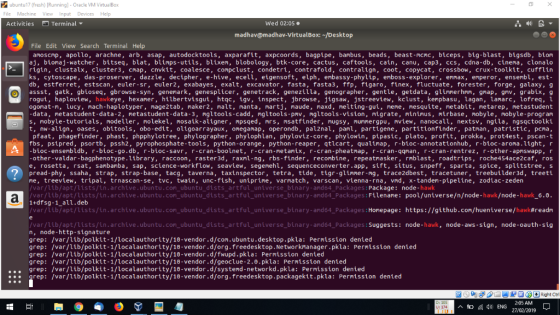
3. Search files in ~ and all subdirectories -- that contain the word 'hawk' (case sensitive) at the beginning OR end of a line only. Provide two lines of context before and after each word found. Extended Grep is your friend
Homework Answers
Answer 1
*********
find . -name "*.dat" -exec ls -il {} \;
Answer 2
*********
find /tmp -size +65k -exec ls -l {} \;
find /tmp -size +65k -exec rm {} \;
Answer 3
*********
sudo find / -type f -iname '*.*' -print0 | xargs -I {} -0 grep -H
--color 'hawk' "{}"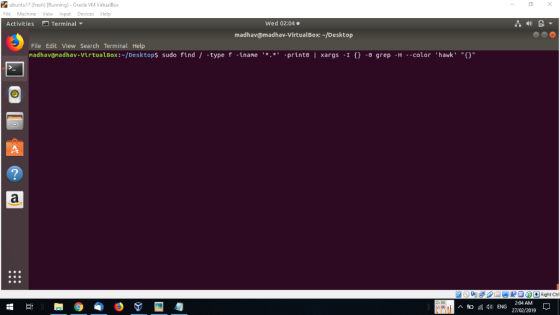
if you have any doubt then please ask me without any hesitation in the comment section below , if you like my answer then please thumbs up for the answer , before giving thumbs down please discuss the question it may possible that we may understand the question different way and we can edit and change the answers if you argue, thanks :)
Add Answer to:
Linux commands questions help
1.Find all files under the current directory which ends in
'.dat' (just...
LINUX QUESTIONS (dont have to display output, I will be running these commands myself to check...
LINUX QUESTIONS (dont have to display output, I will be running these commands myself to check the output) Display the command(s) used to do the following: create an empty file called history by using just a redirection operator. Verify and show. Show/verify all results (i.e., all commands and their corresponding outputs). Wait 1 minute or more and then display the command(s) used to do the following: change the timestamp on the history file you just created. Verify/display the change. Show/verify...
Most questions answered within 3 hours.
-
Where is the error in this code sequence?
String s1 = "Hello";
String s2 = "ello";...
asked 11 months ago -
Financial data for Joel de Paris, Inc., for last year
follow:
Joel de Paris, Inc.
Balance...
asked 11 months ago -
Consider this reaction:
Al2(SO4)3 (aq)+ BaCl3
(aq) Al2Cl6 (aq)- +
3BaSO4(s) . What is the...
asked 11 months ago -
Suppose that Savneet is considering increasing her
recent random sample from 20 car rentals to 40...
asked 11 months ago -
Trucks arrive at an unloading terminal at an average rate of 120
per hour.
Trucks arrive...
asked 11 months ago -
Why are methanol and ethanol completely soluble in water while
octanol is not very little soluble....
asked 11 months ago -
A facilities manager at a university reads in a research report
that the mean amount of...
asked 11 months ago -
When the CuSO4 is rehydrated by adding water to the anhydrous
compound, is this an endothermic...
asked 11 months ago -
A ray of sunlight is passing from diamond into crown glass; the
angle of incidence is...
asked 11 months ago -
A block of mass 0.249 kg is placed on top of a light, vertical
spring of...
asked 11 months ago -
how do the kidneys compensate in the presences of acidosis
a) trigger hyperventilate
b) reserve acid...
asked 11 months ago -
Question 501 pts
The rental rate of capital to the firm increases. Which of the
following...
asked 11 months ago