Entropy is likely to decrease for the reaction below, because there are 7 moles of gas...
Entropy is likely to decrease for the reaction below, because there are 7 moles of gas on the reactant side and no moles of gas on the product side. 4 C(s) + 6 H2(g) + O2(g) → 2 C2H5OH(l) TRUE or FALSE
Homework Answers
Request Answer!
We need at least 10 more requests to produce the answer.
0 / 10 have requested this problem solution
The more requests, the faster the answer.
Add Answer to:
Entropy is likely to decrease for the reaction below, because
there are 7 moles of gas...
Name: 1. An exothermic reaction is allowed to reach equilibrium. If the temperature of the reaction...
 Name: 1. An exothermic reaction is allowed to reach equilibrium. If the temperature of the reaction mixture is decreased, the equilibrium will shift towards the product side: True False [1pt] 2. For the reaction C(s) + H2O(g) CO(g) + H2(g) a decrease in concentration of C(s) will cause the reaction to shift to the left oTrue False [1pt] 3. Define the following terms: [1.5pts] a. Activation Energy b. Exothermic Reaction c. Equilibrium [1p) 4. Determine the equilibrium constant K C(s)...
Question 21 of 39 What will the sign on AS be for the following reaction and...
 Question 21 of 39 What will the sign on AS be for the following reaction and why? 2 Mg (s) + O2(g) → 2 Mgo (s) A) Positive, because there is a solid as a product. B) Positive, because there are more moles of reactant than product. C) Positive, because it is a synthesis reaction. D) Negative, because there are more moles of gas on the reactant side than the product side. E) Negative, because there are more moles of...
175Q16 Because the number of moles of gas are increasing from 6 to 7 in the...
175Q16 Because the number of moles of gas are increasing from 6 to 7 in the reaction shown below, at constant pressure ΔE is predicted to be slightly ________ negative than ΔH. C3H8(g) + 5 O2(g) → 3 CO2(g) + 4 H2O(g)
The change in entropy, ΔS°rxn, is related to the the change in the number of moles...
The change in entropy, ΔS°rxn, is related to the the change in the number of moles of gas molecules, Δngas. Determine the change in the moles of gas for each of the following reactions and decide if the entropy increases, decreases, or has little or no change. a) 2H2(g) +O2(g)->2H2O b)C2H4(g) +H2(g)-> C2H6(g) c) CH4(g) + 2O2(g) -> CO2(g)+2H2O(l) d) PCL5(s)--> PCL3(l) + CL2(g)
The change in entropy, ASixn, is related to the the change in the number of moles...
 The change in entropy, ASixn, is related to the the change in the number of moles of gas molecules, Angas. Determine the change in the moles of gas for each of the reactions and decide if the entropy increases, decreases, or has little or no change. A. C(s) + H2O(g) → CO(g) + H2(g) The entropy, ASixn Angas = Angos =D mol has little or no change. increases. decreases. B. CO(g) + 3H2(g) = CH(g) + H2(g) The entropy, ASixn...
The change in entropy, ASiam, is related to the the change in the number of moles...
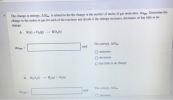 The change in entropy, ASiam, is related to the the change in the number of moles of gas molecules, Ang. Determine the change in the moles of gas for each of the reactions and decide if the entropy increases, decreases, or has little or no change A. K(s) + O2(%) KO,(s) The entropy, AS Ang- mol increases. decreases has little or no change. B. H,0,(1) H,(8) +0,(€) The entropy, A.SE increases B. H2O2(1) → H2(g) + O2(g) The entropy, AS...
1. Predict the effect on the equilibrium system in below if the reaction temperature is increased....
1. Predict the effect on the equilibrium system in below if the reaction temperature is increased. 2 SO2(g) + O2(g) ↔ 2 SO3(g)+ heat a. Shift to the product side b. There will be no change. c. Shift to the reactant side 2. Predict the effect on the equilibrium system in below if the SO2 gas concentration is decreased. 2 SO2(g) + O2(g) ↔ 2 SO3(g) a. Shift to product side b. shift to reactant side c. no change 3....
1. Gas turning to liquid is A) Increase in entropy B) Decrease in entropy C) Endothermic...
1. Gas turning to liquid is A) Increase in entropy B) Decrease in entropy C) Endothermic 2. Breaking of bonds is always A) Endothermic B) Exothermic C) No net change of energy 3. Forming bonds is A) Exothermic B) Endothermic C) No change in energy 4. Which of the following is standard state function? A) density B) heat C) rate of reaction 5. Which of the following is a decrease in entropy? A) solid becomes a liquid B) liquid becomes...
2. Which reaction produces a decrease in the entropy of the system? 4 NO (g) 6 H20 (g) A) 4 NH3 (g) +5 O2 (g) B) 2H...
 2. Which reaction produces a decrease in the entropy of the system? 4 NO (g) 6 H20 (g) A) 4 NH3 (g) +5 O2 (g) B) 2H2 (g) 02 (g) 2H20 (I) 2 Hg (l)O2(g) C) 2 HgO (s)2 D) UF6 (s)U (s) + 3F2 (g) E) H20 (s) H20 (g)
Question 7 of 10 Submit If 2.05 moles of H2 and 1.55 moles of O2 react...
 Question 7 of 10 Submit If 2.05 moles of H2 and 1.55 moles of O2 react how many moles of H2O can be produced in the reaction below? 2 H2(g) O2(g)2 H20(g) mol 1 2 3 4 5 6 7 9 +/- x 100
 Name: 1. An exothermic reaction is allowed to reach equilibrium. If the temperature of the reaction mixture is decreased, the equilibrium will shift towards the product side: True False [1pt] 2. For the reaction C(s) + H2O(g) CO(g) + H2(g) a decrease in concentration of C(s) will cause the reaction to shift to the left oTrue False [1pt] 3. Define the following terms: [1.5pts] a. Activation Energy b. Exothermic Reaction c. Equilibrium [1p) 4. Determine the equilibrium constant K C(s)...
 Question 21 of 39 What will the sign on AS be for the following reaction and why? 2 Mg (s) + O2(g) → 2 Mgo (s) A) Positive, because there is a solid as a product. B) Positive, because there are more moles of reactant than product. C) Positive, because it is a synthesis reaction. D) Negative, because there are more moles of gas on the reactant side than the product side. E) Negative, because there are more moles of...
 The change in entropy, ASixn, is related to the the change in the number of moles of gas molecules, Angas. Determine the change in the moles of gas for each of the reactions and decide if the entropy increases, decreases, or has little or no change. A. C(s) + H2O(g) → CO(g) + H2(g) The entropy, ASixn Angas = Angos =D mol has little or no change. increases. decreases. B. CO(g) + 3H2(g) = CH(g) + H2(g) The entropy, ASixn...
 The change in entropy, ASiam, is related to the the change in the number of moles of gas molecules, Ang. Determine the change in the moles of gas for each of the reactions and decide if the entropy increases, decreases, or has little or no change A. K(s) + O2(%) KO,(s) The entropy, AS Ang- mol increases. decreases has little or no change. B. H,0,(1) H,(8) +0,(€) The entropy, A.SE increases B. H2O2(1) → H2(g) + O2(g) The entropy, AS...
 2. Which reaction produces a decrease in the entropy of the system? 4 NO (g) 6 H20 (g) A) 4 NH3 (g) +5 O2 (g) B) 2H2 (g) 02 (g) 2H20 (I) 2 Hg (l)O2(g) C) 2 HgO (s)2 D) UF6 (s)U (s) + 3F2 (g) E) H20 (s) H20 (g)
 Question 7 of 10 Submit If 2.05 moles of H2 and 1.55 moles of O2 react how many moles of H2O can be produced in the reaction below? 2 H2(g) O2(g)2 H20(g) mol 1 2 3 4 5 6 7 9 +/- x 100
Most questions answered within 3 hours.
-
Where is the error in this code sequence?
String s1 = "Hello";
String s2 = "ello";...
asked 10 months ago -
Financial data for Joel de Paris, Inc., for last year
follow:
Joel de Paris, Inc.
Balance...
asked 10 months ago -
Consider this reaction:
Al2(SO4)3 (aq)+ BaCl3
(aq) Al2Cl6 (aq)- +
3BaSO4(s) . What is the...
asked 10 months ago -
Suppose that Savneet is considering increasing her
recent random sample from 20 car rentals to 40...
asked 10 months ago -
Trucks arrive at an unloading terminal at an average rate of 120
per hour.
Trucks arrive...
asked 10 months ago -
Why are methanol and ethanol completely soluble in water while
octanol is not very little soluble....
asked 10 months ago -
A facilities manager at a university reads in a research report
that the mean amount of...
asked 10 months ago -
When the CuSO4 is rehydrated by adding water to the anhydrous
compound, is this an endothermic...
asked 10 months ago -
A ray of sunlight is passing from diamond into crown glass; the
angle of incidence is...
asked 10 months ago -
A block of mass 0.249 kg is placed on top of a light, vertical
spring of...
asked 10 months ago -
how do the kidneys compensate in the presences of acidosis
a) trigger hyperventilate
b) reserve acid...
asked 10 months ago -
Question 501 pts
The rental rate of capital to the firm increases. Which of the
following...
asked 10 months ago