G3-1: precipitation of group 3 cations by adding ammonium chloride, ammonia, and thioacetamide
Homework Answers
Precipitation of the Group III Cations.
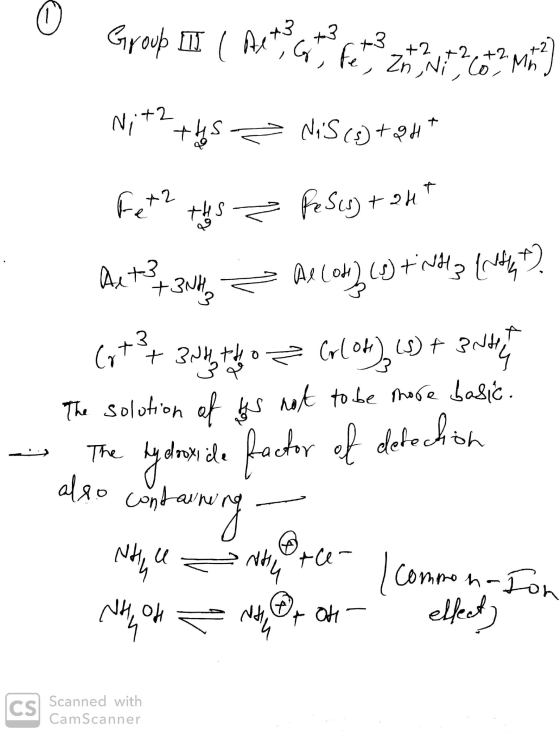
In the sulfides forms The ions of Group III are precipitated., or as their hydroxides, from a basic solution of hydrogen sulfide.
The sulfides of the ions of Group III are not sufficiently insoluble to be precipitated in the acidic solution of hydrogen sulfide of Group II but will be precipitated by basic solutions of hydrogen sulfide.
One of teh most important factor comes for the separation is thye common ion effect while tratting with the hydroxide ions.
olubility products of group (III) hydroxides are low as compared to the hydroxides of higher groups, so a low concentration of OH− ions is required to precipitate group (III) cations. Presence of NH4Cl which is a strong electrolyte suppresses dissociation of weak electrolyte NH4OH by common ion effect and decreases OH− ion concentration considerably..
Add Answer to:
G3-1: precipitation of group 3 cations by adding ammonium chloride,
ammonia, and thioacetamide
A buffer solution contains 0.229 M ammonium chloride and 0.457 M ammonia. If 0.0568 moles of...
 A buffer solution contains 0.229 M ammonium chloride and 0.457 M ammonia. If 0.0568 moles of hydroiodic acid are added to 250 mL of this buffer, what is the pH of the resulting solution ? (Assume that the volume does not change upon adding hydroiodic acid) pH = Submit Answer Retry Entire Group 9 more group attempts remaining A buffer solution contains 0.443 M ammonium chloride and 0.314 M ammonia. If 0.0313 moles of potassium hydroxide are added to 225...
Solid ammonium chloride decomposes when heated to ammonia and hydrogen chloride. The mass of hydrogen...
Solid ammonium chloride decomposes when heated to ammonia and hydrogen chloride. The mass of hydrogen chloride and ammonia equals the original mass of ammonium chloride. This illustrates the Law of __.
At high temperatures, solid ammonium chloride decomposes into gaseous ammonia and hydrogen chloride. NH4Cl (s) ⇌...
At high temperatures, solid ammonium chloride decomposes into gaseous ammonia and hydrogen chloride. NH4Cl (s) ⇌ NH3 (g) + HCl (g) a) An excess of ammonium chloride was introduced into an evacuated container. After raising the temperature to 340 ° C, the pressure was measured 1.013 bar. Calculate the equilibrium constant at this temperature. (4p) b) A container of volume 1.00 dm3 initially contained 0.0200 moles of ammonia. What are the partial pressures for ammonia and hydrogen chloride after an...
What is the pH of a solution containing 0.50 M ammonia and 0.50 M ammonium chloride?...
What is the pH of a solution containing 0.50 M ammonia and 0.50 M ammonium chloride? What will the pH be after 25mL of 0.20 M of hydrochloric acid has been added to 100.0mL of the solution containing the ammonia and ammonium chloride? What will the pH be after 18mL of 0.25 M of lithium hydroxide has been added to 100.0mL of the solution containing the ammonia and ammonium chloride? The ionization constant for ammonia is 1.8x10⁻⁵.
1. CoCl2*6H2O reacting with ammonium chloride, ammonia, and hydrogen peroxide to form hexaamminecobalt(III) chloride and water...
1. CoCl2*6H2O reacting with ammonium chloride, ammonia, and hydrogen peroxide to form hexaamminecobalt(III) chloride and water 2. cobalt (II) nitrate hexahydrate reacting with ammonium carbonate, concentrated ammonia, and hydrogen peroxide and water to form [Co(NH3)4CO3]NO3 Both synthesis above include hydrogen peroxide. What is the purpose of this hydrogen peroxide? Could we use a different cobalt starting material and skip the addition of hydrogen peroxide?
A buffer solution contains 0.392 M ammonium chloride and 0.498 M ammonia. If 0.0206 moles of...
A buffer solution contains 0.392 M ammonium chloride and 0.498 M ammonia. If 0.0206 moles of perchloric acid are added to 150 mL of this buffer, what is the pH of the resulting solution ? (Assume that the volume does not change upon adding perchloric acid)
A buffer solution contains 0.322 M ammonium chloride and 0.486 M ammonia. If 0.0545 moles of...
A buffer solution contains 0.322 M ammonium chloride and 0.486 M ammonia. If 0.0545 moles of hydrochloric acid are added to 250 mL of this buffer, what is the pH of the resulting solution? (Assume that the volume does not change upon adding hydrochloric acid.)
The pH 10 buffer used involves mixing ammonia and ammonium chloride. What is the molar ratio...
The pH 10 buffer used involves mixing ammonia and ammonium chloride. What is the molar ratio of ammonia to ammonium chloride needed to produce a buffer with a pH of 10?
Enter an equation for the precipitation reaction that occurs (if any) when solutions of ammonium chloride...
Enter an equation for the precipitation reaction that occurs (if any) when solutions of ammonium chloride and calcium nitrate are mixed.
4. Calcium oxide will react with ammonium chloride to produce ammonia gas, water vapor and calcium...
 4. Calcium oxide will react with ammonium chloride to produce ammonia gas, water vapor and calcium chloride. If only 16.3 g of ammonia is produced from 112 g of calcium oxide and 224 g of ammonium chloride, what is the percent yield?
 A buffer solution contains 0.229 M ammonium chloride and 0.457 M ammonia. If 0.0568 moles of hydroiodic acid are added to 250 mL of this buffer, what is the pH of the resulting solution ? (Assume that the volume does not change upon adding hydroiodic acid) pH = Submit Answer Retry Entire Group 9 more group attempts remaining A buffer solution contains 0.443 M ammonium chloride and 0.314 M ammonia. If 0.0313 moles of potassium hydroxide are added to 225...
 4. Calcium oxide will react with ammonium chloride to produce ammonia gas, water vapor and calcium chloride. If only 16.3 g of ammonia is produced from 112 g of calcium oxide and 224 g of ammonium chloride, what is the percent yield?
Most questions answered within 3 hours.
-
Where is the error in this code sequence?
String s1 = "Hello";
String s2 = "ello";...
asked 10 months ago -
Financial data for Joel de Paris, Inc., for last year
follow:
Joel de Paris, Inc.
Balance...
asked 10 months ago -
Consider this reaction:
Al2(SO4)3 (aq)+ BaCl3
(aq) Al2Cl6 (aq)- +
3BaSO4(s) . What is the...
asked 10 months ago -
Suppose that Savneet is considering increasing her
recent random sample from 20 car rentals to 40...
asked 10 months ago -
Trucks arrive at an unloading terminal at an average rate of 120
per hour.
Trucks arrive...
asked 10 months ago -
Why are methanol and ethanol completely soluble in water while
octanol is not very little soluble....
asked 10 months ago -
A facilities manager at a university reads in a research report
that the mean amount of...
asked 10 months ago -
When the CuSO4 is rehydrated by adding water to the anhydrous
compound, is this an endothermic...
asked 10 months ago -
A ray of sunlight is passing from diamond into crown glass; the
angle of incidence is...
asked 10 months ago -
A block of mass 0.249 kg is placed on top of a light, vertical
spring of...
asked 10 months ago -
how do the kidneys compensate in the presences of acidosis
a) trigger hyperventilate
b) reserve acid...
asked 10 months ago -
Question 501 pts
The rental rate of capital to the firm increases. Which of the
following...
asked 10 months ago