a. Find gcd(31415, 14142) by applying Euclid’s algorithm. b. Estimate how many times faster it will...
a. Find gcd(31415, 14142) by applying Euclid’s algorithm.
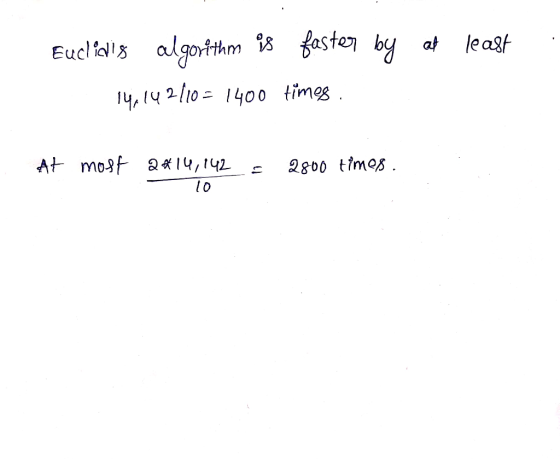
b. Estimate how many times faster it will be to find gcd(31415, 14142) by Euclid’s algorithm compared with the algorithm based on checking consecutive integers from min{m, n}down to gcd(m, n).
Homework Answers
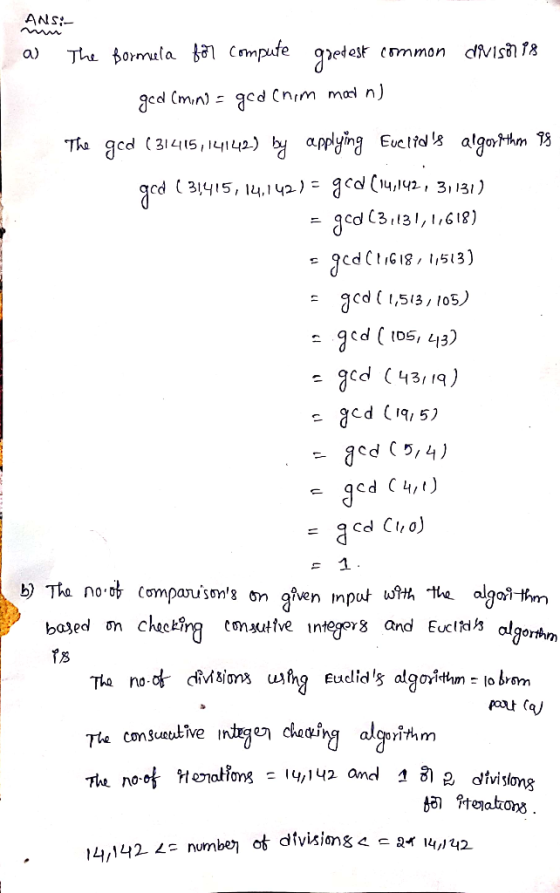
ANS:- The bormula for compute gredest common dVIS a) ged (min) = gcd (nim mad n) "The ged (31415, 14142) by applying Euclid's algorthm 18 ged ( 31415, 14.1 42) = ged(14,142, 3,131) ged (3,131,1,618) -gedciG18.1513) ged ( 1,513, 105) ged (105, 43) ged (43119) - ged (19,5) ged c5,4) ged (411) %3D = 1. b) The no of comparison's on given mput with the algai thm checking consutive integers and Eucltas algorthm based on The no ot ciu Bions using Eudid's algorithm = 10 brom part caj The consueutive integen checesing algorithm 81 2 divislong fan iterations. The no-of terations = 14,142 and 14,142 2= number of divisions<=24 14
ANS:- The bormula for compute gredest common dVIS a) ged (min) = gcd (nim mad n) "The ged (31415, 14142) by applying Euclid's algorthm 18 ged ( 31415, 14.1 42) = ged(14,142, 3,131) ged (3,131,1,618) -gedciG18.1513) ged ( 1,513, 105) ged (105, 43) ged (43119) - ged (19,5) ged c5,4) ged (411) %3D = 1. b) The no of comparison's on given mput with the algai thm checking consutive integers and Eucltas algorthm based on The no ot ciu Bions using Eudid's algorithm = 10 brom part caj The consueutive integen checesing algorithm 81 2 divislong fan iterations. The no-of terations = 14,142 and 14,142 2= number of divisions<=24 14
18 faster by least Eucl'all's algorithm 8 at 14,142/10= 140o times. At mosf 2*14,142 2800 timos . 10
Add Answer to:
a. Find gcd(31415, 14142) by applying Euclid’s algorithm.
b. Estimate how many times faster it will...
1. Design an algorithm to find all the non-common elements in two sorted lists of numbers....
 1. Design an algorithm to find all the non-common elements in two sorted lists of numbers. What is the maximum number of comparisons your algorithm makes if the lengths of the two given lists are m and n, ?respectively 2. Estimate how many times faster it will be to find ged(98765, 56789) by Euclid's algorithm compared with the algorithm based on checking consecutive integers from min{m, n} down to gcd(m, n). 3. For each of the following functions, indicate how...
Apply Euclid’s algorithm to find the GCD (Greatest Common Divisor) of 126 and 28. Describe or...
Apply Euclid’s algorithm to find the GCD (Greatest Common Divisor) of 126 and 28. Describe or give the pseudocode of the consecutive integer checking algorithm for finding the GCD. What is the time complexity of this second algorithm? Explain.
Find gcd(31415, 14142) by applying the Euclid’s algorithm. Please show detailed steps. (all math and equations...
Find gcd(31415, 14142) by applying the Euclid’s algorithm. Please show detailed steps. (all math and equations should be done using Latex math symbols )
Using Extended Euclid a. Use Euclid’s algorithm to compute gcd(1175, 423) b. Use the extended Euclid...
Using Extended Euclid a. Use Euclid’s algorithm to compute gcd(1175, 423) b. Use the extended Euclid algorithm to find integers x and y such that gcd(1175, 423) = 1175x + 423y. What is x and y?
a Find the greatest common divisor (gcd) of 322 and 196 by using the Euclidean Algorithm....
 a Find the greatest common divisor (gcd) of 322 and 196 by using the Euclidean Algorithm. gcd- By working back in the Euclidean Algorithm, express the gcd in the form 322m196n where m and n are integers b) c) Decide which of the following equations have integer solutions. (i) 322z +196y 42 ii) 322z +196y-57
PROBLEM 1 For each of the following pairs of integers, use the Euclidean Algorithm to find...
 PROBLEM 1 For each of the following pairs of integers, use the Euclidean Algorithm to find ged(a,b), and to write gcd(a,b) as a linear combination of a and b, i.e. find integers m and n such that gcd(a,b) = am + bn. (a) a = 36, b = 60. (b) a = 12628, b = 21361. (c) a = 901, b = -935. (d) a = 72, b = 714. (e) a = -36, b = -60.
Question 3 (a) Write down the prime factorization of 10!. (b) Find the number of positive...
 Question 3 (a) Write down the prime factorization of 10!. (b) Find the number of positive integers n such that n|10! and gcd(n, 27.34.7) = 27.3.7. Justify your answer. Question 4 Let m, n E N. Prove that ged(m2, n2) = (gcd(m, n))2. Question 5 Let p and q be consecutive odd primes with p < q. Prove that (p + q) has at least three prime divisors (not necessarily distinct).
The rate at which popcorn pops was measured at two different temperatures. How many times faster...
The rate at which popcorn pops was measured at two different temperatures. How many times faster does the popcorn pop at 250.0 °C compared with that at 150.0 °C when the activation energy is 53.8 kJ/mol?
2,3,4,5,6 please 2. Use the Euclidean algorithm to find the following: a gcd(100, 101) b. ged(2482,...
 2,3,4,5,6 please
2. Use the Euclidean algorithm to find the following: a gcd(100, 101) b. ged(2482, 7633) 3. Prove that if a = bq+r, then ged(a, b) = ged(b,r). such that sa tb ged(a,b) for the following pairs 4. Use Bézout's theorem to find 8 and a. 33, 44 b. 101, 203 c. 10001, 13422 5. Prove by induction that if p is prime and plaja... An, then pla, for at least one Q. (Hint: use n = 2 as...
2,3,4,5,6 please
2. Use the Euclidean algorithm to find the following: a gcd(100, 101) b. ged(2482, 7633) 3. Prove that if a = bq+r, then ged(a, b) = ged(b,r). such that sa tb ged(a,b) for the following pairs 4. Use Bézout's theorem to find 8 and a. 33, 44 b. 101, 203 c. 10001, 13422 5. Prove by induction that if p is prime and plaja... An, then pla, for at least one Q. (Hint: use n = 2 as...
C++ Problem 1 Write a function to calculate the greatest common divisor (GCD) of two integers...
C++ Problem 1 Write a function to calculate the greatest common divisor (GCD) of two integers using Euclid’s algorithm (also known as the Euclidean algorithm). Write a main () function that requests two integers from the user, calls your function to compute the GCD, and outputs the return value of the function (all user input and output should be done in main ()). In particular, you will find this pseudocode for calculating the GCD, which should be useful to you:...
 1. Design an algorithm to find all the non-common elements in two sorted lists of numbers. What is the maximum number of comparisons your algorithm makes if the lengths of the two given lists are m and n, ?respectively 2. Estimate how many times faster it will be to find ged(98765, 56789) by Euclid's algorithm compared with the algorithm based on checking consecutive integers from min{m, n} down to gcd(m, n). 3. For each of the following functions, indicate how...
 a Find the greatest common divisor (gcd) of 322 and 196 by using the Euclidean Algorithm. gcd- By working back in the Euclidean Algorithm, express the gcd in the form 322m196n where m and n are integers b) c) Decide which of the following equations have integer solutions. (i) 322z +196y 42 ii) 322z +196y-57
 PROBLEM 1 For each of the following pairs of integers, use the Euclidean Algorithm to find ged(a,b), and to write gcd(a,b) as a linear combination of a and b, i.e. find integers m and n such that gcd(a,b) = am + bn. (a) a = 36, b = 60. (b) a = 12628, b = 21361. (c) a = 901, b = -935. (d) a = 72, b = 714. (e) a = -36, b = -60.
 Question 3 (a) Write down the prime factorization of 10!. (b) Find the number of positive integers n such that n|10! and gcd(n, 27.34.7) = 27.3.7. Justify your answer. Question 4 Let m, n E N. Prove that ged(m2, n2) = (gcd(m, n))2. Question 5 Let p and q be consecutive odd primes with p < q. Prove that (p + q) has at least three prime divisors (not necessarily distinct).
 2,3,4,5,6 please
2. Use the Euclidean algorithm to find the following: a gcd(100, 101) b. ged(2482, 7633) 3. Prove that if a = bq+r, then ged(a, b) = ged(b,r). such that sa tb ged(a,b) for the following pairs 4. Use Bézout's theorem to find 8 and a. 33, 44 b. 101, 203 c. 10001, 13422 5. Prove by induction that if p is prime and plaja... An, then pla, for at least one Q. (Hint: use n = 2 as...
2,3,4,5,6 please
2. Use the Euclidean algorithm to find the following: a gcd(100, 101) b. ged(2482, 7633) 3. Prove that if a = bq+r, then ged(a, b) = ged(b,r). such that sa tb ged(a,b) for the following pairs 4. Use Bézout's theorem to find 8 and a. 33, 44 b. 101, 203 c. 10001, 13422 5. Prove by induction that if p is prime and plaja... An, then pla, for at least one Q. (Hint: use n = 2 as...
Most questions answered within 3 hours.
-
Where is the error in this code sequence?
String s1 = "Hello";
String s2 = "ello";...
asked 10 months ago -
Financial data for Joel de Paris, Inc., for last year
follow:
Joel de Paris, Inc.
Balance...
asked 10 months ago -
Consider this reaction:
Al2(SO4)3 (aq)+ BaCl3
(aq) Al2Cl6 (aq)- +
3BaSO4(s) . What is the...
asked 10 months ago -
Suppose that Savneet is considering increasing her
recent random sample from 20 car rentals to 40...
asked 10 months ago -
Trucks arrive at an unloading terminal at an average rate of 120
per hour.
Trucks arrive...
asked 10 months ago -
Why are methanol and ethanol completely soluble in water while
octanol is not very little soluble....
asked 10 months ago -
A facilities manager at a university reads in a research report
that the mean amount of...
asked 10 months ago -
When the CuSO4 is rehydrated by adding water to the anhydrous
compound, is this an endothermic...
asked 10 months ago -
A ray of sunlight is passing from diamond into crown glass; the
angle of incidence is...
asked 10 months ago -
A block of mass 0.249 kg is placed on top of a light, vertical
spring of...
asked 10 months ago -
how do the kidneys compensate in the presences of acidosis
a) trigger hyperventilate
b) reserve acid...
asked 10 months ago -
Question 501 pts
The rental rate of capital to the firm increases. Which of the
following...
asked 10 months ago