A 10Mbps (1M = 10^6) CSMA/CD network has a distance of 5000 m between stations sharing...
A 10Mbps (1M = 10^6) CSMA/CD network has a distance of 5000 m between stations sharing the link. The data frame is 512 bits long. The speed of the signal is 2x10^8m/s
1. Find the total time spent to transmit one frame (including transmission and propagation time)
2. Does the frame length of 512 bits work for a new 100 Mbps CSMA/CD network of this length? Why?
Homework Answers

Add Answer to:
A 10Mbps (1M = 10^6) CSMA/CD network has a distance of 5000 m
between stations sharing...
(TCO 4) The distance between two stations in a 10 Mbps LAN using CSM/CD multiple access...
 (TCO 4) The distance between two stations in a 10 Mbps LAN using CSM/CD multiple access method is 2,000 meters. Station A sends a long frame first and three micro seconds later, C starts sending a long frame. Notice that when C begins sending, the signal due to the frame from A has not reached station C yet. If it reached, station C would not send it. How many bits from station C have already been sent when it hears...
Question#1 1. What is the difference between a BSS and an ESS? 2. Discuss the three...
Question#1 1. What is the difference between a BSS and an ESS? 2. Discuss the three types of mobility in a wireless LAN. Question#2 A network using CSMA/CD has a bandwidth of 10 Mbps. If the maximum propagation time (Including the delays in the devices and ignoring the time needed to send a jamming signal, as we see later) is 25.611US, what is the minimum size of the frame? Question#3 Assume that, in a Stop-and-Wait ARQ system, the bandwidth of...
(1) The sublayer is responsible for CSMA/CD operation. Select one: a. Logical Link Control (LLC) b. Medium Access Control (MAC) c. Physical Layer Management d. Data Link Layer (2) Carrier Sense M...
 (1) The sublayer is responsible for CSMA/CD operation. Select one: a. Logical Link Control (LLC) b. Medium Access Control (MAC) c. Physical Layer Management d. Data Link Layer (2) Carrier Sense Multiple Access (CSMA) method was developed to increase the of local area networks. Select one: a. collision b. performance d. number of station c. transmission time (3) In Carrier Sense Multiple Access/Collision Detection (CSMA/CD), sending station must detect collisions by "listening" to the medium for at least b. one-way...
Question 4: If the BW of the line is 1.5Mbps, round trip time is 45ms and...
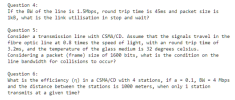 Question 4: If the BW of the line is 1.5Mbps, round trip time is 45ms and packet size is 1kB, what is the link utilisation in stop and wait? Question 5: Consider a transmission line with CSMA/CD. Assume that the signals travel in the fibre optic line at 0.8 times the speed of light, with an round trip time of 3.2ms, and the temperature of the glass medium is 32 degrees Celsius. Considering a packet (frame) size of 1600 bits,...
5. (10 points) Multiple Access Protocols Suppose nodes A and B are on the same 10...
 5. (10 points) Multiple Access Protocols Suppose nodes A and B are on the same 10 Mbps Ethernet segment and the propagation delay between the two nodes is 225 bit times. Suppose A and B send frames at the same time, the frames collide, and then A and B choose their own values of K in the CSMA/CD algorithm. Assuming active, no other nodes are can retransmissions from A and B collide. For our purposes, it suffices to work out...
Q6. Total: 7 marks] Nodes A and B are accessing a shared medium with propagation delay...
 Q6. Total: 7 marks] Nodes A and B are accessing a shared medium with propagation delay of 300 bit times between them (i.e., propagation delay equals to the amount of time to transmit 300 bits onto the link). A and B each have a frame of 1,000 bits (including all headers and preambles) to send to each other. a) (3 marks] In the worst case, how many bits would A have sent out when it detects collision? Briefly show how...
help with computer network questions 1. What is the difference between circuit switching and packet switching?...
help with computer network questions 1. What is the difference between circuit switching and packet switching? 2. What are the different layers in today’s Internet? Why do we create layers? 3. Suppose there is a 10 Mbps microwave link between a geostationary satellite and its base station on Earth. Every minute the satellite takes a digital photo and sends it to the base station. Assume a propagation speed of 2.4 * 10^8 meters/sec. a. What is the propagation delay of...
Compute the time required for circuit switching and packet switching with the following conditions: •The destination...
Compute the time required for circuit switching and packet switching with the following conditions: •The destination is 4hops away from the source: three intermediate switches between the source and the destination, with 4links. •The distance between source (anddestination) computerto its connected switch is 1Km.The distance between any two adjacent switches is 10Km. •The signal propagation speed is 5x10^5m per second.•The message size is 5 Mega bits (1 Mega = 10^6) •The maximum packet size is 200k bits (1k = 10^3....
Please Answer all Questions on Networks, They all involve calculation ( 1-9 Questions) "A single router...
Please Answer all Questions on Networks, They all involve calculation ( 1-9 Questions) "A single router is transmitting packets, each of length L bits, over a single link with transmission rate R Mbps to another router at the other end of the link. Suppose that the packet length is L= 12000 bits, and that the link transmission rate along the link to router on the right is R = 1000 Mbps. What is the maximum number of packets per second...
Problem 2 For a given network, the average packet length L = 1024 bytes, packets are...
 Problem 2 For a given network, the average packet length L = 1024 bytes, packets are arriving with an average rate = 8 pakets/s, the network is used to support voice call services which can tolerate a maximum end-to-end delay of 150 ms, the average end-to-end distance between any two connected nodes in the network is 1000 km, the average phase velocity for signal travelling throughout the network links is 0.1 speed of light in free space and the call...
 (TCO 4) The distance between two stations in a 10 Mbps LAN using CSM/CD multiple access method is 2,000 meters. Station A sends a long frame first and three micro seconds later, C starts sending a long frame. Notice that when C begins sending, the signal due to the frame from A has not reached station C yet. If it reached, station C would not send it. How many bits from station C have already been sent when it hears...
 (1) The sublayer is responsible for CSMA/CD operation. Select one: a. Logical Link Control (LLC) b. Medium Access Control (MAC) c. Physical Layer Management d. Data Link Layer (2) Carrier Sense Multiple Access (CSMA) method was developed to increase the of local area networks. Select one: a. collision b. performance d. number of station c. transmission time (3) In Carrier Sense Multiple Access/Collision Detection (CSMA/CD), sending station must detect collisions by "listening" to the medium for at least b. one-way...
 Question 4: If the BW of the line is 1.5Mbps, round trip time is 45ms and packet size is 1kB, what is the link utilisation in stop and wait? Question 5: Consider a transmission line with CSMA/CD. Assume that the signals travel in the fibre optic line at 0.8 times the speed of light, with an round trip time of 3.2ms, and the temperature of the glass medium is 32 degrees Celsius. Considering a packet (frame) size of 1600 bits,...
 5. (10 points) Multiple Access Protocols Suppose nodes A and B are on the same 10 Mbps Ethernet segment and the propagation delay between the two nodes is 225 bit times. Suppose A and B send frames at the same time, the frames collide, and then A and B choose their own values of K in the CSMA/CD algorithm. Assuming active, no other nodes are can retransmissions from A and B collide. For our purposes, it suffices to work out...
 Q6. Total: 7 marks] Nodes A and B are accessing a shared medium with propagation delay of 300 bit times between them (i.e., propagation delay equals to the amount of time to transmit 300 bits onto the link). A and B each have a frame of 1,000 bits (including all headers and preambles) to send to each other. a) (3 marks] In the worst case, how many bits would A have sent out when it detects collision? Briefly show how...
 Problem 2 For a given network, the average packet length L = 1024 bytes, packets are arriving with an average rate = 8 pakets/s, the network is used to support voice call services which can tolerate a maximum end-to-end delay of 150 ms, the average end-to-end distance between any two connected nodes in the network is 1000 km, the average phase velocity for signal travelling throughout the network links is 0.1 speed of light in free space and the call...
Most questions answered within 3 hours.
-
Where is the error in this code sequence?
String s1 = "Hello";
String s2 = "ello";...
asked 10 months ago -
Financial data for Joel de Paris, Inc., for last year
follow:
Joel de Paris, Inc.
Balance...
asked 10 months ago -
Consider this reaction:
Al2(SO4)3 (aq)+ BaCl3
(aq) Al2Cl6 (aq)- +
3BaSO4(s) . What is the...
asked 10 months ago -
Suppose that Savneet is considering increasing her
recent random sample from 20 car rentals to 40...
asked 10 months ago -
Trucks arrive at an unloading terminal at an average rate of 120
per hour.
Trucks arrive...
asked 10 months ago -
Why are methanol and ethanol completely soluble in water while
octanol is not very little soluble....
asked 10 months ago -
A facilities manager at a university reads in a research report
that the mean amount of...
asked 10 months ago -
When the CuSO4 is rehydrated by adding water to the anhydrous
compound, is this an endothermic...
asked 10 months ago -
A ray of sunlight is passing from diamond into crown glass; the
angle of incidence is...
asked 10 months ago -
A block of mass 0.249 kg is placed on top of a light, vertical
spring of...
asked 10 months ago -
how do the kidneys compensate in the presences of acidosis
a) trigger hyperventilate
b) reserve acid...
asked 10 months ago -
Question 501 pts
The rental rate of capital to the firm increases. Which of the
following...
asked 10 months ago