3. A rocket of mass 21,400 kg fires rockets to slow its motion to 13,000 m/s....
3. A rocket of mass 21,400 kg fires rockets to slow its motion to 13,000 m/s. If the rocket motor delivers 1.05×10⁶ N for 102 seconds, what was the beginning speed of the rocket?
Homework Answers

Add Answer to:
3. A rocket of mass 21,400 kg fires rockets to slow its motion
to 13,000 m/s....
A rocket traveling 1950 m/s away from the Earth at an altitude of 6400 km fires...
A rocket traveling 1950 m/s away from the Earth at an altitude of 6400 km fires its rockets, which eject gas at a speed of 1300 m/s (relative to the rocket). If the mass of the rocket at this moment is 2.65×10⁴ kg and an acceleration of 1.6 m/s2 is desired, at what rate must the gases be ejected? The answer is not 132.19 it is coming up wrong.
Model rockets have tiny engines that fire for around 2 seconds. Your rocket has a mass...
 Model rockets have tiny engines that fire for around 2 seconds. Your rocket has a mass of 0.5 kg and you want to know its maximum speed. Using a radar gun you measure the velocity of the rocket to be 47 m/s the moment the engine runs out of fuel. Calculate the force this engine exerts on your rocket. Hint: There are two forces in play here that give each their own accelerations to the rocket. You observe a NET...
A shuttlecraft is initially moving at 96.0 m/s as it travels in deep space. The mass...
 A shuttlecraft is initially moving at 96.0 m/s as it travels in
deep space. The mass of the shuttle given its current fuel level is
approximately 6.41 ✕ 106 kg. When the
shuttle fires its rockets to move faster, the speed of the exhaust
leaving the rockets is 2900 m/s. What is the mass of the fuel
necessary to get the shuttlecraft up to a final speed of 130 m/s?
A shuttlecraft is initially moving at 96.0 m/s as...
A shuttlecraft is initially moving at 96.0 m/s as it travels in
deep space. The mass of the shuttle given its current fuel level is
approximately 6.41 ✕ 106 kg. When the
shuttle fires its rockets to move faster, the speed of the exhaust
leaving the rockets is 2900 m/s. What is the mass of the fuel
necessary to get the shuttlecraft up to a final speed of 130 m/s?
A shuttlecraft is initially moving at 96.0 m/s as...
A small rocket (because I like rockets) of mass 1 kg and thrust capability of 250...
 A small rocket (because I like rockets) of mass 1 kg and thrust capability of 250 N is slapped onto the edge of a large wheel. The wheel has a mass of 20 kg and a radius of 0.75 m. You light the fuse, stand WAY back, and watch as this Chinese-style firework wheel starts to spin as the rocket fires. Calculate the time it would take the wheel to spin up to 10 revolutions per second. HINT: This problem...
Far in space, where gravity is negligible, a 440 kg rocket traveling at 75 m/s fires itsengines. Figure P9.26 shows the...
 Far in space, where gravity is negligible, a 440 kg rocket
traveling at 75 m/s fires itsengines. Figure P9.26 shows the thrust
force as a function of time,with the horizontal axis in 11
sincrements. The mass lost by the rocket during these 33 s is
negligible.
Figure P9.26
(a) What impulse does the engine impart to
therocket?
N·s
(b) At what time does the rocket reach its maximum speed?
s
What is the maximum speed?
m/s
Far in space, where gravity is negligible, a 440 kg rocket
traveling at 75 m/s fires itsengines. Figure P9.26 shows the thrust
force as a function of time,with the horizontal axis in 11
sincrements. The mass lost by the rocket during these 33 s is
negligible.
Figure P9.26
(a) What impulse does the engine impart to
therocket?
N·s
(b) At what time does the rocket reach its maximum speed?
s
What is the maximum speed?
m/s
Constants Periodic Table A rocket of total mass 3230 kg is traveling in outer space with...
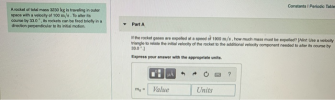 Constants Periodic Table A rocket of total mass 3230 kg is traveling in outer space with a velocity of 100 m/s. To alter its course by 33.0, its rockets can be fired briefly in a direction perpendicular to its initial motion Part A If the rocket gases are expelled at a speed of 1900 m/s, how much mass must be expelled? [Mint Uso a velocity triangle to relate the initial velocity of the rocket to the additional velocity component needed...
39. Rocket Motion Suppose a small single-stage rocket of total mass m) is launched vertically, th...
 I'd question 40 please.
39. Rocket Motion Suppose a small single-stage rocket of total mass m) is launched vertically, the positive direction is upward, the air resistance is linear, and the rocket consumes its fuel at a constant rate. In Problem 22 of Exercises 1.3 you were asked to use Newton's second law of motion in the form given in (17) of that exercise set to show that a mathematical model for the velocity v(t) of the rocket is given...
I'd question 40 please.
39. Rocket Motion Suppose a small single-stage rocket of total mass m) is launched vertically, the positive direction is upward, the air resistance is linear, and the rocket consumes its fuel at a constant rate. In Problem 22 of Exercises 1.3 you were asked to use Newton's second law of motion in the form given in (17) of that exercise set to show that a mathematical model for the velocity v(t) of the rocket is given...
A rocket in deep space moving with velocity of 300 m/s has an initial mass of...
A rocket in deep space moving with velocity of 300 m/s has an initial mass of 5000 kg, of which 2000 kg are fuel. If it is ejecting gasses at a rate of 5 kg/s at a speed of 200 m/s relative to the rocket, then after 200 second of motion, its speed is
1. Consider the rocket sled below. The mass of the system is 2.1 x 10³ k...
 1. Consider the rocket sled below. The mass of the system is 2.1 x 10³ k a. If the rocket sled decelerates at 196 m/s', what force is necessary to produce this deceleration? Assume the rockets are off. If the rocket sled starts from rest with only one rocket burning, what is the magnitude of its acceleration? Assume the thrust is T = 2.4 × 10⁴ N and the force of friction opposing the motion is f-650 N With four...
Im having trouble with this problem. Can someone break it down for me please? Model rockets...
 Im
having trouble with this problem. Can someone break it down for me
please?
Model rockets have tiny engines that fire for around 2 seconds. Your rocket has a mass of 0.5 kg and you want to know its maximum speed. Using a radar gun you measure the velocity of the rocket to be 47 m/s the moment the engine runs out of fuel. Calculate the force this engine exerts on your rocket. Hint: There are two forces in play...
Im
having trouble with this problem. Can someone break it down for me
please?
Model rockets have tiny engines that fire for around 2 seconds. Your rocket has a mass of 0.5 kg and you want to know its maximum speed. Using a radar gun you measure the velocity of the rocket to be 47 m/s the moment the engine runs out of fuel. Calculate the force this engine exerts on your rocket. Hint: There are two forces in play...
 Model rockets have tiny engines that fire for around 2 seconds. Your rocket has a mass of 0.5 kg and you want to know its maximum speed. Using a radar gun you measure the velocity of the rocket to be 47 m/s the moment the engine runs out of fuel. Calculate the force this engine exerts on your rocket. Hint: There are two forces in play here that give each their own accelerations to the rocket. You observe a NET...
 A shuttlecraft is initially moving at 96.0 m/s as it travels in
deep space. The mass of the shuttle given its current fuel level is
approximately 6.41 ✕ 106 kg. When the
shuttle fires its rockets to move faster, the speed of the exhaust
leaving the rockets is 2900 m/s. What is the mass of the fuel
necessary to get the shuttlecraft up to a final speed of 130 m/s?
A shuttlecraft is initially moving at 96.0 m/s as...
A shuttlecraft is initially moving at 96.0 m/s as it travels in
deep space. The mass of the shuttle given its current fuel level is
approximately 6.41 ✕ 106 kg. When the
shuttle fires its rockets to move faster, the speed of the exhaust
leaving the rockets is 2900 m/s. What is the mass of the fuel
necessary to get the shuttlecraft up to a final speed of 130 m/s?
A shuttlecraft is initially moving at 96.0 m/s as...
 A small rocket (because I like rockets) of mass 1 kg and thrust capability of 250 N is slapped onto the edge of a large wheel. The wheel has a mass of 20 kg and a radius of 0.75 m. You light the fuse, stand WAY back, and watch as this Chinese-style firework wheel starts to spin as the rocket fires. Calculate the time it would take the wheel to spin up to 10 revolutions per second. HINT: This problem...
 Far in space, where gravity is negligible, a 440 kg rocket
traveling at 75 m/s fires itsengines. Figure P9.26 shows the thrust
force as a function of time,with the horizontal axis in 11
sincrements. The mass lost by the rocket during these 33 s is
negligible.
Figure P9.26
(a) What impulse does the engine impart to
therocket?
N·s
(b) At what time does the rocket reach its maximum speed?
s
What is the maximum speed?
m/s
Far in space, where gravity is negligible, a 440 kg rocket
traveling at 75 m/s fires itsengines. Figure P9.26 shows the thrust
force as a function of time,with the horizontal axis in 11
sincrements. The mass lost by the rocket during these 33 s is
negligible.
Figure P9.26
(a) What impulse does the engine impart to
therocket?
N·s
(b) At what time does the rocket reach its maximum speed?
s
What is the maximum speed?
m/s
 Constants Periodic Table A rocket of total mass 3230 kg is traveling in outer space with a velocity of 100 m/s. To alter its course by 33.0, its rockets can be fired briefly in a direction perpendicular to its initial motion Part A If the rocket gases are expelled at a speed of 1900 m/s, how much mass must be expelled? [Mint Uso a velocity triangle to relate the initial velocity of the rocket to the additional velocity component needed...
 I'd question 40 please.
39. Rocket Motion Suppose a small single-stage rocket of total mass m) is launched vertically, the positive direction is upward, the air resistance is linear, and the rocket consumes its fuel at a constant rate. In Problem 22 of Exercises 1.3 you were asked to use Newton's second law of motion in the form given in (17) of that exercise set to show that a mathematical model for the velocity v(t) of the rocket is given...
I'd question 40 please.
39. Rocket Motion Suppose a small single-stage rocket of total mass m) is launched vertically, the positive direction is upward, the air resistance is linear, and the rocket consumes its fuel at a constant rate. In Problem 22 of Exercises 1.3 you were asked to use Newton's second law of motion in the form given in (17) of that exercise set to show that a mathematical model for the velocity v(t) of the rocket is given...
 1. Consider the rocket sled below. The mass of the system is 2.1 x 10³ k a. If the rocket sled decelerates at 196 m/s', what force is necessary to produce this deceleration? Assume the rockets are off. If the rocket sled starts from rest with only one rocket burning, what is the magnitude of its acceleration? Assume the thrust is T = 2.4 × 10⁴ N and the force of friction opposing the motion is f-650 N With four...
 Im
having trouble with this problem. Can someone break it down for me
please?
Model rockets have tiny engines that fire for around 2 seconds. Your rocket has a mass of 0.5 kg and you want to know its maximum speed. Using a radar gun you measure the velocity of the rocket to be 47 m/s the moment the engine runs out of fuel. Calculate the force this engine exerts on your rocket. Hint: There are two forces in play...
Im
having trouble with this problem. Can someone break it down for me
please?
Model rockets have tiny engines that fire for around 2 seconds. Your rocket has a mass of 0.5 kg and you want to know its maximum speed. Using a radar gun you measure the velocity of the rocket to be 47 m/s the moment the engine runs out of fuel. Calculate the force this engine exerts on your rocket. Hint: There are two forces in play...
Most questions answered within 3 hours.
-
Where is the error in this code sequence?
String s1 = "Hello";
String s2 = "ello";...
asked 11 months ago -
Financial data for Joel de Paris, Inc., for last year
follow:
Joel de Paris, Inc.
Balance...
asked 11 months ago -
Consider this reaction:
Al2(SO4)3 (aq)+ BaCl3
(aq) Al2Cl6 (aq)- +
3BaSO4(s) . What is the...
asked 11 months ago -
Suppose that Savneet is considering increasing her
recent random sample from 20 car rentals to 40...
asked 11 months ago -
Trucks arrive at an unloading terminal at an average rate of 120
per hour.
Trucks arrive...
asked 11 months ago -
Why are methanol and ethanol completely soluble in water while
octanol is not very little soluble....
asked 11 months ago -
A facilities manager at a university reads in a research report
that the mean amount of...
asked 11 months ago -
When the CuSO4 is rehydrated by adding water to the anhydrous
compound, is this an endothermic...
asked 11 months ago -
A ray of sunlight is passing from diamond into crown glass; the
angle of incidence is...
asked 11 months ago -
A block of mass 0.249 kg is placed on top of a light, vertical
spring of...
asked 11 months ago -
how do the kidneys compensate in the presences of acidosis
a) trigger hyperventilate
b) reserve acid...
asked 11 months ago -
Question 501 pts
The rental rate of capital to the firm increases. Which of the
following...
asked 11 months ago