QUESTION 1 "A single router is transmitting packets, each of length L bits, over a single...
QUESTION 1
- "A single router is transmitting packets, each of length L bits, over a single link with transmission rate R Mbps to another router at the other end of the link. Suppose that the packet length is L= 12000 bits, and that the link transmission rate along the link to router on the right is R = 1000 Mbps. What is the maximum number of packets per second that can be transmitted by the link (use a whole number)?"
1 points
QUESTION 2
- "A single router is transmitting packets, each of length L bits, over a single link with transmission rate R Mbps to another router at the other end of the link. Suppose that the packet length is L= 4000 bits, and that the link transmission rate along the link to router on the right is R = 1000 Mbps. What is the transmission delay (the time needed to transmit all of a packet's bits into the link) (in seconds)?"
1 points
QUESTION 3
- "A circuit-switching scenario in which Ncs users, each requiring a bandwidth of 20 Mbps, must share a link of capacity 200 Mbps. What is the maximum number of circuit-switched users that can be supported?"
1 points
QUESTION 4
- A user needs to transmit a file of 1.5 GB to a server. What will the transmission delay be using A Wi-fi transmission rate of 100 Mbps (round off to to the nearest seconds)(remember to convert bytes to bits):
1 points
QUESTION 5
- "Host A is sending a file to Host B. There are 3 links (therefore 2 switches) between the hosts. The file is segmented into packets of 40 bytes, with a 10 byte header added to each packet. Each link has a transmission rate of 100 kbps and a speed of 1000 km per sec. The switches are 100km away from each other. Host A is 50 km away from the first switch while Host B is 150 km away from the second switch. Data travels from Host A to the first switch, on to the second switch and then to Host B. What is the propagation delay (in seconds) when a packet of data travels from Host A to the first router?"
1 points
QUESTION 6
- The time taken to push all bits of a packet onto a transmission link is known as the:
|
transmission rate |
||
|
propagation rate |
||
|
processing rate |
||
|
all of the above |
||
|
none of the above |
1 points
QUESTION 7
- The two fundamental approaches to moving data through a network of links and switches are
|
transmission and propagation |
||
|
bandwidth and transmission rate |
||
|
packet and circuit switching |
||
|
messages and packets |
||
|
none of the above |
1 points
QUESTION 8
- The time required to examine the packet's header and determine where to direct the packet is the ______________________
|
propagation delay |
||
|
transmission delay |
||
|
processing delay |
||
|
all of the above |
||
|
none of the above |
1 points
QUESTION 9
- What type of delay is dependent on the level of congestion in the network?
|
propagation delay |
||
|
transmission delay |
||
|
processing delay |
||
|
queuing delay |
||
|
none of the above |
1 points
QUESTION 10
- Which is NOT one of the layers in the 5 layer Internet protocol stack?
|
link layer |
||
|
presentation layer |
||
|
network layer |
||
|
physical layer |
||
|
none of the above |
1 points
QUESTION 11
- "A general term addressing I/O devices, used by persons and organizations, that are connected to the Internet (e.g. laptops, smartphones, tablets, TVs, gaming consoles, Web cams, automobiles, environmental sensing devices, picture frames, and home electrical and security systems) are known as _____________________"
|
routers |
||
|
links |
||
|
hosts |
||
|
switches |
||
|
ISPs |
1 points
QUESTION 12
- "Packet switches have multiple links attached to them. For each attached link the packet switch has a/an ____________, which stores packets that the router is about to send into that link."
|
link buffer |
||
|
access buffer |
||
|
output buffer |
||
|
transmission buffer |
||
|
none of the above |
1 points
QUESTION 13
- Data in the network layer is known as a:
|
segment |
||
|
network edge |
||
|
message |
||
|
datagram |
||
|
none of the above |
1 points
QUESTION 14
- What is the difference between a host and an end system?
|
a host is not part of the edge network but an end system is |
||
|
an end system is not part of an edge network but a host is |
||
|
both are not a part of the edge network |
||
|
they are the same |
||
|
none of the above |
1 points
QUESTION 15
- The amount of data per second (in bits/sec) at which Host B is actually receiving a file at a moment in time is called the ___________________
|
bandwidth |
||
|
instantaneous throughput |
||
|
average throughput |
||
|
processing throughput |
||
|
none of the above |
Homework Answers
Dear Student ,
As per the requirement submitted above , kindly find the below solution.
Question 6:
Answer :transmission rate
Explanation :The time taken to push all bits of a packet onto a transmission link is known as the transmission rate
******************************
Question 7:
Answer :packet and circuit switching
Explanation :The two fundamental approaches to moving data through a network of links and switches are packet and circuit switching.
******************************
Question 8:
Answer :processing delay
Explanation :The time required to examine the packet's header and determine where to direct the packet is the processing delay.
******************************
Question 9:
Answer :queuing delay
Explanation :queuing delay is dependent on the level of congestion in the network
******************************
Question 10:
Answer :presentation layer
Explanation :Internet protocol stack consists of Application layer ,Transport layer , physical layer , network layer etc.
******************************
Question 13:
Answer :segment
Explanation :Data in the network layer is known as a segment which is also known as packet.
******************************
Question 14:
Answer :they are the same
Explanation :host and end system are same like email server , workstations etc.
******************************
NOTE : PLEASE FEEL FREE TO PROVIDE FEEDBACK ABOUT THE SOLUTION.
Add Answer to:
QUESTION 1
"A single router is transmitting packets, each of length L
bits, over a single...
3. Suppose there is exactly one packet switch (or router) between a sending host and a...
3. Suppose there is exactly one packet switch (or router) between a sending host and a receiving host. The transmission rates between the sending host and the switch and between the switch and the receiving host are R1 = 1Mbps and R2 = 2Mbps, respectively. Assuming that the switch uses store-and-forward packet switching, what is the total end-to-end delay to send a packet of length 18000bits? Assume that the propagation speed is 2 * 108 meters/sec, the distance between source...
Please Answer all Questions on Networks, They all involve calculation ( 1-9 Questions) "A single router...
Please Answer all Questions on Networks, They all involve calculation ( 1-9 Questions) "A single router is transmitting packets, each of length L bits, over a single link with transmission rate R Mbps to another router at the other end of the link. Suppose that the packet length is L= 12000 bits, and that the link transmission rate along the link to router on the right is R = 1000 Mbps. What is the maximum number of packets per second...
Transmission Delay Consider sending N packets each of length L bits from Host A to Host B, as shown in the figure below. Assume that the links between Host A and the Router and between the Router and...
 Transmission Delay
Consider sending N packets each of length L bits from Host A to
Host B, as shown in the figure below. Assume that the links between
Host A and the Router and between the Router and Host B each has a
transmission rate of R bits per second. Assume all buffers are of
infinite capacity. Ignore all processing and propagation
delays.
a) Express the delay it takes to send 2 packets
from A to B as a function...
Transmission Delay
Consider sending N packets each of length L bits from Host A to
Host B, as shown in the figure below. Assume that the links between
Host A and the Router and between the Router and Host B each has a
transmission rate of R bits per second. Assume all buffers are of
infinite capacity. Ignore all processing and propagation
delays.
a) Express the delay it takes to send 2 packets
from A to B as a function...
Consider a two-link network where Host A is connected to the router by a 1 Mbps...
Consider a two-link network where Host A is connected to the router by a 1 Mbps link with 10 ms propagation delay and the router is connected to Host B by a 15 Mbps link with a 25 ms propagation delay. Host A sends a 1500-byte packet to Host B. What is the transmission delay (in ms) of the packet from Host A to the router?
Note: b denotes bits and B denotes Bytes (1 Byte 8 bits) Question 1: 32 points:...
 Note: b denotes bits and B denotes Bytes (1 Byte 8 bits) Question 1: 32 points: (16)+(16) Source Destination Consider a packet of length L, which begins at source and travels over seven links to a destination. These links are connected through six routers. Let di, si, and Ri denote the length, propagation speed, and the transmission rate of link i, for i 1 to 7. The processing delay at each router is d-proc. The queuing delay at each router...
Note: b denotes bits and B denotes Bytes (1 Byte = 8 bits). Consider a packet...
Note: b denotes bits and B denotes Bytes (1 Byte = 8 bits). Consider a packet of length L, which begins at source and travels over seven links to a destination. These links are connected through six routers. Let di, si, and Ri denote the length, propagation speed, and the transmission rate of link i, for i = 1 to 7. The processing delay at each router is d-proc. The queuing delay at each router is d-que. What is the...
Need help with this question urgently! If all questions could be answered that would be amazing,...
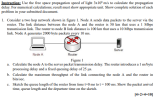 Need help with this question urgently! If all questions could be
answered that would be amazing, if only one or two that'd still be
greatly appreciated..
Instruction: Use the free space propagation speed of light 3x10 m/s to calculate the propagation delay. For numerical calculations; result must show appropriate unit. Show complete solution of each problem in your submitted document 1. Consider a two hop network shown in figure 1. Node A sends data packets to the server via the...
Need help with this question urgently! If all questions could be
answered that would be amazing, if only one or two that'd still be
greatly appreciated..
Instruction: Use the free space propagation speed of light 3x10 m/s to calculate the propagation delay. For numerical calculations; result must show appropriate unit. Show complete solution of each problem in your submitted document 1. Consider a two hop network shown in figure 1. Node A sends data packets to the server via the...
Suppose that N packets are in the queue of a router, and that the router is...
 Suppose that N packets are in the queue of a router, and that the router is transmitting a packet. Suppose also that x bits of the currently-being-transmitted packet has been transmitted. Assume that all packets are composed of L bits, and that the output link of the router has a transmission rate of R bits/sec. What is the queuing delay of the Nth (last) packet in the queue of the router?
1. Consider a packet of length L which begins at end system A and travels over...
1. Consider a packet of length L which begins at end system A and travels over three links to a destination end system. These three links are connected by two packet switches. Let di, si, and Ri denote the length, propagation speed, and the transmission rate of link i, for i=1,2,3. The packet switch delays each packet by dproc. Assuming no queuing delays, in terms of di, si, and Ri, (i=1,2,3), and L, what is the total end-to-end delay for...
Problem 2 For a given network, the average packet length L = 1024 bytes, packets are...
 Problem 2 For a given network, the average packet length L = 1024 bytes, packets are arriving with an average rate = 8 pakets/s, the network is used to support voice call services which can tolerate a maximum end-to-end delay of 150 ms, the average end-to-end distance between any two connected nodes in the network is 1000 km, the average phase velocity for signal travelling throughout the network links is 0.1 speed of light in free space and the call...
 Transmission Delay
Consider sending N packets each of length L bits from Host A to
Host B, as shown in the figure below. Assume that the links between
Host A and the Router and between the Router and Host B each has a
transmission rate of R bits per second. Assume all buffers are of
infinite capacity. Ignore all processing and propagation
delays.
a) Express the delay it takes to send 2 packets
from A to B as a function...
Transmission Delay
Consider sending N packets each of length L bits from Host A to
Host B, as shown in the figure below. Assume that the links between
Host A and the Router and between the Router and Host B each has a
transmission rate of R bits per second. Assume all buffers are of
infinite capacity. Ignore all processing and propagation
delays.
a) Express the delay it takes to send 2 packets
from A to B as a function...
 Note: b denotes bits and B denotes Bytes (1 Byte 8 bits) Question 1: 32 points: (16)+(16) Source Destination Consider a packet of length L, which begins at source and travels over seven links to a destination. These links are connected through six routers. Let di, si, and Ri denote the length, propagation speed, and the transmission rate of link i, for i 1 to 7. The processing delay at each router is d-proc. The queuing delay at each router...
 Need help with this question urgently! If all questions could be
answered that would be amazing, if only one or two that'd still be
greatly appreciated..
Instruction: Use the free space propagation speed of light 3x10 m/s to calculate the propagation delay. For numerical calculations; result must show appropriate unit. Show complete solution of each problem in your submitted document 1. Consider a two hop network shown in figure 1. Node A sends data packets to the server via the...
Need help with this question urgently! If all questions could be
answered that would be amazing, if only one or two that'd still be
greatly appreciated..
Instruction: Use the free space propagation speed of light 3x10 m/s to calculate the propagation delay. For numerical calculations; result must show appropriate unit. Show complete solution of each problem in your submitted document 1. Consider a two hop network shown in figure 1. Node A sends data packets to the server via the...
 Suppose that N packets are in the queue of a router, and that the router is transmitting a packet. Suppose also that x bits of the currently-being-transmitted packet has been transmitted. Assume that all packets are composed of L bits, and that the output link of the router has a transmission rate of R bits/sec. What is the queuing delay of the Nth (last) packet in the queue of the router?
 Problem 2 For a given network, the average packet length L = 1024 bytes, packets are arriving with an average rate = 8 pakets/s, the network is used to support voice call services which can tolerate a maximum end-to-end delay of 150 ms, the average end-to-end distance between any two connected nodes in the network is 1000 km, the average phase velocity for signal travelling throughout the network links is 0.1 speed of light in free space and the call...
Most questions answered within 3 hours.
-
Where is the error in this code sequence?
String s1 = "Hello";
String s2 = "ello";...
asked 1 year ago -
Financial data for Joel de Paris, Inc., for last year
follow:
Joel de Paris, Inc.
Balance...
asked 1 year ago -
Consider this reaction:
Al2(SO4)3 (aq)+ BaCl3
(aq) Al2Cl6 (aq)- +
3BaSO4(s) . What is the...
asked 1 year ago -
Suppose that Savneet is considering increasing her
recent random sample from 20 car rentals to 40...
asked 1 year ago -
Trucks arrive at an unloading terminal at an average rate of 120
per hour.
Trucks arrive...
asked 1 year ago -
Why are methanol and ethanol completely soluble in water while
octanol is not very little soluble....
asked 1 year ago -
A facilities manager at a university reads in a research report
that the mean amount of...
asked 1 year ago -
When the CuSO4 is rehydrated by adding water to the anhydrous
compound, is this an endothermic...
asked 1 year ago -
A ray of sunlight is passing from diamond into crown glass; the
angle of incidence is...
asked 1 year ago -
A block of mass 0.249 kg is placed on top of a light, vertical
spring of...
asked 1 year ago -
how do the kidneys compensate in the presences of acidosis
a) trigger hyperventilate
b) reserve acid...
asked 1 year ago -
Question 501 pts
The rental rate of capital to the firm increases. Which of the
following...
asked 1 year ago