1. Additive manufacturing is a candidate process when production volumes are ________. 2. Infusion of living...
1. Additive manufacturing is a candidate process when production volumes are ________.
2. Infusion of living bone into a porous product = ________________.
3. Two primary model types are made as prototypes: conceptual and __________.
Homework Answers
1)Additive manufacturing is a candidate process when production volumes are small quantities and parts are complex in shape.
2) Infusion of living bone into a porous product =porous scaffolds (https://www.sciencedirect.com/topics/engineering/porous-scaffold) for more information you can go to the link.
3)Two primary model types are made as prototypes: conceptual and Feasibility Prototype.
Add Answer to:
1. Additive manufacturing is a candidate process when production
volumes are ________.
2. Infusion of living...
Additive Manufacturing: 1. Explain the difference between subtractive manufacturing and additive manufacturing processes, and include one...
Additive Manufacturing: 1. Explain the difference between subtractive manufacturing and additive manufacturing processes, and include one example in each case. 2. Identify one comparative advantage and one limitation of additive manufacturing. 3. Explain how selective laser sintering and 3D printing processes are different? 4. Describe fused deposition modeling briefly. 5. Identify the additive manufacturing process that utilizes an adhesive to join layers of powder to build a prototype. 6. What it is important to develop prototypes.
2. Identify one comparative advantage and one limitation of additive manufacturing. 3. Explain how selective laser...
2. Identify one comparative advantage and one limitation of additive manufacturing. 3. Explain how selective laser sintering and 3D printing processes are different? 4. Describe fused deposition modeling briefly. 5. Identify the additive manufacturing process that utilizes an adhesive to join layers of powder to build a prototype. 6. What it is important to develop prototypes.
2 Additive Manufacturing 3D printing is a growing trend in the manufacturing industry, with sever...
 2 Additive Manufacturing 3D printing is a growing trend in the manufacturing industry, with several factories and makers using this technology to quickly produce prototypes or replacement parts. 3D printing comes in different forms and uses different types of materials. One disadvantage to 3D printing is its relatively slow processing time, which makes it difficult to use for mass production of items Your family business has recently decided to purchase a high quality 3D printer to explore a new business...
Suppose a manufacturing firm has two factories (Factory 1 and Factory 2), and a single production process (Process A) that is used in both factories. A new process (Process B) is developed that potent...
Suppose a manufacturing firm has two factories (Factory 1 and Factory 2), and a single production process (Process A) that is used in both factories. A new process (Process B) is developed that potentially reduces production costs. To test whether Process B is less costly than Process A, an experiment is designed where: Within each Factory, products are assigned randomly to Process A or Process B. Production costs for each product are recorded. Note that resources (i.e. materials, workers, equipment)...
2 A production department in a process manufacturing system completed its work on 86,000 units of...
 2 A production department in a process manufacturing system completed its work on 86,000 units of product and transferred them to the next department during a recent period. Of these units, 25,800 were in process at the beginning of the period. The other 60,200 units were started and completed during the period. At period-end, 16,300 units were in process. 1 points Exercise 20-4 Weighted average: Computing equivalent units LO C2 eBook Prepare the production department's equivalent units of production for...
Applied manufacturing overheads are overheads allocated to the production process according to a tariff, based on...
Applied manufacturing overheads are overheads allocated to the production process according to a tariff, based on the budgeted overheads and expected capacity utilization. The following is the budget of a car manufacturing company XYD: Total Per unit Budgeted production (units) 1500 Budgeted direct material cost R20 000 R14.00 Budgeted direct labor cost R45 000 R30.00 Budgeted manufacturing overheads R12 000 Fixed variable R8 000 R 4 000 Budgeted direct labor hours 4 000 3 Budgeted machine hours 3000 2 Answer...
The production department in a process manufacturing system completed 234,000 units of product and transferred them...
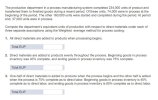 The production department in a process manufacturing system completed 234,000 units of product and transferred them to finished goods during a recent period. Of these units, 74,000 were in process at the beginning of the period. The other 160,000 units were started and completed during the period. At period end, 37,000 units were in process. Compute the department's equivalent units of production with respect to direct materials under each of three separate assumptions using the Weighted -average method for process...
Suppose a manufacturing firm has two factories (Factory 1 and Factory 2), and a single production...
Suppose a manufacturing firm has two factories (Factory 1 and Factory 2), and a single production process (Process A) that is used in both factories. A new process (Process B) is developed that potentially reduces production costs. To test whether Process B is less costly than Process A, an experiment is designed where: Within each Factory, products are assigned randomly to Process A or Process B. Production costs for each product are recorded. Note that resources (i.e. materials, workers, equipment)...
During April, the production department of a process manufacturing system completed a number of units of...
 During April, the production department of a process manufacturing
system completed a number of units of a product transferred them to
finished goods. these transferred units, 60, 00 were in process in
the production department at the beginning of April and 240.000
were started and completed in April. April's beginning inventory
units were 60% complete with respect to materials and 40% complete
with respect to conversion. At the end of April, 82,000 additional
units were in process in the production...
During April, the production department of a process manufacturing
system completed a number of units of a product transferred them to
finished goods. these transferred units, 60, 00 were in process in
the production department at the beginning of April and 240.000
were started and completed in April. April's beginning inventory
units were 60% complete with respect to materials and 40% complete
with respect to conversion. At the end of April, 82,000 additional
units were in process in the production...
1) What are primary differences in job cost accounting versus process cost accounting with respect to...
 1) What are primary differences in job cost accounting versus process cost accounting with respect to the following categories? Job Cost Process Cost Type of order Type of product Volume Flexibility Standardization Documents Used Work in Process Accounts 2) How do the journal entries for a process costing system differ from a job costing system? 3) What does equivalent units of production (EUP) measure? Why is EUP used? 4) What are the two types of cost that make up conversion...
 2 Additive Manufacturing 3D printing is a growing trend in the manufacturing industry, with several factories and makers using this technology to quickly produce prototypes or replacement parts. 3D printing comes in different forms and uses different types of materials. One disadvantage to 3D printing is its relatively slow processing time, which makes it difficult to use for mass production of items Your family business has recently decided to purchase a high quality 3D printer to explore a new business...
 2 A production department in a process manufacturing system completed its work on 86,000 units of product and transferred them to the next department during a recent period. Of these units, 25,800 were in process at the beginning of the period. The other 60,200 units were started and completed during the period. At period-end, 16,300 units were in process. 1 points Exercise 20-4 Weighted average: Computing equivalent units LO C2 eBook Prepare the production department's equivalent units of production for...
 The production department in a process manufacturing system completed 234,000 units of product and transferred them to finished goods during a recent period. Of these units, 74,000 were in process at the beginning of the period. The other 160,000 units were started and completed during the period. At period end, 37,000 units were in process. Compute the department's equivalent units of production with respect to direct materials under each of three separate assumptions using the Weighted -average method for process...
 During April, the production department of a process manufacturing
system completed a number of units of a product transferred them to
finished goods. these transferred units, 60, 00 were in process in
the production department at the beginning of April and 240.000
were started and completed in April. April's beginning inventory
units were 60% complete with respect to materials and 40% complete
with respect to conversion. At the end of April, 82,000 additional
units were in process in the production...
During April, the production department of a process manufacturing
system completed a number of units of a product transferred them to
finished goods. these transferred units, 60, 00 were in process in
the production department at the beginning of April and 240.000
were started and completed in April. April's beginning inventory
units were 60% complete with respect to materials and 40% complete
with respect to conversion. At the end of April, 82,000 additional
units were in process in the production...
 1) What are primary differences in job cost accounting versus process cost accounting with respect to the following categories? Job Cost Process Cost Type of order Type of product Volume Flexibility Standardization Documents Used Work in Process Accounts 2) How do the journal entries for a process costing system differ from a job costing system? 3) What does equivalent units of production (EUP) measure? Why is EUP used? 4) What are the two types of cost that make up conversion...
Most questions answered within 3 hours.
-
Where is the error in this code sequence?
String s1 = "Hello";
String s2 = "ello";...
asked 11 months ago -
Financial data for Joel de Paris, Inc., for last year
follow:
Joel de Paris, Inc.
Balance...
asked 11 months ago -
Consider this reaction:
Al2(SO4)3 (aq)+ BaCl3
(aq) Al2Cl6 (aq)- +
3BaSO4(s) . What is the...
asked 11 months ago -
Suppose that Savneet is considering increasing her
recent random sample from 20 car rentals to 40...
asked 11 months ago -
Trucks arrive at an unloading terminal at an average rate of 120
per hour.
Trucks arrive...
asked 11 months ago -
Why are methanol and ethanol completely soluble in water while
octanol is not very little soluble....
asked 11 months ago -
A facilities manager at a university reads in a research report
that the mean amount of...
asked 11 months ago -
When the CuSO4 is rehydrated by adding water to the anhydrous
compound, is this an endothermic...
asked 11 months ago -
A ray of sunlight is passing from diamond into crown glass; the
angle of incidence is...
asked 11 months ago -
A block of mass 0.249 kg is placed on top of a light, vertical
spring of...
asked 11 months ago -
how do the kidneys compensate in the presences of acidosis
a) trigger hyperventilate
b) reserve acid...
asked 11 months ago -
Question 501 pts
The rental rate of capital to the firm increases. Which of the
following...
asked 11 months ago