1. Starting from a separating equilbirum, the government wants to create a National Health Insurance Program...
1. Starting from a separating equilbirum, the government wants to create a National
Health Insurance Program (NHIP) that would bring full insurance to all its citizens
via a new national pooling contract, while banning any private insurance company
from offering any other contracts. With the aid of an indifference-curve (IC) diagram
for two types of insurees (viz., those with low health-risks and those with high health-
risks), show whether this new policy is a Pareto-improvement. If not, who gains and
who loses?
2. Due to fierce protests from private insurance companies, suppose the government lifts
the ban, and gives people the freedom to purchase insurance from NHIP (a pooling
contract) and/or from the private market (the original separating contracts) as they
see fit. Show diagrammatically whether this .freedom.is welfare-improving. If not,
who gains and who loses?
3. Explain whether there is any alternative policy the government can introduce that
would surely be Pareto-improving and thus favored by everyone.
Homework Answers
Insurance markets suffer from adverse selection and moral hazard. The population of individuals subject to the risk of loss (of life, property, health, income, etc.). Wealth if accident does not happen is w > 0. If accident happens loss of wealth is L (0 < L < w). Utility of wealth level w: u(w)
There are two types of individuals: High risk: probability of accident pH. Low risk: probability of accident pL (0 < pL < pH)
An insurance policy is (I, D) where I: insurance premium ,D: deductible. Wealth with insurance policy (I, D).
No accident: w − I Accident: w − D − I.
Expected utility of type i = L, H with insurance (I, D) Ui(D, I) = piu(w − D − I) + (1 − pi)u(w − I)
Separating equilibrium: if complete information policies (FH , FL) were offered.
figure 1 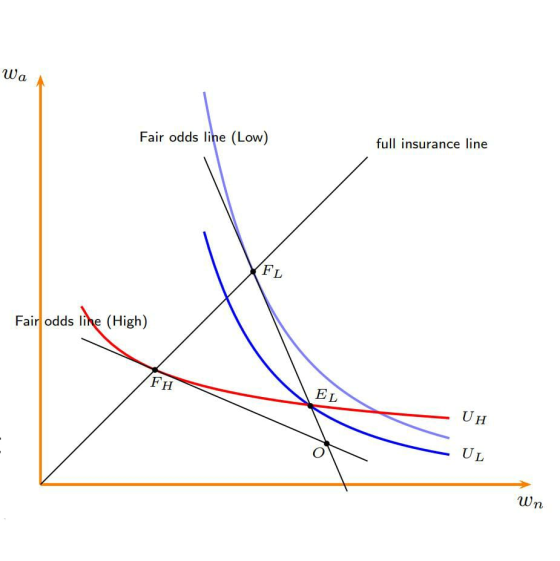
- High risk buys Low risk’s policy
- Since Low does not want to mimic High risk keep offering High risk FH
- But, have to offer Low risk a policy that High doesn’t want to mimic
- Has to be on fair odds line
- Equilibrium candidate is EL
- Best that can be done for Low risk without attracting High risk
- Note that High risk are fully insured DH = 0, IH = pHL
- Low risk is partially insured at a lower premium DL > 0, IL < IH
- This is the only way to separate Low risk from High
- Low risk is willing to accept higher deductible (deductible is paid in case of an accident, which is a lower probability event for Low risk)
- In exchange for a lower premium Compared to complete information case
- Low risk is worse off
- High risk is indifferent
- Companies still make zero profit
- Asymmetric information has a welfare cost
For equilibrium, Consider policy d. Both types prefer d to their current policies. Does it make a profit?
figure 2 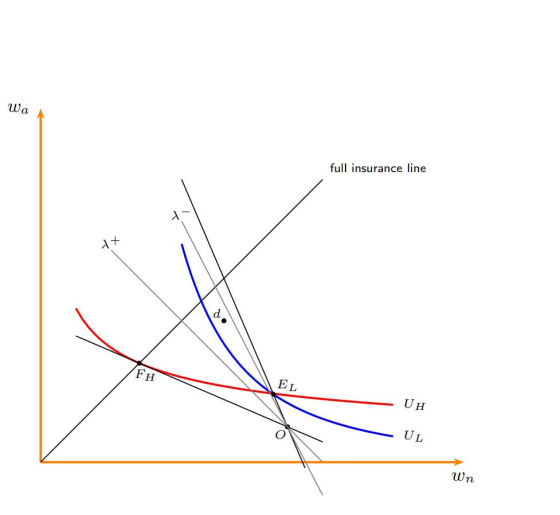
Depends on µ = λpH + (1 − λ)pL
- λ +: average fair odds line with high λ
- λ −: average fair odds line with low λ
- If λ is high (λ +) d does not make a positive profit, We found an equilibrium
- If λ is low (λ −) d makes a positive profit, What we found is not an equilibrium.
In the candidate separating equilibrium Low risk gets low insurance coverage
- they don’t like this because they are risk-averse
- They prefer a pooling policy such as d although they are cross-subsidizing high risk
- If the proportion of High risk (λ) is low, a firm can offer d, attract both types and still make profit
- This destroys the candidate equilibrium
- There is no pooling equilibrium
- There may not be a separating equilibrium either If there is an equilibrium
- High risk gets full insurance at higher premium
- Low risk gets partial coverage at lower premium
- There is a welfare cost of adverse selection
- Entirely borne by Low risk individuals
Pooling Equilibrium: Since both types buy the same policy, expected company profits: w − µL − µwa − (1 − µ)wn
where µ is the expected risk µ = λpH + (1 − λ)pL
Figure 3 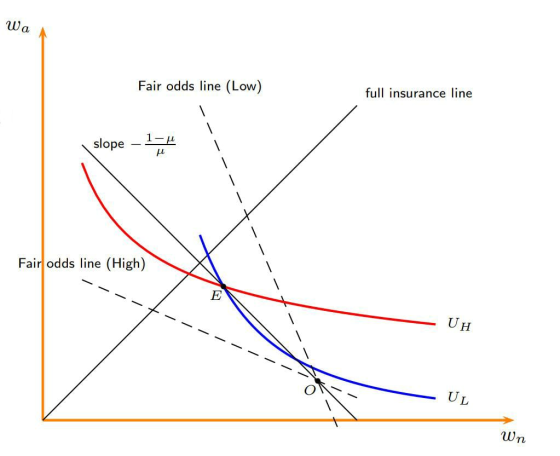
- Suppose there is a pooling equilibrium
- It must be on expected fair odds line
- Low type must prefer it to no insurance: say E
- Then high type also prefers it
- Low risk is worse off and high risk is better off compared to complete information
- Company makes losses on high risk and profit on low risk
- Low risk cross-subsidizes high risk
Add Answer to:
1. Starting from a separating equilbirum, the government wants
to create a National
Health Insurance Program...
1. Consider 2 policies: A) The government requires everyone to buy a standard health insurance package...
1. Consider 2 policies: A) The government requires everyone to buy a standard health insurance package that costs $5000; B) The government taxes everybody $5000 but cuts taxes by $5000 for everybody who buys the standard health insurance package. Do these policies have different effects on the size of government? Explain why. 2. Show graphically and explain why Pareto optimality occurs at a commodity distribution bundle between 2 agents where the marginal rates of substitution between the goods for both...
Proponents of universal health insurance coverage prefer the _______ system national insurance program.
QUESTION 1 Proponents of universal health insurance coverage prefer the _______ system national insurance program. QUESTION 3 Which of the following are concerns that must be addressed when developing and implementing policies to reform the healthcare system? A. Quality of care B. Access to care C. Demand of care O D. Costs of care QUESTION 4 Which of the following are alternative strategies routinely proposed at the federal and state levels to increase financial access to health care? A. Market incentives B. Mandated insurance coverage C. Social welfare...
" Rising prices for health-care services and insurance continued to drive up health spending in 2018,...
" Rising prices for health-care services and insurance continued to drive up health spending in 2018, even as the amount of health care Americans used remained steady. National health spending reached $3.6 trillion — about $11,172 per person — in 2018, a 4.6% increase from the previous year, according to an annual report by the Office of the Actuary at the Centers for Medicare and Medicaid Services, published online in Health Affairs. CMS researchers found that the rise in overall...
Instructions- please describe how you feel about the following statement without plagiarizing; What are the top...
Instructions- please describe how you feel about the following statement without plagiarizing; What are the top 3 risks to your business expanding globally? The three important factors to evaluate before expanding any business globally or in foreign countries are economic risks, political risks and corruption. Economic risks include devaluation of foreign currency due to different exchange rates or restriction by foreign country on money transfers therefore lowering the initial invested capital; inflation is another economic risk, inflation creates low profit...
16 Basics of Health Insurance VOCABULARY REVIEW de blanks with the corecr vewcubulary terns from this...
 16 Basics of Health Insurance VOCABULARY REVIEW de blanks with the corecr vewcubulary terns from this chopte hi phsomeric number isued by the insurance compuny giving approval of a procedure or service is ai : The The amsunt pagable by an insaurane conpany for a monetary loss to an inrvidual insuned by tha for a monetary loss to an individual insured by that company cash coverage. is known as be-0643 , In the United States beultheare practitioners rendr services bieft...
2 Hospitals Are Accused Of Segregating by Race By RONALD SULLIVANMAY 20, 1994 .New York State's...
2 Hospitals Are Accused Of Segregating by Race By RONALD SULLIVANMAY 20, 1994 .New York State's top human rights official said yesterday that she was investigating charges that black and Hispanic maternity patients at Mount Sinai Medical Center and Presbyterian Hospital in Manhattan were segregated by race. The official, Commissioner Margarita Rosa of the State Division of Human Rights, announced the investigation at a legislative hearing in Manhattan at which three maternity patients accused Mount Sinai of discrimination, testifying that...
1) A bond is a ["financial contract: a borrower agrees to repay the amount that was...
1) A bond is a ["financial contract: a borrower agrees to repay the amount that was borrowed and also a rate of interest over a period of time in the future.", "risk-free investment", "type of stock in a company", "rate of interest"] and also a ["risk-free investment", "rate of interest", "guarantee of payment", "rate of business growth"] over a period of time in the future. A corporate bond is issued by firms, but bonds are also issued...
Grading Obamacare: Successes, Failures and ‘Incompletes’ We’ve updated this article with the news that Republicans abandoned...
Grading Obamacare: Successes, Failures and ‘Incompletes’ We’ve updated this article with the news that Republicans abandoned a vote to repeal the Affordable Care Act. As House Speaker Paul Ryan acknowledged, Obamacare is still “the law of the land.” Did Obamacare work? It’s worth reflecting upon after President Trump and House Republicans failed on Friday to repeal and replace the “disaster” of Obamacare. Ever since the Affordable Care Act was passed in 2010, it has been so contentious that it can...
Here we set those articles into broad context. The literature generally supported taxes on sugar-sweetened beverages (SS...
Here we set those articles into broad context. The literature generally supported taxes on sugar-sweetened beverages (SSBs): SSB taxes reduced purchase and consumption of those items across socioeconomic strata. In addition, some researchers suggest that SSB taxes as part of a more comprehensive approach may amplify the positive effects on obesity reduction and other health-related morbidities (Cobiac, Tam, Veerman, and Blakely, 2017). For example, an SSB tax combined with sugar, salt, alcohol, and tobacco taxes combined with subsidies for purchasing...
QUESTION 1 After a discrimination charge is filed by the employee and notice of the charge...
QUESTION 1 After a discrimination charge is filed by the employee and notice of the charge is given to the employer, the EEOC screens the charge to see if it is one that is appropriate for mediation. If it is appropriate for mediation, the EEOC will offer that option to the parties. In this case, each side has _____ days to respond to the offer to mediate. A. 30 B. 40 C. 10 D. 20 0.3 points QUESTION 2...
 16 Basics of Health Insurance VOCABULARY REVIEW de blanks with the corecr vewcubulary terns from this chopte hi phsomeric number isued by the insurance compuny giving approval of a procedure or service is ai : The The amsunt pagable by an insaurane conpany for a monetary loss to an inrvidual insuned by tha for a monetary loss to an individual insured by that company cash coverage. is known as be-0643 , In the United States beultheare practitioners rendr services bieft...
Most questions answered within 3 hours.
-
Where is the error in this code sequence?
String s1 = "Hello";
String s2 = "ello";...
asked 11 months ago -
Financial data for Joel de Paris, Inc., for last year
follow:
Joel de Paris, Inc.
Balance...
asked 11 months ago -
Consider this reaction:
Al2(SO4)3 (aq)+ BaCl3
(aq) Al2Cl6 (aq)- +
3BaSO4(s) . What is the...
asked 11 months ago -
Suppose that Savneet is considering increasing her
recent random sample from 20 car rentals to 40...
asked 11 months ago -
Trucks arrive at an unloading terminal at an average rate of 120
per hour.
Trucks arrive...
asked 11 months ago -
Why are methanol and ethanol completely soluble in water while
octanol is not very little soluble....
asked 11 months ago -
A facilities manager at a university reads in a research report
that the mean amount of...
asked 11 months ago -
When the CuSO4 is rehydrated by adding water to the anhydrous
compound, is this an endothermic...
asked 11 months ago -
A ray of sunlight is passing from diamond into crown glass; the
angle of incidence is...
asked 11 months ago -
A block of mass 0.249 kg is placed on top of a light, vertical
spring of...
asked 11 months ago -
how do the kidneys compensate in the presences of acidosis
a) trigger hyperventilate
b) reserve acid...
asked 11 months ago -
Question 501 pts
The rental rate of capital to the firm increases. Which of the
following...
asked 11 months ago