"What is the point of entering a perfectly competitive industry if it is simply to earn...
- "What is the point of entering a perfectly competitive industry if it is simply to earn zero profits anyway?" Discuss this statement with reference to the long and short run, as well as to heterogeneity across firms. (Use appropriate graphs to support your answer).
Homework Answers
A perfectly competitive market has homogenous firms, products ad perfect knowledge. It is an extreme and ideal case far from reality. Therefore, the firms are price taker and have no control over the prices. Competition ensures that the most efficient allocation is reached. However, in the process, the profit of each of the firms are driven down to zero in the long run. The following points illustrate why firms join a perfectly competitive industry.
- In the short run, a perfectly competitive industry can earn a super-normal profit. This is demonstrated by the figure below. Economic profit is given by the rectangle.
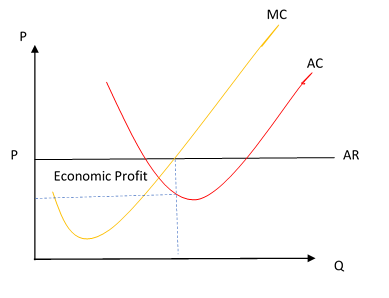
- There are free entry and exits so in the long run profits are driven down to zero. However, economic profit is not the only source of profit for the producers. The economic profits are what the producers get after deducting the payments to the factors of production, In most of the cases, the firms are also the owners of the factors of production, Therefore, even if economic profit is zero, accounting profit is not zero. Accounting profit = economic profit + earnings from factors of production.
- There is no cost of advertisement or awareness as there is perfect knowledge in the market.
Add Answer to:
"What is the point of entering a perfectly competitive industry
if it is simply to earn...
1. A competitive industry is comprised of 20 firms, 6 of which earn profits. What can...
 1. A competitive industry is comprised of 20 firms, 6 of which earn profits. What can you infer about the shape of the long-run supply curve of this industry? ( point) positive, non-zero
1. A competitive industry is comprised of 20 firms, 6 of which earn profits. What can you infer about the shape of the long-run supply curve of this industry? ( point) positive, non-zero
1. A competitive industry is comprised of 20 firms, 6 of which earn profits. What can you infer about the shape of the long-run supply curve of this industry? ( point) positive, non-zero
In the long run, all of the firms in a perfectly competitive industry will: exit the...
 In the long run, all of the firms in a perfectly competitive industry will: exit the industry if price is greater than average total cost. produce at an output level at which average total cost equals marginal cost. earn an economic profit greater than zero. O produce an output level at which price is greater than average total cost. Which statement about the differences between monopoly and perfect competition is INCORRECT? A monopoly will charge a higher price and produce...
A company is considering entering industry A which is perfectly competitive. Here are further details on...
A company is considering entering industry A which is perfectly competitive. Here are further details on the industry: 100 firms currently operating each with a fixed cost of $1,000 and TVC of 5Q^2 +10Q Industry demand is given by P = 400-2Q/19 a) Given that the industry is in the short run, that is, there is no entry and exit, how much profit would be made by each company? b) How many firms would enter into this industry in the...
1. A company is considering entering industry A which is perfectly competitive. Here are further details...
 1. A company is considering entering industry A which is perfectly competitive. Here are further details on the industry: 100 firms currently operating each with a fixed cost of $1,000 and TVC of 5Q2+100 Industry demand is given by P = 400-20/19 a) (40 points) Given that the industry is in the short run, that is, there is no entry and exit, how much profit would be made by each company? b) (60 points) How many firms would enter into...
1. A company is considering entering industry A which is perfectly competitive. Here are further details...
 1. A company is considering entering industry A which is perfectly competitive. Here are further details on the industry: 100 firms currently operating each with a fixed cost of $1,000 and TVC of 5Q+100 Industry demand is given by P 400-20/19 a) (40 points) Given that the industry is in the short run, that is, there is no entry and exit, how much profit would be made by each company b) (60 points) How many firms would enter into this...
1. A company is considering entering industry A which is perfectly competitive. Here are further details...
 1. A company is considering entering industry A which is perfectly competitive. Here are further details on the industry: 100 firms currently operating each with a fixed cost of $1,000 and TVC of 5Q2+100 Industry demand is given by P = 400-20/19 a) (40 points) Given that the industry is in the short run, that is, there is no entry and exit, how much profit would be made by each company? b) (60 points) How many firms would enter into...
Consider a perfectly competitive market for titanium. Assume that all firms in the industry are identical and...
 Consider a perfectly competitive market for titanium. Assume that all firms in the industry are identical and have the marginal cost (MC), average total cost (ATC), and average variable cost (AVC) curves shown on the following graph. Assume also that it does not matter how many firms are in the industry Tool Tip: Place the mouse cursor over orange square points on the MC curve to see coordinates. COST PER UNIT IDollars per pound) 10 MC ATC AVC 0 5...
If the donut industry is perfectly competitive and is in long-run equilibrium, then the price of...
If the donut industry is perfectly competitive and is in long-run equilibrium, then the price of a donut Question 20 options: A) equals long-run average cost. B) is greater than marginal cost. C) is greater than long-run average cost. D) is greater than short-run average cost. The industry that produces zangs is in long-run equilibrium. Then the demand for zangs increases permanently. As a result, firms in the industry will ________. Some firms will ________ the industry, and the industry...
a) Using both market and firm graphs for a perfectly competitive industry, show the effect of...
a) Using both market and firm graphs for a perfectly competitive industry, show the effect of an increase in consumers’ income taxes. Assume the representative firm and market begin in long run equilibrium. Illustrate the short run effect on price, output, and profits, assuming this firm does not shut down. Label your graphs and explain your answer. b) Assuming the representative firm does not withdraw from the market, show the long run effect on price, output, and profits. Label your...
¬8) Assume a perfectly competitive industry. In the short run suppose that the market price for the good is $10. You als...
¬8) Assume a perfectly competitive industry. In the short run suppose that the market price for the good is $10. You also know that the minimum point on the average variable cost curve occurs at $6 per unit while the minimum point on the average total cost curve occurs at $11 per unit. From this information you know that in the short run, firms in this industry ____ and in the long run, holding everything else constant, there will be...
 1. A competitive industry is comprised of 20 firms, 6 of which earn profits. What can you infer about the shape of the long-run supply curve of this industry? ( point) positive, non-zero
1. A competitive industry is comprised of 20 firms, 6 of which earn profits. What can you infer about the shape of the long-run supply curve of this industry? ( point) positive, non-zero
1. A competitive industry is comprised of 20 firms, 6 of which earn profits. What can you infer about the shape of the long-run supply curve of this industry? ( point) positive, non-zero
 In the long run, all of the firms in a perfectly competitive industry will: exit the industry if price is greater than average total cost. produce at an output level at which average total cost equals marginal cost. earn an economic profit greater than zero. O produce an output level at which price is greater than average total cost. Which statement about the differences between monopoly and perfect competition is INCORRECT? A monopoly will charge a higher price and produce...
 1. A company is considering entering industry A which is perfectly competitive. Here are further details on the industry: 100 firms currently operating each with a fixed cost of $1,000 and TVC of 5Q2+100 Industry demand is given by P = 400-20/19 a) (40 points) Given that the industry is in the short run, that is, there is no entry and exit, how much profit would be made by each company? b) (60 points) How many firms would enter into...
 1. A company is considering entering industry A which is perfectly competitive. Here are further details on the industry: 100 firms currently operating each with a fixed cost of $1,000 and TVC of 5Q+100 Industry demand is given by P 400-20/19 a) (40 points) Given that the industry is in the short run, that is, there is no entry and exit, how much profit would be made by each company b) (60 points) How many firms would enter into this...
 1. A company is considering entering industry A which is perfectly competitive. Here are further details on the industry: 100 firms currently operating each with a fixed cost of $1,000 and TVC of 5Q2+100 Industry demand is given by P = 400-20/19 a) (40 points) Given that the industry is in the short run, that is, there is no entry and exit, how much profit would be made by each company? b) (60 points) How many firms would enter into...
 Consider a perfectly competitive market for titanium. Assume that all firms in the industry are identical and have the marginal cost (MC), average total cost (ATC), and average variable cost (AVC) curves shown on the following graph. Assume also that it does not matter how many firms are in the industry Tool Tip: Place the mouse cursor over orange square points on the MC curve to see coordinates. COST PER UNIT IDollars per pound) 10 MC ATC AVC 0 5...
Most questions answered within 3 hours.
-
Where is the error in this code sequence?
String s1 = "Hello";
String s2 = "ello";...
asked 11 months ago -
Financial data for Joel de Paris, Inc., for last year
follow:
Joel de Paris, Inc.
Balance...
asked 11 months ago -
Consider this reaction:
Al2(SO4)3 (aq)+ BaCl3
(aq) Al2Cl6 (aq)- +
3BaSO4(s) . What is the...
asked 11 months ago -
Suppose that Savneet is considering increasing her
recent random sample from 20 car rentals to 40...
asked 11 months ago -
Trucks arrive at an unloading terminal at an average rate of 120
per hour.
Trucks arrive...
asked 11 months ago -
Why are methanol and ethanol completely soluble in water while
octanol is not very little soluble....
asked 11 months ago -
A facilities manager at a university reads in a research report
that the mean amount of...
asked 11 months ago -
When the CuSO4 is rehydrated by adding water to the anhydrous
compound, is this an endothermic...
asked 11 months ago -
A ray of sunlight is passing from diamond into crown glass; the
angle of incidence is...
asked 11 months ago -
A block of mass 0.249 kg is placed on top of a light, vertical
spring of...
asked 11 months ago -
how do the kidneys compensate in the presences of acidosis
a) trigger hyperventilate
b) reserve acid...
asked 11 months ago -
Question 501 pts
The rental rate of capital to the firm increases. Which of the
following...
asked 11 months ago