1. Define the terms: oxidation, reduction, standard reduction potential, anode, and cathode. 2. Draw a diagram...
1. Define the terms: oxidation, reduction, standard reduction potential, anode, and cathode.
2. Draw a diagram of a voltaic cell using zinc-zinc ion and aluminum-aluminum ion half-cells. Label the following parts: cathode, anode, salt bridge, the oxidizing agent, and the reducing agent.
3. What is the function of a salt bridge?
Homework Answers


Add Answer to:
1. Define the terms: oxidation, reduction, standard reduction
potential, anode, and cathode.
2. Draw a diagram...
Draw the diagram for the standard cell potential of a Cu/Cu cell that is 0.05 M...
 Draw the diagram for the standard cell potential of a Cu/Cu cell that is 0.05 M and 1.00 M in cusoa. Label the anode, cathode, direction of electron flow, salt bridge, oxidation side, and reducing side. 1.
The CuCu ions undergo reduction by accepting two electrons from the copper electrode (cathode) and depositing...
 The CuCu ions undergo reduction by accepting two electrons from
the copper electrode (cathode) and depositing on the electrode as
Cu(s)Cu(s). The reduction half-cell reaction that takes place at
the cathode is
Cu^2+(aq)+2e^−→Cu(s)Cu^2+(aq)+2e^-→Cu(s)
The electrons lost by the ZnZn metal are gained by the CuCu ion.
The transfer of electrons between ZnZn metal and CuCu ions is made
possible by connecting the wire between the ZnZn electrode and the
CuCu electrode. Thus, in the voltaic cell, the electrons flow
through...
The CuCu ions undergo reduction by accepting two electrons from
the copper electrode (cathode) and depositing on the electrode as
Cu(s)Cu(s). The reduction half-cell reaction that takes place at
the cathode is
Cu^2+(aq)+2e^−→Cu(s)Cu^2+(aq)+2e^-→Cu(s)
The electrons lost by the ZnZn metal are gained by the CuCu ion.
The transfer of electrons between ZnZn metal and CuCu ions is made
possible by connecting the wire between the ZnZn electrode and the
CuCu electrode. Thus, in the voltaic cell, the electrons flow
through...
In a copper-zinc voltaic cell, one half-cell consists of a ZnZn electrode inserted in a solution...
 In a copper-zinc voltaic cell, one half-cell consists of a ZnZn
electrode inserted in a solution of zinc sulfate and the other
half-cell consists of a CuCu electrode inserted in a copper sulfate
solution. These two half-cells are separated by a salt bridge.
At the zinc electrode (anode), ZnZn metal undergoes oxidation by
losing two electrons and enters the solution as Zn2+Zn2+ ions. The
oxidation half-cell reaction that takes place at the anode is
Zn(s)→Zn2+(aq)+2e−Zn(s)→Zn2+(aq)+2e−
The CuCu ions undergo reduction...
In a copper-zinc voltaic cell, one half-cell consists of a ZnZn
electrode inserted in a solution of zinc sulfate and the other
half-cell consists of a CuCu electrode inserted in a copper sulfate
solution. These two half-cells are separated by a salt bridge.
At the zinc electrode (anode), ZnZn metal undergoes oxidation by
losing two electrons and enters the solution as Zn2+Zn2+ ions. The
oxidation half-cell reaction that takes place at the anode is
Zn(s)→Zn2+(aq)+2e−Zn(s)→Zn2+(aq)+2e−
The CuCu ions undergo reduction...
Draw the voltaic cell (labeling the anode, cathode, and salt bridge) for the reaction between Ag/Ag...
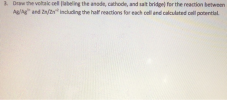 Draw the voltaic cell (labeling the anode, cathode, and salt bridge) for the reaction between Ag/Ag and Zn/Zn"7 including the half reactions for each cell and calculated cell potential. 3.
please help answer question 4, a-f please using the data below from chart 1 objectives from...
 please help answer question 4, a-f please
using the data below from chart 1
objectives from lab, thank you
DATA:CA y 3 Ay No3 Part I: Cell Potential of voltaic cells under standard conditions: cell CU CND2 #27 14.0m Give the half Half cell reaction at Combinations Oxidation Reduction E the anode and with [ion] takes place Theoretical takes place cathode. Write in M here here (V) above the arrow E c (V) if it is oxidation or reduction. |-0.340...
please help answer question 4, a-f please
using the data below from chart 1
objectives from lab, thank you
DATA:CA y 3 Ay No3 Part I: Cell Potential of voltaic cells under standard conditions: cell CU CND2 #27 14.0m Give the half Half cell reaction at Combinations Oxidation Reduction E the anode and with [ion] takes place Theoretical takes place cathode. Write in M here here (V) above the arrow E c (V) if it is oxidation or reduction. |-0.340...
2. A voltaic cell consists of Pb/Pb2 and Al Al half-cells 9 points Pb Al' +...
 2. A voltaic cell consists of Pb/Pb2 and Al Al half-cells 9 points Pb Al' + 2 e + 3 Pb Al Ered = -0.126 V Ered = -1.662 V Write out the balanced reaction for the cell and calculate the standard cell potential, Ecall On the diagram below, label the anode, the cathode, the direction of electron flow Also indicate at which electrode the oxidation occurs and which electrode the reduction occurs m ayar yar salt bridge
Calculate the theoretical cell potential (E°) of a galvanic cell under standard conditions made up of...
 Calculate the theoretical cell potential (E°) of a galvanic cell
under standard conditions made up of copper and magnesium (see Part
II and Table 1 for more information).
PARTIL Creating and Testing Voltaic Cells Introduction and Background for the Voltaic Cells A galvanic cell (sometimes more appropriately called a voltaic cell) consists of two half-cells joined by a salt bridge that allow ions to pass between the two sides in order to maintain electroneutrality. Each half-cell contains the Components of...
Calculate the theoretical cell potential (E°) of a galvanic cell
under standard conditions made up of copper and magnesium (see Part
II and Table 1 for more information).
PARTIL Creating and Testing Voltaic Cells Introduction and Background for the Voltaic Cells A galvanic cell (sometimes more appropriately called a voltaic cell) consists of two half-cells joined by a salt bridge that allow ions to pass between the two sides in order to maintain electroneutrality. Each half-cell contains the Components of...
Draw out a cell for Al in Al(NO3)3 and Ag in AgNO3. Label the anode and...
Draw out a cell for Al in Al(NO3)3 and Ag in AgNO3. Label the anode and cathode sides, including charge on each electrode. (hint: use a table of standard reduction potentials). Indicate direction of electron flow. Write the net reaction, and the half reactions. What is the standard cell potential? Indicate for both electrodes whether they are dissolving, growing, or staying the same size. Assuming the salt bridge contains KNO3, indicate flow of ions into and out of salt bridge....
(aq), Rh(aq)| Pt 30. & 31. & 32. Consider this voltaic cell: Pd Pd(aa)l a. The...
 (aq), Rh(aq)| Pt 30. & 31. & 32. Consider this voltaic cell: Pd Pd(aa)l a. The E cell 0.525 V for the voltaic cell, and the standard reduction potential for the palladium (Pd) half-reaction is Eo 0.915 V. What is the E° for the rhodium half reaction? b. Identify the oxidizing agent and the reducing agent in the reaction. c. Identify the anode and the cathode in the cell.
Parts a-j of this question refer to the following cell at 298 K. Complete the diagram...
Parts a-j of this question refer to the following cell at 298 K. Complete the diagram of the following voltaic cell: Zinc and iron electrodes, aqueous zinc nitrate, aqueous iron (III) nitrate, potassium nitrate salt bridge. Fe3+ (aq) + 3e- → Fe (s) E°= -0.040 V Ag+(aq) + e- → Ag(s) E°= 0.795 V a. Identify the electrodes as Anode or Cathode. Write the correct metal for each assuming the reactions are spontaneous b. Show the direction of the electron...
 Draw the diagram for the standard cell potential of a Cu/Cu cell that is 0.05 M and 1.00 M in cusoa. Label the anode, cathode, direction of electron flow, salt bridge, oxidation side, and reducing side. 1.
 The CuCu ions undergo reduction by accepting two electrons from
the copper electrode (cathode) and depositing on the electrode as
Cu(s)Cu(s). The reduction half-cell reaction that takes place at
the cathode is
Cu^2+(aq)+2e^−→Cu(s)Cu^2+(aq)+2e^-→Cu(s)
The electrons lost by the ZnZn metal are gained by the CuCu ion.
The transfer of electrons between ZnZn metal and CuCu ions is made
possible by connecting the wire between the ZnZn electrode and the
CuCu electrode. Thus, in the voltaic cell, the electrons flow
through...
The CuCu ions undergo reduction by accepting two electrons from
the copper electrode (cathode) and depositing on the electrode as
Cu(s)Cu(s). The reduction half-cell reaction that takes place at
the cathode is
Cu^2+(aq)+2e^−→Cu(s)Cu^2+(aq)+2e^-→Cu(s)
The electrons lost by the ZnZn metal are gained by the CuCu ion.
The transfer of electrons between ZnZn metal and CuCu ions is made
possible by connecting the wire between the ZnZn electrode and the
CuCu electrode. Thus, in the voltaic cell, the electrons flow
through...
 In a copper-zinc voltaic cell, one half-cell consists of a ZnZn
electrode inserted in a solution of zinc sulfate and the other
half-cell consists of a CuCu electrode inserted in a copper sulfate
solution. These two half-cells are separated by a salt bridge.
At the zinc electrode (anode), ZnZn metal undergoes oxidation by
losing two electrons and enters the solution as Zn2+Zn2+ ions. The
oxidation half-cell reaction that takes place at the anode is
Zn(s)→Zn2+(aq)+2e−Zn(s)→Zn2+(aq)+2e−
The CuCu ions undergo reduction...
In a copper-zinc voltaic cell, one half-cell consists of a ZnZn
electrode inserted in a solution of zinc sulfate and the other
half-cell consists of a CuCu electrode inserted in a copper sulfate
solution. These two half-cells are separated by a salt bridge.
At the zinc electrode (anode), ZnZn metal undergoes oxidation by
losing two electrons and enters the solution as Zn2+Zn2+ ions. The
oxidation half-cell reaction that takes place at the anode is
Zn(s)→Zn2+(aq)+2e−Zn(s)→Zn2+(aq)+2e−
The CuCu ions undergo reduction...
 Draw the voltaic cell (labeling the anode, cathode, and salt bridge) for the reaction between Ag/Ag and Zn/Zn"7 including the half reactions for each cell and calculated cell potential. 3.
 please help answer question 4, a-f please
using the data below from chart 1
objectives from lab, thank you
DATA:CA y 3 Ay No3 Part I: Cell Potential of voltaic cells under standard conditions: cell CU CND2 #27 14.0m Give the half Half cell reaction at Combinations Oxidation Reduction E the anode and with [ion] takes place Theoretical takes place cathode. Write in M here here (V) above the arrow E c (V) if it is oxidation or reduction. |-0.340...
please help answer question 4, a-f please
using the data below from chart 1
objectives from lab, thank you
DATA:CA y 3 Ay No3 Part I: Cell Potential of voltaic cells under standard conditions: cell CU CND2 #27 14.0m Give the half Half cell reaction at Combinations Oxidation Reduction E the anode and with [ion] takes place Theoretical takes place cathode. Write in M here here (V) above the arrow E c (V) if it is oxidation or reduction. |-0.340...
 2. A voltaic cell consists of Pb/Pb2 and Al Al half-cells 9 points Pb Al' + 2 e + 3 Pb Al Ered = -0.126 V Ered = -1.662 V Write out the balanced reaction for the cell and calculate the standard cell potential, Ecall On the diagram below, label the anode, the cathode, the direction of electron flow Also indicate at which electrode the oxidation occurs and which electrode the reduction occurs m ayar yar salt bridge
 Calculate the theoretical cell potential (E°) of a galvanic cell
under standard conditions made up of copper and magnesium (see Part
II and Table 1 for more information).
PARTIL Creating and Testing Voltaic Cells Introduction and Background for the Voltaic Cells A galvanic cell (sometimes more appropriately called a voltaic cell) consists of two half-cells joined by a salt bridge that allow ions to pass between the two sides in order to maintain electroneutrality. Each half-cell contains the Components of...
Calculate the theoretical cell potential (E°) of a galvanic cell
under standard conditions made up of copper and magnesium (see Part
II and Table 1 for more information).
PARTIL Creating and Testing Voltaic Cells Introduction and Background for the Voltaic Cells A galvanic cell (sometimes more appropriately called a voltaic cell) consists of two half-cells joined by a salt bridge that allow ions to pass between the two sides in order to maintain electroneutrality. Each half-cell contains the Components of...
 (aq), Rh(aq)| Pt 30. & 31. & 32. Consider this voltaic cell: Pd Pd(aa)l a. The E cell 0.525 V for the voltaic cell, and the standard reduction potential for the palladium (Pd) half-reaction is Eo 0.915 V. What is the E° for the rhodium half reaction? b. Identify the oxidizing agent and the reducing agent in the reaction. c. Identify the anode and the cathode in the cell.
Most questions answered within 3 hours.
-
Where is the error in this code sequence?
String s1 = "Hello";
String s2 = "ello";...
asked 10 months ago -
Financial data for Joel de Paris, Inc., for last year
follow:
Joel de Paris, Inc.
Balance...
asked 10 months ago -
Consider this reaction:
Al2(SO4)3 (aq)+ BaCl3
(aq) Al2Cl6 (aq)- +
3BaSO4(s) . What is the...
asked 10 months ago -
Suppose that Savneet is considering increasing her
recent random sample from 20 car rentals to 40...
asked 10 months ago -
Trucks arrive at an unloading terminal at an average rate of 120
per hour.
Trucks arrive...
asked 10 months ago -
Why are methanol and ethanol completely soluble in water while
octanol is not very little soluble....
asked 10 months ago -
A facilities manager at a university reads in a research report
that the mean amount of...
asked 10 months ago -
When the CuSO4 is rehydrated by adding water to the anhydrous
compound, is this an endothermic...
asked 10 months ago -
A ray of sunlight is passing from diamond into crown glass; the
angle of incidence is...
asked 10 months ago -
A block of mass 0.249 kg is placed on top of a light, vertical
spring of...
asked 10 months ago -
how do the kidneys compensate in the presences of acidosis
a) trigger hyperventilate
b) reserve acid...
asked 10 months ago -
Question 501 pts
The rental rate of capital to the firm increases. Which of the
following...
asked 10 months ago