Cameras often use polarizing filters to reduce glare. What angle would the axis of a polarizing...
Cameras often use polarizing filters to reduce glare. What angle would the axis of a polarizing filter need to make with the direction of polarized light of intensity 194 W/m2 to reduce the intensity to 19.0 W/m2? (θ should be between 0° and 90°)
Homework Answers

Add Answer to:
Cameras often use polarizing filters to reduce glare. What angle
would the axis of a polarizing...
#18. Cameras often use polarizing filters to reduce glare. What angle would the axis of a...
#18. Cameras often use polarizing filters to reduce glare. What angle would the axis of a polarizing filter need to make with the direction of polarized light of intensity 116 W/m2 to reduce the intensity to 10.0 W/m2? (θ should be between 0° and 90°.)
Polarizing windows, filters, etc. are often used to reduce the amount of light that enters the...
Polarizing windows, filters, etc. are often used to reduce the amount of light that enters the lens of a camera or into a room or a car. A library atrium has an overhead skylight that lets in too much light during the day which heats up the interior of the library far too much. The building engineer installs new double paned polarizing sky lights to reduce the intensity. If sunlight, which is unpolarized, has an average intensity of 1340 W/m2...
A polarizing filter is aligned vertically, a second filter is aligned at an arbitrary angle θ...
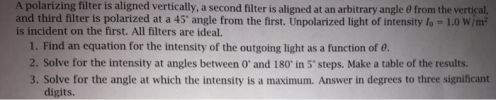 A polarizing filter is aligned vertically, a second filter is aligned at an arbitrary angle θ from the vertical, and third filter is polarized at a 45 angle from the first. Unpolarized light of intensity lo -1.0 W/m2 is incident on the first. All filters are ideal 1. Find an equation for the intensity of the outgoing light as a function of 0 2. Solve for the intensity at angles between O and 180 in 5 steps. Make a table...
Light that passes through a series of three polarizing filters emerges from the third filter horizontally...
 Light that passes through a
series of three polarizing filters emerges from the third filter
horizontally polarized with an intensity of 225 W/m2. If the
polarization angle between the filters increases by 25° from one
filter to the next, find the intensity of the incident beam of
light, assuming it is initially unpolarized.
Light that passes through a
series of three polarizing filters emerges from the third filter
horizontally polarized with an intensity of 225 W/m2. If the
polarization angle between the filters increases by 25° from one
filter to the next, find the intensity of the incident beam of
light, assuming it is initially unpolarized.
Light that passes through a series of three polarizing filters emerges from the third filter horizontally...
 Light that passes through a series of three polarizing filters emerges from the third filter horizontally polarized with an intensity of 280 W/m2. 1) If the polarization angle between the filters increases by 25° from one filter to the next, find the intensity of the incident beam of light, assuming it is initially unpolarized. (Express your answer to two significant figures.) W/m2 Submit
A beam of polarized light passes through a polarizing filter. When the angle between the polarizing...
A beam of polarized light passes through a polarizing filter. When the angle between the polarizing axis of the filter and the direction of polarization of the light is 29 ∘, the intensity of the emerging beam is I A) If you instead want the intensity to be I/2, what should be the angle between the filter axis and the original direction of polarization of the light?
When a beam of light passes through a pair of polarizing filters (polarizer and analyzer), the...
When a beam of light passes through a pair of polarizing filters (polarizer and analyzer), the intensity of the transmitted light is a maximum when the transmission axes of the polarizer and analyzer are parallel to each other (θ = 0° or θ= 180°) and zero when the axes are perpendicular to each other (θ = 90°). For any value of theta between 0° and 90° the transmitted intensity is given by I = Ii cos2(θ) where Ii is the...
What angle would the axis of a polarizing filter need to make with the direction of...
 What angle would the axis of a polarizing filter need to make with the direction of polarized light of intensity 1.80 kW/m2 to reduce the intensity to 30.0 W/m2? 88.5 One of the primary goals of the Kepler space telescope is to search for Earth-like planets. Data gathered by the telescope indicates the existence of one such planet named Boralis orbiting a star 115 ly from our solar system. Consider an interstellar spaceship leaving Earth to travel to Boralis. The...
Unpolarized light passes through two polarizing filters. After passing through the first filter the intensity of...
 Unpolarized light passes through two polarizing filters. After passing through the first filter the intensity of the light (11) is 17 W/m2. The first filter is vertical (0 degrees), while the second filter is angled at 34 degrees. What is the new intensity of the light? If you have unpolarized light passing through two polarizing filters that are lined up to the same direction. How can you rotate them to block all light from passing through? rotate one by 45°...
Light that passes through a series of three polarizing filters emerges from the third filter horizontally...
Light that passes through a series of three polarizing filters emerges from the third filter horizontally polarized with an intensity of 230 W/m22. 1) If the polarization angle between the filters increases by 25∘∘ from one filter to the next, find the intensity of the incident beam of light, assuming it is initially unpolarized. (Express your answer to two significant figures.)
 A polarizing filter is aligned vertically, a second filter is aligned at an arbitrary angle θ from the vertical, and third filter is polarized at a 45 angle from the first. Unpolarized light of intensity lo -1.0 W/m2 is incident on the first. All filters are ideal 1. Find an equation for the intensity of the outgoing light as a function of 0 2. Solve for the intensity at angles between O and 180 in 5 steps. Make a table...
 Light that passes through a
series of three polarizing filters emerges from the third filter
horizontally polarized with an intensity of 225 W/m2. If the
polarization angle between the filters increases by 25° from one
filter to the next, find the intensity of the incident beam of
light, assuming it is initially unpolarized.
Light that passes through a
series of three polarizing filters emerges from the third filter
horizontally polarized with an intensity of 225 W/m2. If the
polarization angle between the filters increases by 25° from one
filter to the next, find the intensity of the incident beam of
light, assuming it is initially unpolarized.
 Light that passes through a series of three polarizing filters emerges from the third filter horizontally polarized with an intensity of 280 W/m2. 1) If the polarization angle between the filters increases by 25° from one filter to the next, find the intensity of the incident beam of light, assuming it is initially unpolarized. (Express your answer to two significant figures.) W/m2 Submit
 What angle would the axis of a polarizing filter need to make with the direction of polarized light of intensity 1.80 kW/m2 to reduce the intensity to 30.0 W/m2? 88.5 One of the primary goals of the Kepler space telescope is to search for Earth-like planets. Data gathered by the telescope indicates the existence of one such planet named Boralis orbiting a star 115 ly from our solar system. Consider an interstellar spaceship leaving Earth to travel to Boralis. The...
 Unpolarized light passes through two polarizing filters. After passing through the first filter the intensity of the light (11) is 17 W/m2. The first filter is vertical (0 degrees), while the second filter is angled at 34 degrees. What is the new intensity of the light? If you have unpolarized light passing through two polarizing filters that are lined up to the same direction. How can you rotate them to block all light from passing through? rotate one by 45°...
Most questions answered within 3 hours.
-
Where is the error in this code sequence?
String s1 = "Hello";
String s2 = "ello";...
asked 10 months ago -
Financial data for Joel de Paris, Inc., for last year
follow:
Joel de Paris, Inc.
Balance...
asked 10 months ago -
Consider this reaction:
Al2(SO4)3 (aq)+ BaCl3
(aq) Al2Cl6 (aq)- +
3BaSO4(s) . What is the...
asked 10 months ago -
Suppose that Savneet is considering increasing her
recent random sample from 20 car rentals to 40...
asked 10 months ago -
Trucks arrive at an unloading terminal at an average rate of 120
per hour.
Trucks arrive...
asked 10 months ago -
Why are methanol and ethanol completely soluble in water while
octanol is not very little soluble....
asked 10 months ago -
A facilities manager at a university reads in a research report
that the mean amount of...
asked 10 months ago -
When the CuSO4 is rehydrated by adding water to the anhydrous
compound, is this an endothermic...
asked 10 months ago -
A ray of sunlight is passing from diamond into crown glass; the
angle of incidence is...
asked 10 months ago -
A block of mass 0.249 kg is placed on top of a light, vertical
spring of...
asked 10 months ago -
how do the kidneys compensate in the presences of acidosis
a) trigger hyperventilate
b) reserve acid...
asked 10 months ago -
Question 501 pts
The rental rate of capital to the firm increases. Which of the
following...
asked 10 months ago