The value of the marginal product curve slopes _________ due to _______________. a. downward, constant wages...
The value of the marginal product curve slopes _________ due to _______________.
| a. |
downward, constant wages |
|
| b. |
upward, increasing marginal product |
|
| c. |
downward, increasing marginal product |
|
| d. |
downward, diminishing marginal product |
Homework Answers
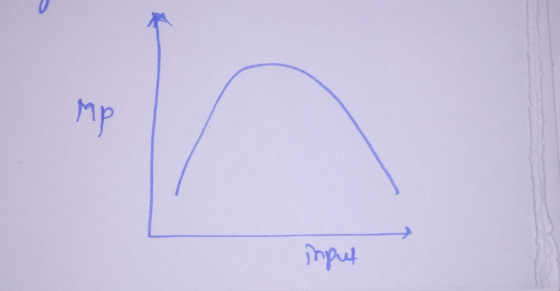
Marginal product is the additional output that is generated by producing extra one additional unit.
It is always downward sloping and follows the law of diminishing returns .
Law of diminishing returns is that when input increases firstly then output increases .
After then it increases at a constant rate and when input in is continuously increasing then output increases but at a diminishing rate.
So the correct answer here is option D
Add Answer to:
The value of the marginal product curve slopes _________ due to
_______________.
a.
downward, constant wages...
The demand curve slopes downwards due to Diminishing Marginal Product of Labor B Decreasing Marginal Costs...
 The demand curve slopes downwards due to Diminishing Marginal Product of Labor B Decreasing Marginal Costs Diminishing Marginal Utility Decreasing Long-run Average Cost
QUESTION 9 The perfectly competitive firm faces a downward sloping demand curve. constant marginal costs. a...
 QUESTION 9 The perfectly competitive firm faces a downward sloping demand curve. constant marginal costs. a horizontal supply function. perfectly elastic demand. QUESTION 10 The short-run industry supply curve slopes up because the law of diminishing marginal product applies in the short run. wages increase as the industry increases output. the firms eventually experience diseconomies of scale. the higher price is needed to get more firms to enter the industry.
Scenario 10-1 The demand curve for gasoline slopes downward and the supply curve for gasoline slopes...
 Scenario 10-1 The demand curve for gasoline slopes downward and the supply curve for gasoline slopes upward. The production of the 200th gallon of gasoline entails the following: . a private cost of $3.03; • a social cost of $3.23; • a value to consumers of $3.39. Refer to Scenario 10-1. Suppose the equilibrium quantity of gasoline is 220 gallons; that is, Q MARKET = 220. Then the equilibrium price of a gallon could be a. $3.08. b.$2.77. C. $2.45....
1. The long-run average cost curve slopes upward if there are: A. economies of scale B....
1. The long-run average cost curve slopes upward if there are: A. economies of scale B. diseconomies of scope in the management of multiplant operates C. Some factors without diminishing marginal returns D. diseconomies of scale E. no factor without diminishing marginal returns
A portion of a network good's demand curve slopes downward, due to lower production costs. True...
A portion of a network good's demand curve slopes downward, due to lower production costs. True False
Diminishing marginal returns implies that O A. marginal product is constant. O B. marginal product is decreasing. O C....
 Diminishing marginal returns implies that O A. marginal product is constant. O B. marginal product is decreasing. O C. marginal product is increasing. OD. marginal product may be increasing or decreasing.
Suppose a firm has market power and faces a downward-sloping demand curve for its product, and...
Suppose a firm has market power and faces a downward-sloping demand curve for its product, and its marginal cost curve is upward sloping. If the firm reduces its price, then A. producer surplus increases due to new buyers, but the producer surplus from existing customers declines due to the lower price. B. the sum of producer and consumer surplus remains the same, but surplus value is transferred from the producer to consumers. C. the change in producer surplus is transferred...
what happens to total cost curve due to diminishing marginal product and explain the reasons for...
what happens to total cost curve due to diminishing marginal product and explain the reasons for the curve??
The average variable cost curve slopes upward with a higher rate of output in the short...
The average variable cost curve slopes upward with a higher rate of output in the short run because of A. The effect of diminishing returns. B. The shape of the average fixed cost curve. C. Diseconomies of scale. D. Implicit but not explicit costs.
Draw a basic supply and demand curve. Which one (supply or demand) slopes downward? Which one...
 Draw a basic supply and demand curve. Which one (supply or demand) slopes downward? Which one (supply or demand) slopes upward? What does this mean? What do you call the part where they intersect?
 The demand curve slopes downwards due to Diminishing Marginal Product of Labor B Decreasing Marginal Costs Diminishing Marginal Utility Decreasing Long-run Average Cost
 QUESTION 9 The perfectly competitive firm faces a downward sloping demand curve. constant marginal costs. a horizontal supply function. perfectly elastic demand. QUESTION 10 The short-run industry supply curve slopes up because the law of diminishing marginal product applies in the short run. wages increase as the industry increases output. the firms eventually experience diseconomies of scale. the higher price is needed to get more firms to enter the industry.
 Scenario 10-1 The demand curve for gasoline slopes downward and the supply curve for gasoline slopes upward. The production of the 200th gallon of gasoline entails the following: . a private cost of $3.03; • a social cost of $3.23; • a value to consumers of $3.39. Refer to Scenario 10-1. Suppose the equilibrium quantity of gasoline is 220 gallons; that is, Q MARKET = 220. Then the equilibrium price of a gallon could be a. $3.08. b.$2.77. C. $2.45....
 Diminishing marginal returns implies that O A. marginal product is constant. O B. marginal product is decreasing. O C. marginal product is increasing. OD. marginal product may be increasing or decreasing.
 Draw a basic supply and demand curve. Which one (supply or demand) slopes downward? Which one (supply or demand) slopes upward? What does this mean? What do you call the part where they intersect?
Most questions answered within 3 hours.
-
Where is the error in this code sequence?
String s1 = "Hello";
String s2 = "ello";...
asked 11 months ago -
Financial data for Joel de Paris, Inc., for last year
follow:
Joel de Paris, Inc.
Balance...
asked 11 months ago -
Consider this reaction:
Al2(SO4)3 (aq)+ BaCl3
(aq) Al2Cl6 (aq)- +
3BaSO4(s) . What is the...
asked 11 months ago -
Suppose that Savneet is considering increasing her
recent random sample from 20 car rentals to 40...
asked 11 months ago -
Trucks arrive at an unloading terminal at an average rate of 120
per hour.
Trucks arrive...
asked 11 months ago -
Why are methanol and ethanol completely soluble in water while
octanol is not very little soluble....
asked 11 months ago -
A facilities manager at a university reads in a research report
that the mean amount of...
asked 11 months ago -
When the CuSO4 is rehydrated by adding water to the anhydrous
compound, is this an endothermic...
asked 11 months ago -
A ray of sunlight is passing from diamond into crown glass; the
angle of incidence is...
asked 11 months ago -
A block of mass 0.249 kg is placed on top of a light, vertical
spring of...
asked 11 months ago -
how do the kidneys compensate in the presences of acidosis
a) trigger hyperventilate
b) reserve acid...
asked 11 months ago -
Question 501 pts
The rental rate of capital to the firm increases. Which of the
following...
asked 11 months ago