Pure solid NaH2PO4 is dissolved in distilled water, making 100.00 ml of solution. 10.00ml of this...
- Pure solid NaH2PO4 is dissolved in distilled water, making 100.00 ml of solution. 10.00ml of this solution is diluted to 100.00 ml to prepare the original phosphate standard solution. Three working standard solutions are made from this by pipetting 0.8ml, 1.5ml and 3.0 ml of the original standard solution into 100.00 ml volumetric flasks. Acid and molybdate reagent are added and the solutions are diluted to 100.00 ml.
You may assume that all these absorbance measurements have already been corrected for any blank absorbance.
The absorbance of each is measured in the spectrophotometer.
Mass of NaH2PO4 (mg) 512.2
Absorbance Standard 1 (0.8 ml)
0.1922
Standard 2 (1.5 ml) 0.3604
Standard 3 (3.0 ml) 0.7209
Calculate the following
1.Concentration of original
phosphate standard (mM)
2. Concentration of Standard 1(mM)
3.Concentration of Standard 2(mM)
4.Concentration of Standard 3(mM)
5.Slope of calibration line
6.A 10.00 ml volume of soft drink is treated with acid and molybdate and diluted to 100.00 ml. Its absorbance is measured. From the following data, calculate the concentration of phosphate in the soft drink (mM).
Sample absorbance 0.3826
Slope of the calibration line: 5.33
Homework Answers
1. The atomic masses are
Na: 22.990 u
H: 1.008 u
P: 30.974 u
O: 15.999 u
The gram molar mass of NaH2PO4 = (1*22.990 + 2*1.008 + 1*30.974 + 4*15.999) g/mol = 119.976 g/mol.
Mol(s) NaH2PO4 corresponding to 512.2 mg = (512.2 mg)/(119.976 g/mol)
= (512.2 mg)/(119.976 g/mol)*(1 g)/(1000 mg)
= 0.0042768 mol.
Volume of the prepared NaH2PO4 stock solution = 100.0 mL = (100.0 mL)*(1 L)/(1000 mL) = 0.100 L.
Molarity of the prepared NaH2PO4 stock solution = (0.0042768 mol)/(0.100 L)
= 0.042768 mol/L = 0.042768 M.
10.00 mL of the stock solution was diluted to 100.00 mL to prepare the original phosphate standard solution.
Use the dilution equation
M1V1 = M2V2
where M1 = molarity of the stock solution; V1 = volume of the stock solution; M2 = molarity of the original phosphate standard and V2 = final volume of the original phosphate standard.
Plug in values and obtain
(0.042768 M)*(10.00 mL) = M2*(100.00 mL)
======> M2 = (0.042768 M)*(10.00 mL)/(100.00 mL)
======> M2 = 4.2768*10-3M ≈ 4.277*10-3 M = (4.277*10-3 M)*(1000 mM)/(1 M) = 4.277 mM (ans, correct to 4 sig. figs).
2. Standard 1 is prepared by taking 0.8 mL of original phosphate standard and diluting to 100.00 mL.
Again, use the dilution equation.
M1V1 = M2V2
======> (4.277 mM)*(0.8 mL) = M2*(100.00 mL)
======> M2 = (4.277 mM)*(0.8 mL)/(100.00 mL)
======> M2 = 0.034216 mM ≈ 3.422*10-2 mM (correct to 4 sig. figs).
The concentration of standard 1 is 3.422*10-2 mM (ans).
3. Standard 2 is prepared by taking 1.5 mL of original phosphate standard and diluting to 100.00 mL.
Again, use the dilution equation.
M1V1 = M2V2
======> (4.277 mM)*(1.5 mL) = M2*(100.00 mL)
======> M2 = (4.277 mM)*(1.5 mL)/(100.00 mL)
======> M2 = 0.064155 mM ≈ 6.415*10-2 mM (correct to 4 sig. figs).
The concentration of standard 2 is 6.415*10-2 mM (ans).
4. Standard 3 is prepared by taking 3.0 mL of original phosphate standard and diluting to 100.00 mL.
Again, use the dilution equation.
M1V1 = M2V2
======> (4.277 mM)*(3.0 mL) = M2*(100.00 mL)
======> M2 = (4.277*10 mM)*(3.0 mL)/(100.00 mL)
======> M2 = 0.12831 mM ≈ 0.1281 M (correct to 4 sig. figs).
The concentration of standard 3 is 1.283*10-4 M (ans).
5. Plot absorbances vs concentrations of the standards 1, 2 and 3.
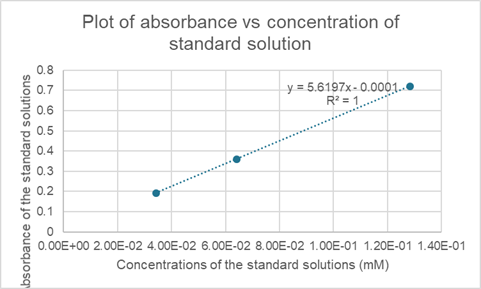
Plot of absorbance vs concentration of the standard solution.
The slope of the calibration plot is 5.6197 mM-1 (ans).
Add Answer to:
Pure solid NaH2PO4 is dissolved in
distilled water, making 100.00 ml of solution. 10.00ml of this...
A 10.00 ml volume of soft drink is treated with acid and molybdate and diluted to...
A 10.00 ml volume of soft drink is treated with acid and molybdate and diluted to 100.00 ml. Its absorbance is measured. From the following data, calculate the concentration of phosphate in the soft drink (mM). Sample absorbance 0.2815 Slope of the calibration line: 5.82
If 2.0 mL of distilled water is added to 3.0 mL of a 0.150 M solution...
 If 2.0 mL of distilled water is added to 3.0 mL of a 0.150 M solution of CoCly, what is the concentration of the resulting solution? Show your work. (a) What is a calibration curve? (b) Why do we use a calibration curve to determine the concentration of our unknown 5. A colored sample with a concentration of 0.160 M has an absorbance of 0.80 in a 1.0 cm path length cuvette. (a) What would be the absorbance expected if...
An unknown soft drink solution is prepared by diluting 3.36 mL of soda to 124.08 mL....
 An unknown soft drink solution is prepared by diluting 3.36 mL of soda to 124.08 mL. If the phosphate concentration in the diluted solution was found to be about 0.000345 M, calculate the phosphate concentration in the original soft drink.
Answer 2) To measure the concentration of phosphorous in a water sample, Phosphorous was first converted...
 Answer
2) To measure the concentration of phosphorous in a water sample, Phosphorous was first converted into a color complex in the presence of ammonium molybdate and SnClo. The absorbance of a series of standard phosphorous solutions was measured by a spectrophotometer and gave the calibration curve y 1.150 x, where y is the absorbance of phosphorous complex at 690 nm while x is the concentration of P in ppm. An unknown natural water sample was collected. 10.00 mL of...
Answer
2) To measure the concentration of phosphorous in a water sample, Phosphorous was first converted into a color complex in the presence of ammonium molybdate and SnClo. The absorbance of a series of standard phosphorous solutions was measured by a spectrophotometer and gave the calibration curve y 1.150 x, where y is the absorbance of phosphorous complex at 690 nm while x is the concentration of P in ppm. An unknown natural water sample was collected. 10.00 mL of...
1. A student makes a solution by mixing 7.0 mL of a 4.5 x 10 M...
 1. A student makes a solution by mixing 7.0 mL of a 4.5 x 10 M solution of Allura Red and 3.0 ml of water. What is the concentration of Allura Red in the resulting solution? A student is interested in the concentration of blue dve in his favorite beverage. He knows that spectroscopy can be used to determine the concentration of dye molecules in a solution. After making several solutions of known concentration, the student measured the absorbance of...
5. Caffeine in Mountain Due is determined by standard addition method. Five mL of the soft...
 5. Caffeine in Mountain Due is determined by standard addition method. Five mL of the soft drink is placed in each of five 100-mL volumetric flask. Then, increasing volumes: 0, 5, 10, 15, 20 mL of a standard solution of 0.300 mM caffeine are added to each flask. All 5 flasks are filled with distilled water to the 100-mL mark and mixed well. Absorbance of - the solution in each flask is obtained. Plotting absorbance vs added volume (as mL)...
A penny having a mass of 2.5340 g was dissolved in 20 mL of 8 M HNO3. The resulting solution was transferred to a 100.00-ml volumetric flask and diluted to the mark with water.
A penny having a mass of 2.5340 g was dissolved in 20 mL of 8 M HNO3. The resulting solution was transferred to a 100.00-ml volumetric flask and diluted to the mark with water. Then, a sample solution was prepared by transferring 10.00 mL of this solution to a 25.00- ml volumetric flask, adding 2.00 mL of 15 M NH3 and diluting to the mark with waterThe concentration of [Cu(NH3)4]2+ in the sample solution (determined using a Spectro Vis spectrophotometer)...
Question 4 (2 points) A working standard 1 is prepared by taking 24.00 mL of a...
 Question 4 (2 points) A working standard 1 is prepared by taking 24.00 mL of a 500.0 ppm stock solution and diluting it to a final volume of 360.0 mL. Working standard 2 is prepared by taking 3.00 mL of working standard 1 and diluting it to a final volume of 250.0 mL. Calculate the ppm concentration of the working standard 2. Provide your answer to three places after the decimal and without units. Your Answer: Answer Question 5 (2...
To construct a calibration curve we would need to take our stock solution and dilute it...
To construct a calibration curve we would need to take our stock solution and dilute it to different concentrations. We would then test those different concentration in our spectrophotometer to test their absorbance. If we diluted our samples as follows, calculate the resulting concentrations. (HINT: this is dilution which means we can use M1V1=M2V2, where M1 is our original 150 mM concentration, V1 is the volume of the original concentration that we added water to dilute, M2 is the concentration...
Chloride in a water sample can be determined indirectly by atomic absorption spectrometry by precipitating chloride...
 Chloride in a water sample can be determined indirectly by
atomic absorption spectrometry by precipitating chloride as AgCl(s)
with a measured amount of AgNO3 that is excess of the chloride
content of the sample. The AgNO3 is added and the sample is
centrifuged. The remaining Ag+ in the solution (supernatant) is
quantified and the chloride is measured by assuming that chloride
was quantitatively precipitated.
Chloride in a water sample can be determined indirectly by atomic absorption spectrometry by precipitating chloride...
Chloride in a water sample can be determined indirectly by
atomic absorption spectrometry by precipitating chloride as AgCl(s)
with a measured amount of AgNO3 that is excess of the chloride
content of the sample. The AgNO3 is added and the sample is
centrifuged. The remaining Ag+ in the solution (supernatant) is
quantified and the chloride is measured by assuming that chloride
was quantitatively precipitated.
Chloride in a water sample can be determined indirectly by atomic absorption spectrometry by precipitating chloride...
 If 2.0 mL of distilled water is added to 3.0 mL of a 0.150 M solution of CoCly, what is the concentration of the resulting solution? Show your work. (a) What is a calibration curve? (b) Why do we use a calibration curve to determine the concentration of our unknown 5. A colored sample with a concentration of 0.160 M has an absorbance of 0.80 in a 1.0 cm path length cuvette. (a) What would be the absorbance expected if...
 An unknown soft drink solution is prepared by diluting 3.36 mL of soda to 124.08 mL. If the phosphate concentration in the diluted solution was found to be about 0.000345 M, calculate the phosphate concentration in the original soft drink.
 Answer
2) To measure the concentration of phosphorous in a water sample, Phosphorous was first converted into a color complex in the presence of ammonium molybdate and SnClo. The absorbance of a series of standard phosphorous solutions was measured by a spectrophotometer and gave the calibration curve y 1.150 x, where y is the absorbance of phosphorous complex at 690 nm while x is the concentration of P in ppm. An unknown natural water sample was collected. 10.00 mL of...
Answer
2) To measure the concentration of phosphorous in a water sample, Phosphorous was first converted into a color complex in the presence of ammonium molybdate and SnClo. The absorbance of a series of standard phosphorous solutions was measured by a spectrophotometer and gave the calibration curve y 1.150 x, where y is the absorbance of phosphorous complex at 690 nm while x is the concentration of P in ppm. An unknown natural water sample was collected. 10.00 mL of...
 1. A student makes a solution by mixing 7.0 mL of a 4.5 x 10 M solution of Allura Red and 3.0 ml of water. What is the concentration of Allura Red in the resulting solution? A student is interested in the concentration of blue dve in his favorite beverage. He knows that spectroscopy can be used to determine the concentration of dye molecules in a solution. After making several solutions of known concentration, the student measured the absorbance of...
 5. Caffeine in Mountain Due is determined by standard addition method. Five mL of the soft drink is placed in each of five 100-mL volumetric flask. Then, increasing volumes: 0, 5, 10, 15, 20 mL of a standard solution of 0.300 mM caffeine are added to each flask. All 5 flasks are filled with distilled water to the 100-mL mark and mixed well. Absorbance of - the solution in each flask is obtained. Plotting absorbance vs added volume (as mL)...
 Question 4 (2 points) A working standard 1 is prepared by taking 24.00 mL of a 500.0 ppm stock solution and diluting it to a final volume of 360.0 mL. Working standard 2 is prepared by taking 3.00 mL of working standard 1 and diluting it to a final volume of 250.0 mL. Calculate the ppm concentration of the working standard 2. Provide your answer to three places after the decimal and without units. Your Answer: Answer Question 5 (2...
 Chloride in a water sample can be determined indirectly by
atomic absorption spectrometry by precipitating chloride as AgCl(s)
with a measured amount of AgNO3 that is excess of the chloride
content of the sample. The AgNO3 is added and the sample is
centrifuged. The remaining Ag+ in the solution (supernatant) is
quantified and the chloride is measured by assuming that chloride
was quantitatively precipitated.
Chloride in a water sample can be determined indirectly by atomic absorption spectrometry by precipitating chloride...
Chloride in a water sample can be determined indirectly by
atomic absorption spectrometry by precipitating chloride as AgCl(s)
with a measured amount of AgNO3 that is excess of the chloride
content of the sample. The AgNO3 is added and the sample is
centrifuged. The remaining Ag+ in the solution (supernatant) is
quantified and the chloride is measured by assuming that chloride
was quantitatively precipitated.
Chloride in a water sample can be determined indirectly by atomic absorption spectrometry by precipitating chloride...
Most questions answered within 3 hours.
-
Where is the error in this code sequence?
String s1 = "Hello";
String s2 = "ello";...
asked 10 months ago -
Financial data for Joel de Paris, Inc., for last year
follow:
Joel de Paris, Inc.
Balance...
asked 10 months ago -
Consider this reaction:
Al2(SO4)3 (aq)+ BaCl3
(aq) Al2Cl6 (aq)- +
3BaSO4(s) . What is the...
asked 10 months ago -
Suppose that Savneet is considering increasing her
recent random sample from 20 car rentals to 40...
asked 10 months ago -
Trucks arrive at an unloading terminal at an average rate of 120
per hour.
Trucks arrive...
asked 10 months ago -
Why are methanol and ethanol completely soluble in water while
octanol is not very little soluble....
asked 10 months ago -
A facilities manager at a university reads in a research report
that the mean amount of...
asked 10 months ago -
When the CuSO4 is rehydrated by adding water to the anhydrous
compound, is this an endothermic...
asked 10 months ago -
A ray of sunlight is passing from diamond into crown glass; the
angle of incidence is...
asked 10 months ago -
A block of mass 0.249 kg is placed on top of a light, vertical
spring of...
asked 10 months ago -
how do the kidneys compensate in the presences of acidosis
a) trigger hyperventilate
b) reserve acid...
asked 10 months ago -
Question 501 pts
The rental rate of capital to the firm increases. Which of the
following...
asked 10 months ago