Your C++ project relate to the dynamic programming to solve the calculating Fibonacci numbers should demonstrate:...
Your C++ project relate to the dynamic programming to solve the calculating Fibonacci numbers should demonstrate:
- Header files
- Abstract Class
- Subclasses
- Virtual function (in addition to the pure virtual function)
- Inheritance
- Polymorphism
- Pointers
- Static variables
- Static functions
- Exceptions
- Templates
- File I/O
- Overloaded << or >> operator
- Overloaded operators (at least one additional)
Extra points for:
- Recursion
- Linked lists / Stacks / Queues
- Binary search trees
- Binary File with random access
- A friend function not related to the << and >> operator
Don’t forget: analysis, design, testing, pseudocode & documentation!!!
Homework Answers
Following is the code and design of the above problem using recursion,:
#include<iostream>
using namespace std;
void Fib(int l){
static int num1=0, num2=1, num3;
if(l>0){
num3 = num1 + num2;
num1 = num2;
num2 = num3;
cout<<num3<<" ";
Fib(l-1);
}
}
int main(){
int n;
cout<<"Enter the length of your Fibonacci series: ";
cin>>n;
cout<<"Fibonacci Series: ";
cout<<"0 "<<"1 ";
Fib(n-2); //n-2 because 2 numbers are already printed
return 0;
}
Please find the attached screenshot of the output after testing:
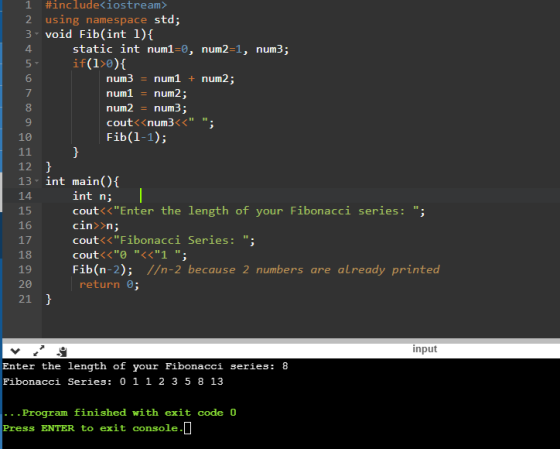
After analysis the time complexity of this program is O(n) and space complexity is constant.
Add Answer to:
Your C++ project relate to the dynamic programming to solve the
calculating Fibonacci numbers should demonstrate:...
C++ program Correctly complete the following assignment. Follow all directions. The main purpose is to show...
C++ program Correctly complete the following assignment. Follow all directions. The main purpose is to show super and sub class relationships with an array of super media pointers to sub class objects and dynamic binding. The < operator will be overloaded in the super class so all subclasses can use it. The selection sort method will be in the main .cpp file because it will sort the array created in main. The final .cpp file, the three .h header class...
C++ problem to use dynamic memory allocation (of arrays) and pointer manipulation in order to implement...
C++ problem to use dynamic memory allocation (of arrays) and pointer manipulation in order to implement the Inner and Outer classes (Circular Buffer of circular buffers using Queues). No need of any classes from the Standard Template Library (STL), not even vector. Add the member functions of those classes by following the codes of InnerCB.h and CBofCB.h below: // file: InnerCB.h // Header file for Inner Circular Buffer. // See project description for details. // #ifndef _INNERCB_H_ #define _INNERCB_H_ class...
Program Purpose In this program you will demonstrate your knowledge in programming OOP concepts, such as classes, encapsulation, and procedural programming concepts such as lınked lists, dynamic me...
 Program Purpose In this program you will demonstrate your knowledge in programming OOP concepts, such as classes, encapsulation, and procedural programming concepts such as lınked lists, dynamic memory allocation, pointers, recursion, and debugging Mandatory Instructions Develop a C++ object oriented solution to the Towers of Hanoi puzzle. Your solution will involve designing two classes one to represent individual Disk and another to represent the TowersOfHanoi game. TowersOfHanoi class will implement the game with three linked lists representing disks on each...
C++ Programming Assignment S Mammal Lab This lab's goal is to give you some practice using inheritance, virtual functions, pointers, dynamic memory allocation, random numbers, and polym...
 C++ Programming Assignment S Mammal Lab This lab's goal is to give you some practice using inheritance, virtual functions, pointers, dynamic memory allocation, random numbers, and polymorphism. To complete the lab implement the following steps: Create a class called Mammal. All mammals have a weight and a name, so its data should be the mammal's weight and name. Provide a default constructor that sets the mammal's weight to 0 and name to null, and another constructor that allows the weight...
I need help writing this code in C++ Proj11.cpp is provided as well as the randomdata.txt thank you in advance! Objectives: The main objectives of this project is to introduce you to recursion,...
 I
need help writing this code in C++
Proj11.cpp is provided as well as the randomdata.txt
thank you in advance!
Objectives: The main objectives of this project is to introduce you to recursion, and test your ability to work with some STL functionalities. A review of your knowledge on working with templates, dynamic data structures, as well as manipulating dynamic memory, classes, pointers and iostream to all extents, is also included. Description: For the entirety of this project, you will...
I
need help writing this code in C++
Proj11.cpp is provided as well as the randomdata.txt
thank you in advance!
Objectives: The main objectives of this project is to introduce you to recursion, and test your ability to work with some STL functionalities. A review of your knowledge on working with templates, dynamic data structures, as well as manipulating dynamic memory, classes, pointers and iostream to all extents, is also included. Description: For the entirety of this project, you will...
This C++ Program consists of: operator overloading, as well as experience with managing dynamic memory allocation...
This C++ Program consists of: operator overloading, as well as experience with managing dynamic memory allocation inside a class. Task One common limitation of programming languages is that the built-in types are limited to smaller finite ranges of storage. For instance, the built-in int type in C++ is 4 bytes in most systems today, allowing for about 4 billion different numbers. The regular int splits this range between positive and negative numbers, but even an unsigned int (assuming 4 bytes)...
 Program Purpose In this program you will demonstrate your knowledge in programming OOP concepts, such as classes, encapsulation, and procedural programming concepts such as lınked lists, dynamic memory allocation, pointers, recursion, and debugging Mandatory Instructions Develop a C++ object oriented solution to the Towers of Hanoi puzzle. Your solution will involve designing two classes one to represent individual Disk and another to represent the TowersOfHanoi game. TowersOfHanoi class will implement the game with three linked lists representing disks on each...
 C++ Programming Assignment S Mammal Lab This lab's goal is to give you some practice using inheritance, virtual functions, pointers, dynamic memory allocation, random numbers, and polymorphism. To complete the lab implement the following steps: Create a class called Mammal. All mammals have a weight and a name, so its data should be the mammal's weight and name. Provide a default constructor that sets the mammal's weight to 0 and name to null, and another constructor that allows the weight...
 I
need help writing this code in C++
Proj11.cpp is provided as well as the randomdata.txt
thank you in advance!
Objectives: The main objectives of this project is to introduce you to recursion, and test your ability to work with some STL functionalities. A review of your knowledge on working with templates, dynamic data structures, as well as manipulating dynamic memory, classes, pointers and iostream to all extents, is also included. Description: For the entirety of this project, you will...
I
need help writing this code in C++
Proj11.cpp is provided as well as the randomdata.txt
thank you in advance!
Objectives: The main objectives of this project is to introduce you to recursion, and test your ability to work with some STL functionalities. A review of your knowledge on working with templates, dynamic data structures, as well as manipulating dynamic memory, classes, pointers and iostream to all extents, is also included. Description: For the entirety of this project, you will...
Most questions answered within 3 hours.
-
Where is the error in this code sequence?
String s1 = "Hello";
String s2 = "ello";...
asked 10 months ago -
Financial data for Joel de Paris, Inc., for last year
follow:
Joel de Paris, Inc.
Balance...
asked 10 months ago -
Consider this reaction:
Al2(SO4)3 (aq)+ BaCl3
(aq) Al2Cl6 (aq)- +
3BaSO4(s) . What is the...
asked 10 months ago -
Suppose that Savneet is considering increasing her
recent random sample from 20 car rentals to 40...
asked 10 months ago -
Trucks arrive at an unloading terminal at an average rate of 120
per hour.
Trucks arrive...
asked 10 months ago -
Why are methanol and ethanol completely soluble in water while
octanol is not very little soluble....
asked 10 months ago -
A facilities manager at a university reads in a research report
that the mean amount of...
asked 10 months ago -
When the CuSO4 is rehydrated by adding water to the anhydrous
compound, is this an endothermic...
asked 10 months ago -
A ray of sunlight is passing from diamond into crown glass; the
angle of incidence is...
asked 10 months ago -
A block of mass 0.249 kg is placed on top of a light, vertical
spring of...
asked 10 months ago -
how do the kidneys compensate in the presences of acidosis
a) trigger hyperventilate
b) reserve acid...
asked 10 months ago -
Question 501 pts
The rental rate of capital to the firm increases. Which of the
following...
asked 10 months ago