In outer space, a ball with a mass of 0.25kg and charge +4/kC is shot from...
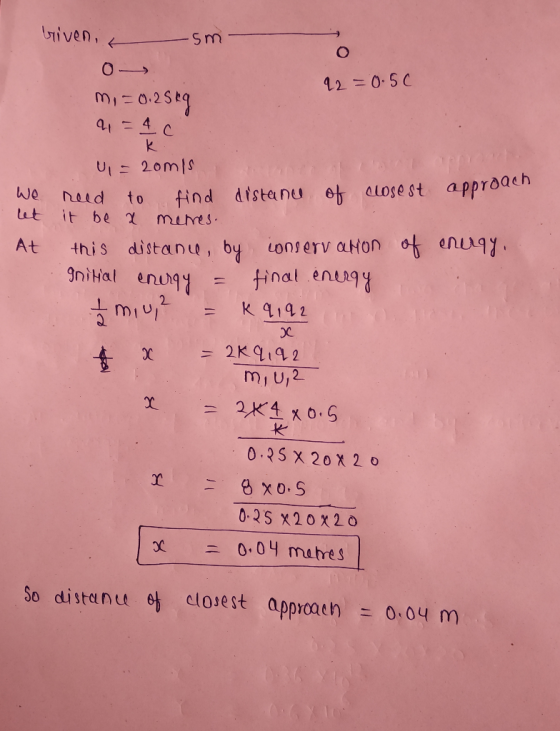
In outer space, a ball with a mass of 0.25kg and charge +4/kC is shot from 5m towards a +0.5C charged ball with an initial velocity of 20 m/s. What is the closest the small ball will get to the large one's center?
Homework Answers
It uses the fact that at distance of closest approach, the kinetic energy of ball will be converted to potential energy between them.
please up vote.thank you.
Add Answer to:
In outer space, a ball with a mass of 0.25kg and charge +4/kC is
shot from...
In outer space, a ball with mass 0.25kg and charge +4/kC is shot from 5m towards...
In outer space, a ball with mass 0.25kg and charge +4/kC is shot from 5m towards a +0.5C charged ball with an initail velocit of 20m/s. b. What is the closest the small ball will get to the large one's center?
A thin metal rod of mass 1.8 kg and length 0.9 m is at rest in outer space, near a space station (see figure below).
 A thin metal rod of mass 1.8 kg and length 0.9 m is at rest in outer space, near a space station (see figure below). A tiny meteorite with mass 0.06 kg traveling at a high speed of 250 m/s strikes the rod a distance 0.2 m from the center and bounces off with speed 60 m/s as shown in the diagram. The magnitudes of the initial and final angles to the x axis of the small mass's velocity are...
Please solve with matlab (show codes) A ball of mass 0.25kg is launched from ground level with initial velocity o50m/s at an angle of 30 degrees with the horizontal. If the aerodynamic drag force act...
 Please solve with matlab (show codes)
A ball of mass 0.25kg is launched from ground level with initial velocity o50m/s at an angle of 30 degrees with the horizontal. If the aerodynamic drag force acting on the ball is Fo -Cu3/2 the differential equations describing the motion are: Determine the time of flight and the range. Use C = 0.03kg/(ms)i/2 and g 980665m/s2
A ball of mass 0.25kg is launched from ground level with initial velocity o50m/s at an angle...
Please solve with matlab (show codes)
A ball of mass 0.25kg is launched from ground level with initial velocity o50m/s at an angle of 30 degrees with the horizontal. If the aerodynamic drag force acting on the ball is Fo -Cu3/2 the differential equations describing the motion are: Determine the time of flight and the range. Use C = 0.03kg/(ms)i/2 and g 980665m/s2
A ball of mass 0.25kg is launched from ground level with initial velocity o50m/s at an angle...
A very large, charged plate floats in deep space. Due to the charge on the plate,...
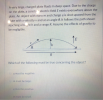 A very large, charged plate floats in deep space. Due to the charge on the plate, a consta electric field E exists everywhere above the plate. An object with mass m and charge q is shot upward from the late with a velocity v and at an angle 8. It follows the path shown reaching a he.ght h and a range R. Assume the effects of gravity to be negligible. Which of the following must be true concerning the object?...
A 25. As shown in figure 9, a ball of mass M is hanging from a...
 A 25. As shown in figure 9, a ball of mass M is hanging from a rope to make a pendulum. A 10 g bullet strikes the ball with a speed v = 308 m/s. The center of mass of the ball + bullet rises a vertical distance of h = 12 cm. Assuming that the bullet remains embedded, calculate the mass M of the ball. (Ans: 2.0 kg) A27. Block A (mass = 2.0 kg, velocity = 50 m/s)...
A ball is shot from the top of a building with an initial velocity of 18...
A ball is shot from the top of a building with an initial velocity of 18 m/s at an angle θ = 47 ∘ above the horizontal.What are the x and y components of the initial velocity?If a nearby building is the same height and 55 m away, how far below the top of the building will the ball strike the nearby building?Express your answer to two significant figures and include the appropriate units.
A 20 g metal ball with a charge of +2 C is moving straight towards a...
A 20 g metal ball with a charge of +2 C is moving straight towards a fixed insulator with a charge of +3 C. If the metal ball has a velocity of 5 m/s when it is very far away from the other charge, how close will it get to the second charge before it stops moving? (Use conservation of energy)
In outer space, far from any other influences, two rocks collide and bounce off each other....
In outer space, far from any other influences, two rocks collide and bounce off each other. All motion is along the x axis. Rock A has a mass of 3 kg, an initial velocity of 〈40,0,0〉m/s, and a final velocity of 〈16,0,0〉m/s. Rock B has a mass of 6kg and an initial velocity of 〈−20, 0, 0〉 m/s. (a) What is the final 3-D velocity vector (not speed!) of Rock B? (b) What is the change in the total kinetic...
Hanging ball. A small insulating ball of mass M and positive charge Q hangs down from...
 Hanging ball. A small insulating ball of mass M and positive charge Q hangs down from gravity from a massless thread of length L attached at one end to a charged vertical wall of infinite extent that has surface charge density σ. Calculate the angle θ of the thread to the vertical.
Constants Periodic Table A rocket of total mass 3230 kg is traveling in outer space with...
 Constants Periodic Table A rocket of total mass 3230 kg is traveling in outer space with a velocity of 100 m/s. To alter its course by 33.0, its rockets can be fired briefly in a direction perpendicular to its initial motion Part A If the rocket gases are expelled at a speed of 1900 m/s, how much mass must be expelled? [Mint Uso a velocity triangle to relate the initial velocity of the rocket to the additional velocity component needed...
 Please solve with matlab (show codes)
A ball of mass 0.25kg is launched from ground level with initial velocity o50m/s at an angle of 30 degrees with the horizontal. If the aerodynamic drag force acting on the ball is Fo -Cu3/2 the differential equations describing the motion are: Determine the time of flight and the range. Use C = 0.03kg/(ms)i/2 and g 980665m/s2
A ball of mass 0.25kg is launched from ground level with initial velocity o50m/s at an angle...
Please solve with matlab (show codes)
A ball of mass 0.25kg is launched from ground level with initial velocity o50m/s at an angle of 30 degrees with the horizontal. If the aerodynamic drag force acting on the ball is Fo -Cu3/2 the differential equations describing the motion are: Determine the time of flight and the range. Use C = 0.03kg/(ms)i/2 and g 980665m/s2
A ball of mass 0.25kg is launched from ground level with initial velocity o50m/s at an angle...
 A very large, charged plate floats in deep space. Due to the charge on the plate, a consta electric field E exists everywhere above the plate. An object with mass m and charge q is shot upward from the late with a velocity v and at an angle 8. It follows the path shown reaching a he.ght h and a range R. Assume the effects of gravity to be negligible. Which of the following must be true concerning the object?...
 A 25. As shown in figure 9, a ball of mass M is hanging from a rope to make a pendulum. A 10 g bullet strikes the ball with a speed v = 308 m/s. The center of mass of the ball + bullet rises a vertical distance of h = 12 cm. Assuming that the bullet remains embedded, calculate the mass M of the ball. (Ans: 2.0 kg) A27. Block A (mass = 2.0 kg, velocity = 50 m/s)...
 Hanging ball. A small insulating ball of mass M and positive charge Q hangs down from gravity from a massless thread of length L attached at one end to a charged vertical wall of infinite extent that has surface charge density σ. Calculate the angle θ of the thread to the vertical.
 Constants Periodic Table A rocket of total mass 3230 kg is traveling in outer space with a velocity of 100 m/s. To alter its course by 33.0, its rockets can be fired briefly in a direction perpendicular to its initial motion Part A If the rocket gases are expelled at a speed of 1900 m/s, how much mass must be expelled? [Mint Uso a velocity triangle to relate the initial velocity of the rocket to the additional velocity component needed...
Most questions answered within 3 hours.
-
Where is the error in this code sequence?
String s1 = "Hello";
String s2 = "ello";...
asked 11 months ago -
Financial data for Joel de Paris, Inc., for last year
follow:
Joel de Paris, Inc.
Balance...
asked 11 months ago -
Consider this reaction:
Al2(SO4)3 (aq)+ BaCl3
(aq) Al2Cl6 (aq)- +
3BaSO4(s) . What is the...
asked 11 months ago -
Suppose that Savneet is considering increasing her
recent random sample from 20 car rentals to 40...
asked 11 months ago -
Trucks arrive at an unloading terminal at an average rate of 120
per hour.
Trucks arrive...
asked 11 months ago -
Why are methanol and ethanol completely soluble in water while
octanol is not very little soluble....
asked 11 months ago -
A facilities manager at a university reads in a research report
that the mean amount of...
asked 11 months ago -
When the CuSO4 is rehydrated by adding water to the anhydrous
compound, is this an endothermic...
asked 11 months ago -
A ray of sunlight is passing from diamond into crown glass; the
angle of incidence is...
asked 11 months ago -
A block of mass 0.249 kg is placed on top of a light, vertical
spring of...
asked 11 months ago -
how do the kidneys compensate in the presences of acidosis
a) trigger hyperventilate
b) reserve acid...
asked 11 months ago -
Question 501 pts
The rental rate of capital to the firm increases. Which of the
following...
asked 11 months ago