The equilibrium HA ⇔ H+ + A– shows complete dissociation in any equilibrium. A) True B)...
The equilibrium HA ⇔ H+ + A– shows complete dissociation in any equilibrium.
A) True
B) False
Homework Answers

Add Answer to:
The equilibrium HA ⇔ H+ + A– shows
complete dissociation in any equilibrium.
A) True
B)...
For a generic weak acid HA, the ionization into H+ and A in water is not complete: HA (aq) =H+ (aq) + A (aq) a. Show...
 For a generic weak acid HA, the ionization into H+ and A in water is not complete: HA (aq) =H+ (aq) + A (aq) a. Show that the acid dissociation constant of the acid, Ka, can be obtained from the degree of dissociation a using the following formula: a2 Ka 1-a b. The freezing-point depression of a 0.010 m acetic acid solution is 0.0193 K. From this data, what is the acid- dissociation constant K of acetic acid?
A diprotic acid, H,A, has acid dissociation constants of Ka molar concentrations of H,A, HA-, and...
 A diprotic acid, H,A, has acid dissociation constants of Ka molar concentrations of H,A, HA-, and A2- at equilibrium for each of the solutions 1.42 x 10⁻⁴ and Ka2 = 4.07 x 10¹². Calculate the pH and = A 0.210 M solution of H,A H2A] = pH HA- A2- М М A 0.210 M solution of NaHA HA pH= М
Many acid-base problems can be evaluated by considering them as chemical reactions at equilibrium. The dissociation...
Many acid-base problems can be evaluated by considering them as chemical reactions at equilibrium. The dissociation reaction of a dilute acid may be written HA ßà A–+ H+ and the reaction is so fast that it comes to equilibrium immediately. a. Show that pH = pK + log10 ([A–]/[HA]) where pK = –log10 (Keq) and pH = –log10(H+) b. Consider a solution of acetic acid, which has a pK of 4.8. Estimate the pH values for 50% dissociation (resulting in...
Use the reaction quotient, Q, to explain why the fraction of dissociation of weak acid, HA,...
 Use the reaction quotient, Q, to explain why the fraction of dissociation of weak acid, HA, increases when the solution is diluted by a factor of 4. When the system is at equilibrium, Q = [A^-][H^+]/[HA] = K_a. Let's call the concentrations at equilibrium [A^-]e, [H^+]e, and [HA]_e. if the solution is diluted by a factor of 4, the concentrations become [A^-]_e, [H^+]_e, [H^+]_e, and [HA]_e. The reaction quotient becomes Q = K_a. Since Q K_a, the concentrations of products...
An equilibrium reaction of the formula HA ↔ H+ + A- has an equilibrium constant of...
An equilibrium reaction of the formula HA ↔ H+ + A- has an equilibrium constant of 13.5 and a [H+] = 0.500 M. What is the value of [HA]? (Show work) A. 13.5 M B. 54.0 M C. 0.250 M D. 0.018 M
2. Find the equilibrium concentrations of HA, H, and A when 5 mol of HA are...
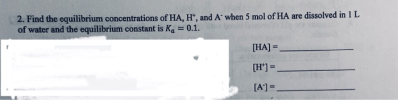 2. Find the equilibrium concentrations of HA, H, and A when 5 mol of HA are dissolved in 1 L of water and the equilibrium constant is K = 0.1. [HA] = [H*] = [A-] =
A diprotic acid, H,A, has acid dissociation constants of Ka1 = 2.09 x 10⁴ and Ka2...
 A diprotic acid, H,A, has acid dissociation constants of Ka1 = 2.09 x 10⁴ and Ka2 = 3.96 x 10⁻¹¹. Calculate the pH and molar concentrations of H,A, HA-, and A2- at equilibrium for each of the solutions. A 0.183 M solution of H,A pH H,A= A2-1 HA] = A 0.183 M solution of N2HA. HA pH= HA A2- A 0.183 M solution of Na, A H,A ] pH= HA A2-1 M M
A diprotic acid, H,A, has acid dissociation...
A diprotic acid, H,A, has acid dissociation constants of Ka1 = 2.09 x 10⁴ and Ka2 = 3.96 x 10⁻¹¹. Calculate the pH and molar concentrations of H,A, HA-, and A2- at equilibrium for each of the solutions. A 0.183 M solution of H,A pH H,A= A2-1 HA] = A 0.183 M solution of N2HA. HA pH= HA A2- A 0.183 M solution of Na, A H,A ] pH= HA A2-1 M M
A diprotic acid, H,A, has acid dissociation...
A monoprotic acid, HA, is dissolved in water: HA <------> H+ +A- The equilibrium concentrations of...
A monoprotic acid, HA, is dissolved in water: HA <------> H+ +A- The equilibrium concentrations of the reactants and products are [HA] = 0.280 M [H ] = 2.00 × 10⁻⁴ M [A–] = 2.00 × 10⁻⁴ M. Calculate the value of pKa for the acid HA.
Calculate the equilibrium constant, Ka for the acid, HA if, at equilibrium, the pH of a...
Calculate the equilibrium constant, Ka for the acid, HA if, at equilibrium, the pH of a 1.85 M solution of HA is 3.13? I know that: Use pH = -log [H+] first and solve for [H+]. Then use Ka = [H+][A-]/[HA] to solve for Ka. [A-] = [H+] [HA] is given in the problem. I keep getting it wrong, any ideas??
A diprotic acid, H 2 A , has acid dissociation constants of K a1 = 3.21...
A diprotic acid, H 2 A , has acid dissociation constants of K a1 = 3.21 × 10 − 4 and K a2 = 5.67 × 10 − 12 . Calculate the pH and molar concentrations of H 2 A , HA − , and A 2 − at equilibrium for each of the solutions. A 0.130 M solution of H 2 A . pH = [ H 2 A ] = ? [ HA − ] = ? [...
 For a generic weak acid HA, the ionization into H+ and A in water is not complete: HA (aq) =H+ (aq) + A (aq) a. Show that the acid dissociation constant of the acid, Ka, can be obtained from the degree of dissociation a using the following formula: a2 Ka 1-a b. The freezing-point depression of a 0.010 m acetic acid solution is 0.0193 K. From this data, what is the acid- dissociation constant K of acetic acid?
 A diprotic acid, H,A, has acid dissociation constants of Ka molar concentrations of H,A, HA-, and A2- at equilibrium for each of the solutions 1.42 x 10⁻⁴ and Ka2 = 4.07 x 10¹². Calculate the pH and = A 0.210 M solution of H,A H2A] = pH HA- A2- М М A 0.210 M solution of NaHA HA pH= М
 Use the reaction quotient, Q, to explain why the fraction of dissociation of weak acid, HA, increases when the solution is diluted by a factor of 4. When the system is at equilibrium, Q = [A^-][H^+]/[HA] = K_a. Let's call the concentrations at equilibrium [A^-]e, [H^+]e, and [HA]_e. if the solution is diluted by a factor of 4, the concentrations become [A^-]_e, [H^+]_e, [H^+]_e, and [HA]_e. The reaction quotient becomes Q = K_a. Since Q K_a, the concentrations of products...
 2. Find the equilibrium concentrations of HA, H, and A when 5 mol of HA are dissolved in 1 L of water and the equilibrium constant is K = 0.1. [HA] = [H*] = [A-] =
 A diprotic acid, H,A, has acid dissociation constants of Ka1 = 2.09 x 10⁴ and Ka2 = 3.96 x 10⁻¹¹. Calculate the pH and molar concentrations of H,A, HA-, and A2- at equilibrium for each of the solutions. A 0.183 M solution of H,A pH H,A= A2-1 HA] = A 0.183 M solution of N2HA. HA pH= HA A2- A 0.183 M solution of Na, A H,A ] pH= HA A2-1 M M
A diprotic acid, H,A, has acid dissociation...
A diprotic acid, H,A, has acid dissociation constants of Ka1 = 2.09 x 10⁴ and Ka2 = 3.96 x 10⁻¹¹. Calculate the pH and molar concentrations of H,A, HA-, and A2- at equilibrium for each of the solutions. A 0.183 M solution of H,A pH H,A= A2-1 HA] = A 0.183 M solution of N2HA. HA pH= HA A2- A 0.183 M solution of Na, A H,A ] pH= HA A2-1 M M
A diprotic acid, H,A, has acid dissociation...
Most questions answered within 3 hours.
-
Where is the error in this code sequence?
String s1 = "Hello";
String s2 = "ello";...
asked 11 months ago -
Financial data for Joel de Paris, Inc., for last year
follow:
Joel de Paris, Inc.
Balance...
asked 11 months ago -
Consider this reaction:
Al2(SO4)3 (aq)+ BaCl3
(aq) Al2Cl6 (aq)- +
3BaSO4(s) . What is the...
asked 11 months ago -
Suppose that Savneet is considering increasing her
recent random sample from 20 car rentals to 40...
asked 11 months ago -
Trucks arrive at an unloading terminal at an average rate of 120
per hour.
Trucks arrive...
asked 11 months ago -
Why are methanol and ethanol completely soluble in water while
octanol is not very little soluble....
asked 11 months ago -
A facilities manager at a university reads in a research report
that the mean amount of...
asked 11 months ago -
When the CuSO4 is rehydrated by adding water to the anhydrous
compound, is this an endothermic...
asked 11 months ago -
A ray of sunlight is passing from diamond into crown glass; the
angle of incidence is...
asked 11 months ago -
A block of mass 0.249 kg is placed on top of a light, vertical
spring of...
asked 11 months ago -
how do the kidneys compensate in the presences of acidosis
a) trigger hyperventilate
b) reserve acid...
asked 11 months ago -
Question 501 pts
The rental rate of capital to the firm increases. Which of the
following...
asked 11 months ago