Suppose that a function is defined as follows: def f(y): m = 1 for x in...
Suppose that a function is defined as follows:
def f(y): m = 1 for x in y:
if x%2==1:
m=m*x
return m
Then, what is the output of the following: >>> f( range(5) )
Homework Answers
f( range(5) ) returns the product of 1*3 i.e 3
So, the output of f( range(5) ) is 3

3
Add Answer to:
Suppose that a function is defined as follows:
def f(y): m = 1 for x in...
IN PYTHON Functions f(), g(), and h() are defined as follows: def f(x): return 2*g(x)...
IN PYTHON Functions f(), g(), and h() are defined as follows: def f(x): return 2*g(x) def g(x): return h(x)**2 def h(x): return x//2 Consider the execution of function call f(2). Show the state of the program stack just prior to executing statement return x//2.
Suppose that the function f is defined, for all real numbers, as follows. f(x) = x-2...
 Suppose that the function f is defined, for all real numbers, as follows. f(x) = x-2 ifx#2 4 if x=2 Find f(-3), f(2), and f(5). s(-3) = 0 s(2) = 0 r(s) = 1 Suppose that the function g is defined, for all real numbers, as follows. if x -2 8(x)= 1-4 if x=-2 Find g(-5), g(-2), and g(4). $(-5) = 0 DO s(-2) = 1 8(4) = 1
Suppose that the function F & G are defined as follows Suppose that the functions f...
 Suppose that the function F & G are defined as
follows
Suppose that the functions f and g are defined as follows. f(x) = 5-2x? g(x) = 2 - 6x (a) Find ( 2 )(-1). (a) Find (b) Find all values that are NOT in the domain of If there is more than one value, separate them with commas. (b) Value(s) that are NOT in the domain of
Suppose that the function F & G are defined as
follows
Suppose that the functions f and g are defined as follows. f(x) = 5-2x? g(x) = 2 - 6x (a) Find ( 2 )(-1). (a) Find (b) Find all values that are NOT in the domain of If there is more than one value, separate them with commas. (b) Value(s) that are NOT in the domain of
(1 point) A function f is defined on the whole of the x, y-plane as follows: f(x,y)0 fy0 otherwise For each of the foll...
 (1 point) A function f is defined on the whole of the x, y-plane as follows: f(x,y)0 fy0 otherwise For each of the following functions g determine if the corresponding functionf is continuous on the whole plane. Use "T" for true,"F" for false 2. g(x, y) 9x2y 3. gx, y)-4 sin) 4. g(x, y) xy sin(xy) 5. g(x, y) 3xy
(1 point) A function f is defined on the whole of the x, y-plane as follows: f(x,y)0 fy0 otherwise For...
(1 point) A function f is defined on the whole of the x, y-plane as follows: f(x,y)0 fy0 otherwise For each of the following functions g determine if the corresponding functionf is continuous on the whole plane. Use "T" for true,"F" for false 2. g(x, y) 9x2y 3. gx, y)-4 sin) 4. g(x, y) xy sin(xy) 5. g(x, y) 3xy
(1 point) A function f is defined on the whole of the x, y-plane as follows: f(x,y)0 fy0 otherwise For...
Look at the following function definition: def my_function(x, y): return x[y] a. Write a statement that...
Look at the following function definition: def my_function(x, y): return x[y] a. Write a statement that calls this function and uses keyword arguments to pass ‘testing’ into x and 2 into y. b. What will be printed when the function call executes? 6. Write a statement that generates a random number in the range I'm using python to solve this this is what i did def main(): result= my_function(x='testing', y=2) print(result) def my_function(x,y): return x[y] main()
Problem 2 Suppose C is a curve of length (, and f(x, y) is a continuous function that is defined on a region D that contains C and f(x,y) < M for all (x, y) E D. Show that f(x, y)ds 3 Me Hint: Use...
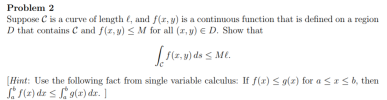 Problem 2 Suppose C is a curve of length (, and f(x, y) is a continuous function that is defined on a region D that contains C and f(x,y) < M for all (x, y) E D. Show that f(x, y)ds 3 Me Hint: Use the following fact from single variable calculus: If f(x) g(x) for a KrS b, then (x)dJ() dr.
Problem 2 Suppose C is a curve of length (, and f(x, y) is a continuous function that...
Problem 2 Suppose C is a curve of length (, and f(x, y) is a continuous function that is defined on a region D that contains C and f(x,y) < M for all (x, y) E D. Show that f(x, y)ds 3 Me Hint: Use the following fact from single variable calculus: If f(x) g(x) for a KrS b, then (x)dJ() dr.
Problem 2 Suppose C is a curve of length (, and f(x, y) is a continuous function that...
A function is defined as follows: y = X + 6 x² 3x + 1 X<-2...
 A function is defined as follows: y = X + 6 x² 3x + 1 X<-2 -2<x<3 x > 3 For which x-values is f(x) = 4? Select all that apply 0-2 1 2. 13 e here to search
using discrete structures 3. Consider the function F(x, y, z) for x, y, z z 0 defined as follows: a. F(x, y, 0)-y+1 b. F(x, 0, 1)-x c, F(x, 0, 2) = 0 d. F(x, 0, z+ 3)-1 e. F(x, y, z)-F(x, F(x, y-1, z...
 using discrete structures
3. Consider the function F(x, y, z) for x, y, z z 0 defined as follows: a. F(x, y, 0)-y+1 b. F(x, 0, 1)-x c, F(x, 0, 2) = 0 d. F(x, 0, z+ 3)-1 e. F(x, y, z)-F(x, F(x, y-1, z), z-1) Using Induction, prove the following a. F(x, y, 1)-x +y b, F(x, y, 2) = xy c. F(x, y, 3)-xy
3. Consider the function F(x, y, z) for x, y, z z 0 defined...
using discrete structures
3. Consider the function F(x, y, z) for x, y, z z 0 defined as follows: a. F(x, y, 0)-y+1 b. F(x, 0, 1)-x c, F(x, 0, 2) = 0 d. F(x, 0, z+ 3)-1 e. F(x, y, z)-F(x, F(x, y-1, z), z-1) Using Induction, prove the following a. F(x, y, 1)-x +y b, F(x, y, 2) = xy c. F(x, y, 3)-xy
3. Consider the function F(x, y, z) for x, y, z z 0 defined...
1. Consider the function y f(x) defined by Supposing that you are given x, write an...
 1. Consider the function y f(x) defined by Supposing that you are given x, write an R expression for y using if state- ments Add your expression for y to the following program, then run it to plot the function f. # input x,values <-seq(-2, 2, by 0.1) # for each x calculate y n <- length(x.values) y.values <- rep(0, n) for (i in 1 :n) x <- x. values[i] # your expression for y goes here y.values ij <-...
1. Consider the function y f(x) defined by Supposing that you are given x, write an...
 1. Consider the function y f(x) defined by Supposing that you are given x, write an R expression for y using if state- ments Add your expression for y to the following program, then run it to plot the function f. # input x,values <-seq(-2, 2, by 0.1) # for each x calculate y n <- length(x.values) y.values <- rep(0, n) for (i in 1 :n) x <- x. values[i] # your expression for y goes here y.values ij <-...
 Suppose that the function f is defined, for all real numbers, as follows. f(x) = x-2 ifx#2 4 if x=2 Find f(-3), f(2), and f(5). s(-3) = 0 s(2) = 0 r(s) = 1 Suppose that the function g is defined, for all real numbers, as follows. if x -2 8(x)= 1-4 if x=-2 Find g(-5), g(-2), and g(4). $(-5) = 0 DO s(-2) = 1 8(4) = 1
 Suppose that the function F & G are defined as
follows
Suppose that the functions f and g are defined as follows. f(x) = 5-2x? g(x) = 2 - 6x (a) Find ( 2 )(-1). (a) Find (b) Find all values that are NOT in the domain of If there is more than one value, separate them with commas. (b) Value(s) that are NOT in the domain of
Suppose that the function F & G are defined as
follows
Suppose that the functions f and g are defined as follows. f(x) = 5-2x? g(x) = 2 - 6x (a) Find ( 2 )(-1). (a) Find (b) Find all values that are NOT in the domain of If there is more than one value, separate them with commas. (b) Value(s) that are NOT in the domain of
 (1 point) A function f is defined on the whole of the x, y-plane as follows: f(x,y)0 fy0 otherwise For each of the following functions g determine if the corresponding functionf is continuous on the whole plane. Use "T" for true,"F" for false 2. g(x, y) 9x2y 3. gx, y)-4 sin) 4. g(x, y) xy sin(xy) 5. g(x, y) 3xy
(1 point) A function f is defined on the whole of the x, y-plane as follows: f(x,y)0 fy0 otherwise For...
(1 point) A function f is defined on the whole of the x, y-plane as follows: f(x,y)0 fy0 otherwise For each of the following functions g determine if the corresponding functionf is continuous on the whole plane. Use "T" for true,"F" for false 2. g(x, y) 9x2y 3. gx, y)-4 sin) 4. g(x, y) xy sin(xy) 5. g(x, y) 3xy
(1 point) A function f is defined on the whole of the x, y-plane as follows: f(x,y)0 fy0 otherwise For...
 Problem 2 Suppose C is a curve of length (, and f(x, y) is a continuous function that is defined on a region D that contains C and f(x,y) < M for all (x, y) E D. Show that f(x, y)ds 3 Me Hint: Use the following fact from single variable calculus: If f(x) g(x) for a KrS b, then (x)dJ() dr.
Problem 2 Suppose C is a curve of length (, and f(x, y) is a continuous function that...
Problem 2 Suppose C is a curve of length (, and f(x, y) is a continuous function that is defined on a region D that contains C and f(x,y) < M for all (x, y) E D. Show that f(x, y)ds 3 Me Hint: Use the following fact from single variable calculus: If f(x) g(x) for a KrS b, then (x)dJ() dr.
Problem 2 Suppose C is a curve of length (, and f(x, y) is a continuous function that...
 A function is defined as follows: y = X + 6 x² 3x + 1 X<-2 -2<x<3 x > 3 For which x-values is f(x) = 4? Select all that apply 0-2 1 2. 13 e here to search
 using discrete structures
3. Consider the function F(x, y, z) for x, y, z z 0 defined as follows: a. F(x, y, 0)-y+1 b. F(x, 0, 1)-x c, F(x, 0, 2) = 0 d. F(x, 0, z+ 3)-1 e. F(x, y, z)-F(x, F(x, y-1, z), z-1) Using Induction, prove the following a. F(x, y, 1)-x +y b, F(x, y, 2) = xy c. F(x, y, 3)-xy
3. Consider the function F(x, y, z) for x, y, z z 0 defined...
using discrete structures
3. Consider the function F(x, y, z) for x, y, z z 0 defined as follows: a. F(x, y, 0)-y+1 b. F(x, 0, 1)-x c, F(x, 0, 2) = 0 d. F(x, 0, z+ 3)-1 e. F(x, y, z)-F(x, F(x, y-1, z), z-1) Using Induction, prove the following a. F(x, y, 1)-x +y b, F(x, y, 2) = xy c. F(x, y, 3)-xy
3. Consider the function F(x, y, z) for x, y, z z 0 defined...
 1. Consider the function y f(x) defined by Supposing that you are given x, write an R expression for y using if state- ments Add your expression for y to the following program, then run it to plot the function f. # input x,values <-seq(-2, 2, by 0.1) # for each x calculate y n <- length(x.values) y.values <- rep(0, n) for (i in 1 :n) x <- x. values[i] # your expression for y goes here y.values ij <-...
 1. Consider the function y f(x) defined by Supposing that you are given x, write an R expression for y using if state- ments Add your expression for y to the following program, then run it to plot the function f. # input x,values <-seq(-2, 2, by 0.1) # for each x calculate y n <- length(x.values) y.values <- rep(0, n) for (i in 1 :n) x <- x. values[i] # your expression for y goes here y.values ij <-...
Most questions answered within 3 hours.
-
Where is the error in this code sequence?
String s1 = "Hello";
String s2 = "ello";...
asked 10 months ago -
Financial data for Joel de Paris, Inc., for last year
follow:
Joel de Paris, Inc.
Balance...
asked 10 months ago -
Consider this reaction:
Al2(SO4)3 (aq)+ BaCl3
(aq) Al2Cl6 (aq)- +
3BaSO4(s) . What is the...
asked 10 months ago -
Suppose that Savneet is considering increasing her
recent random sample from 20 car rentals to 40...
asked 10 months ago -
Trucks arrive at an unloading terminal at an average rate of 120
per hour.
Trucks arrive...
asked 10 months ago -
Why are methanol and ethanol completely soluble in water while
octanol is not very little soluble....
asked 10 months ago -
A facilities manager at a university reads in a research report
that the mean amount of...
asked 10 months ago -
When the CuSO4 is rehydrated by adding water to the anhydrous
compound, is this an endothermic...
asked 10 months ago -
A ray of sunlight is passing from diamond into crown glass; the
angle of incidence is...
asked 10 months ago -
A block of mass 0.249 kg is placed on top of a light, vertical
spring of...
asked 10 months ago -
how do the kidneys compensate in the presences of acidosis
a) trigger hyperventilate
b) reserve acid...
asked 10 months ago -
Question 501 pts
The rental rate of capital to the firm increases. Which of the
following...
asked 10 months ago