convert the following C codes into assembly language var1=5;(32-bits) // assume signed numbers r1=var1 if (r1>0)...
Homework Answers
let var1,r1,r3 are at $t0,$t1,$t2,$t3 respectively.
li $t0,5
mov $t1,$t2
blez $t1,$zero exit
addi $t3, $t3,1
exit:
*****************************************************************************
PLEASE DO UPVOTE IF THE ANSWER IS HELPFUL AS IT GIVES THE
CONFIDENCE TO HELP MORE STUDENTS
*****************************************************************************
Chegg allows me to answer specific no of questions including the
sub parts , so please do post the rest of the questions as a
separate query as per Chegg Guidelines. Thank you :)
*****************************************************************************
Add Answer to:
convert the following C codes into assembly language
var1=5;(32-bits)
// assume signed numbers
r1=var1
if (r1>0)...
How do i convert the following C program into MIPS assembly? int main(void) { short var1[4]...
How do i convert the following C program into MIPS assembly? int main(void) { short var1[4] ={5, 8, 13, 6}; short var2[4]= {16, 4, 7, 15}; short result[4]={0}; for (int i=0 ; i< 4; i++) result[i] = var1[i] - var2[i]; }
How do i convert the following C program into MIPS assembly? int main(void) { int var1[4]...
How do i convert the following C program into MIPS assembly? int main(void) { int var1[4] ={4, 7, 12, 5}; int var2[4]= {15, 3, 6, 14}; int result[4]={0}; for (int i=0 ; i< 4; i++) result[i] = var1[i] - var2[i]; }
Convert the following C/C++ fragment into equivalent MIPS assembly language. Assume that the variables a, b,...
Convert the following C/C++ fragment into equivalent MIPS assembly language. Assume that the variables a, b, c, d, i and x are assigned to registers $t1, $t2, $t3, $t4, $s0 and $s1 respectively. if ((a<b && (c == 0) d = 1;
3. Convert the following signed hexadecimal numbers to decimal . a) EE2 b) 7F2 c) 2FE...
3. Convert the following signed hexadecimal numbers to decimal . a) EE2 b) 7F2 c) 2FE 4. Perform the subtractions with the following binary numbers using 2’s complement Check the answer by straight binary subtractions. a) 10011 – 10001, b) 10110 – 11000, c) 100111011 – 10001. 5. What is the decimal equivalent of the largest binary integer that can be obtained with a) 11 bits unsigned signed b) 25 bits? unsigned signed
Convert the following c code into instructions MIPS Assembly language. Assume a associated with $s0, i...
Convert the following c code into instructions MIPS Assembly language. Assume a associated with $s0, i with $s1, and j with $s2. if( i < 10) { if( j < 10) { a = 0; } else { a = 1;} } else { a = 2; }
Analize the following statements in assembly language using signed 16-bit numbers. 1) Explain how to work...
 Analize the following statements in assembly language using signed
16-bit numbers.
1) Explain how to work the following statement in assembly
language
Part III (30 points)- Analyze the following statements in Assembly language using signe 16 bit numbers movf subwf i+1, bot end if mov i 1, w addwfc. end if rest of oode
Analize the following statements in assembly language using signed
16-bit numbers.
1) Explain how to work the following statement in assembly
language
Part III (30 points)- Analyze the following statements in Assembly language using signe 16 bit numbers movf subwf i+1, bot end if mov i 1, w addwfc. end if rest of oode
Convert the following C fragment to equivalent MIPS assembly language. Assume that the variables a, b,...
Convert the following C fragment to equivalent MIPS assembly language. Assume that the variables a, b, c, d, i and x are assigened to registers $t1, $t2, $t3, $t4, $s0 and $s1 respectively. Assume that the base address of the array A and B is in register $a0 and $a1 respectively. if (a > 0) b = a + 10; else b = a - 10;
2. Answer the following questions (5 points each) i. Convert the following decimal numbers to signed...
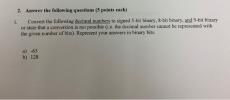 2. Answer the following questions (5 points each) i. Convert the following decimal numbers to signed 5-bit binary, 8-bit binary, and 9-bit binary or state that a conversion is not possible (i.e. the decimal number cannot be represented with the given number of bits). Represent your answers in binary bits. a) -65 b) 128
Given the following C Code segment convert it to ARM assembly. Assume the following register assignment...
 Given the following C Code segment convert it to ARM assembly. Assume the following register assignment have been made before your section of code begins. C Variable Register assignment r1 y r2 r3 r10 j r11 int x=0, y=0, z=0; int main() { for (int i = 0; i<10; i++) for (int j 0; j < 20; j++) if (i* j > 100) X++; if (i j >= 15) y++; + فہه Z = X + y; }
1.Convert the following decimal and binary numbers into signed integer 32-bit representation (2’s complement for negative...
1.Convert the following decimal and binary numbers into signed integer 32-bit representation (2’s complement for negative numbers). -99
 Analize the following statements in assembly language using signed
16-bit numbers.
1) Explain how to work the following statement in assembly
language
Part III (30 points)- Analyze the following statements in Assembly language using signe 16 bit numbers movf subwf i+1, bot end if mov i 1, w addwfc. end if rest of oode
Analize the following statements in assembly language using signed
16-bit numbers.
1) Explain how to work the following statement in assembly
language
Part III (30 points)- Analyze the following statements in Assembly language using signe 16 bit numbers movf subwf i+1, bot end if mov i 1, w addwfc. end if rest of oode
 2. Answer the following questions (5 points each) i. Convert the following decimal numbers to signed 5-bit binary, 8-bit binary, and 9-bit binary or state that a conversion is not possible (i.e. the decimal number cannot be represented with the given number of bits). Represent your answers in binary bits. a) -65 b) 128
 Given the following C Code segment convert it to ARM assembly. Assume the following register assignment have been made before your section of code begins. C Variable Register assignment r1 y r2 r3 r10 j r11 int x=0, y=0, z=0; int main() { for (int i = 0; i<10; i++) for (int j 0; j < 20; j++) if (i* j > 100) X++; if (i j >= 15) y++; + فہه Z = X + y; }
Most questions answered within 3 hours.
-
Where is the error in this code sequence?
String s1 = "Hello";
String s2 = "ello";...
asked 1 year ago -
Financial data for Joel de Paris, Inc., for last year
follow:
Joel de Paris, Inc.
Balance...
asked 1 year ago -
Consider this reaction:
Al2(SO4)3 (aq)+ BaCl3
(aq) Al2Cl6 (aq)- +
3BaSO4(s) . What is the...
asked 1 year ago -
Suppose that Savneet is considering increasing her
recent random sample from 20 car rentals to 40...
asked 1 year ago -
Trucks arrive at an unloading terminal at an average rate of 120
per hour.
Trucks arrive...
asked 1 year ago -
Why are methanol and ethanol completely soluble in water while
octanol is not very little soluble....
asked 1 year ago -
A facilities manager at a university reads in a research report
that the mean amount of...
asked 1 year ago -
When the CuSO4 is rehydrated by adding water to the anhydrous
compound, is this an endothermic...
asked 1 year ago -
A ray of sunlight is passing from diamond into crown glass; the
angle of incidence is...
asked 1 year ago -
A block of mass 0.249 kg is placed on top of a light, vertical
spring of...
asked 1 year ago -
how do the kidneys compensate in the presences of acidosis
a) trigger hyperventilate
b) reserve acid...
asked 1 year ago -
Question 501 pts
The rental rate of capital to the firm increases. Which of the
following...
asked 1 year ago